

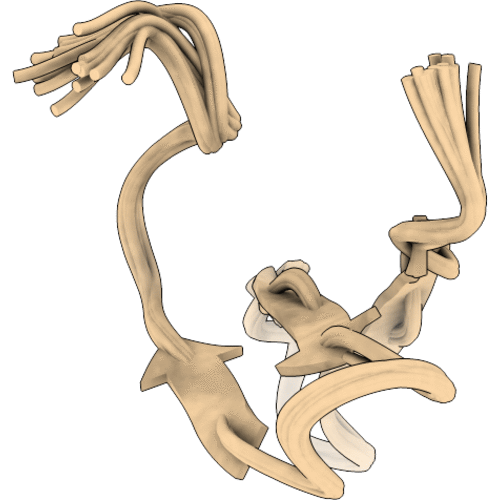
1ZR7 image
Deposition Date 2005-05-19
Release Date 2006-05-30
Last Version Date 2024-05-29
Entry Detail
PDB ID:
1ZR7
Title:
Solution structure of the first WW domain of FBP11
Biological Source:
Source Organism(s):
Homo sapiens (Taxon ID: 9606)
Expression System(s):
Method Details:
Experimental Method:
Conformers Calculated:
100
Conformers Submitted:
20
Selection Criteria:
target function

Macromolecular Entities
Polymer Type:polypeptide(L)
Molecule:huntingtin-interacting protei
Chain IDs:A
Chain Length:30
Number of Molecules:1
Biological Source:Homo sapiens
Ligand Molecules
Primary Citation
Solution structure and binding specificity of FBP11/HYPA WW domain as Group-II/III
Proteins 63 227 234 (2006)
PMID: 16463264 DOI: 10.1002/prot.20880

Abstact

The Group-II/III WW domains bind Pro-rich sequences, the most frequent protein motif found in eucaryotic genomes. We have proposed that the Group-II and -III WW domains be merged into a larger group because the members of each group have relatively wide specificity and bind to the common ligands [Kato et al., J Biol Chem 2004;279:31833-31841]. We have also proposed that Group-II/III has a common surface patch, the XP2 groove, to bind the ligands. The first WW domain of FBP11/HYPA is one of the Group-II/III WW domains. The solution structure of the 26 residue-long converged region exhibits an antiparallel triple stranded beta-sheet with a small hydrophobic core. The WW domain of FBP11/HYPA has both XP and XP2 grooves on its surface. Ligand titration by 1H-15N HSQC NMR spectra revealed that the WW domain of FBP11/HYPA binds all the peptides with the PL, PP, and PR motifs. The profile patterns of chemical shift perturbation were quite similar among the spectra titrated with all three ligands. In addition, the titration significantly shifts the signals of the residues that compose the XP2 groove. All these findings suggest the functional importance of the XP2 groove and group definition of Group-II/III of the WW domains.

Legend

Protein

Chemical

Disease

Primary Citation of related structures
Feedback Form
Name
Email
Institute
Feedback