

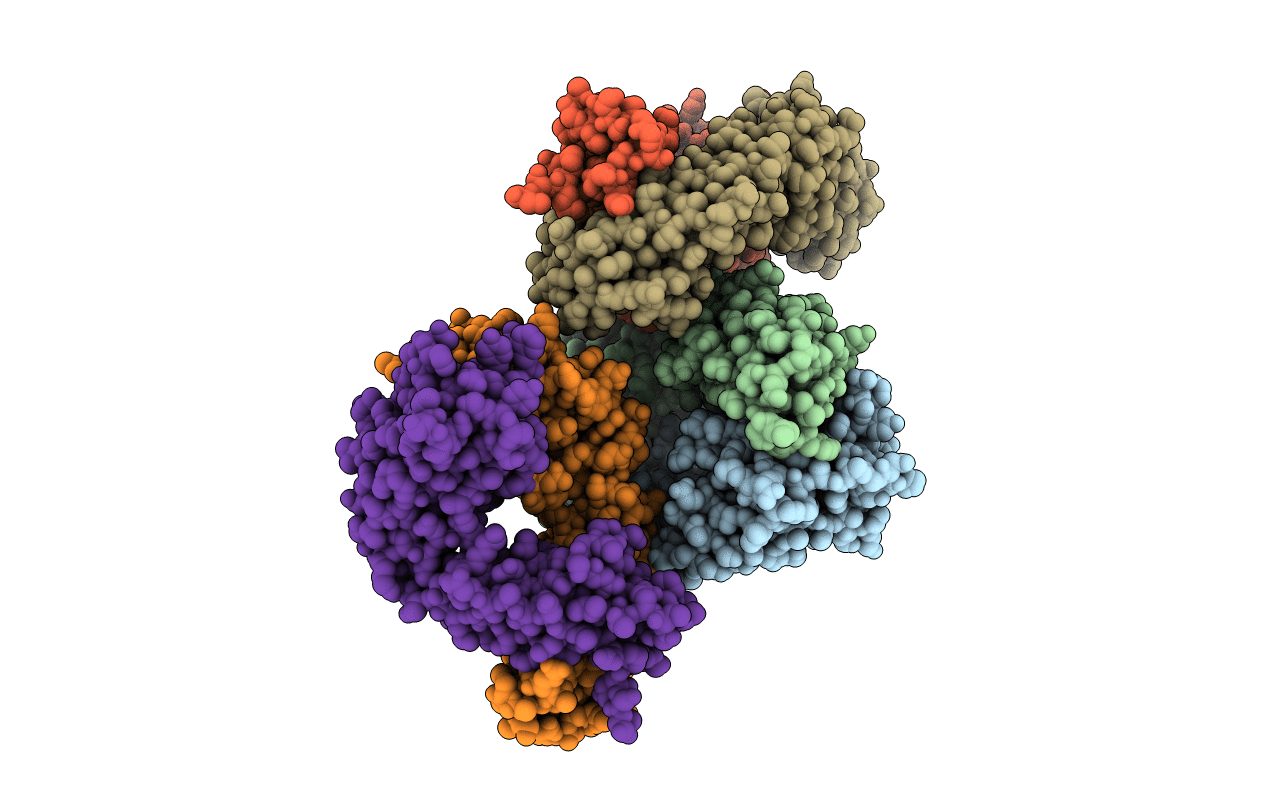
1UWE image
Deposition Date 2004-02-05
Release Date 2004-02-27
Last Version Date 2024-10-16
Entry Detail
PDB ID:
1UWE
Keywords:
Title:
MOLECULAR MECHANISM OF ENANTIOSELECTIVE PROTON TRANSFER TO CARBON IN CATALYTIC ANTIBODY 14D9
Biological Source:
Source Organism(s):
MUS MUSCULUS (Taxon ID: 10090)
Homo sapiens (Taxon ID: 9606)
Expression System(s):
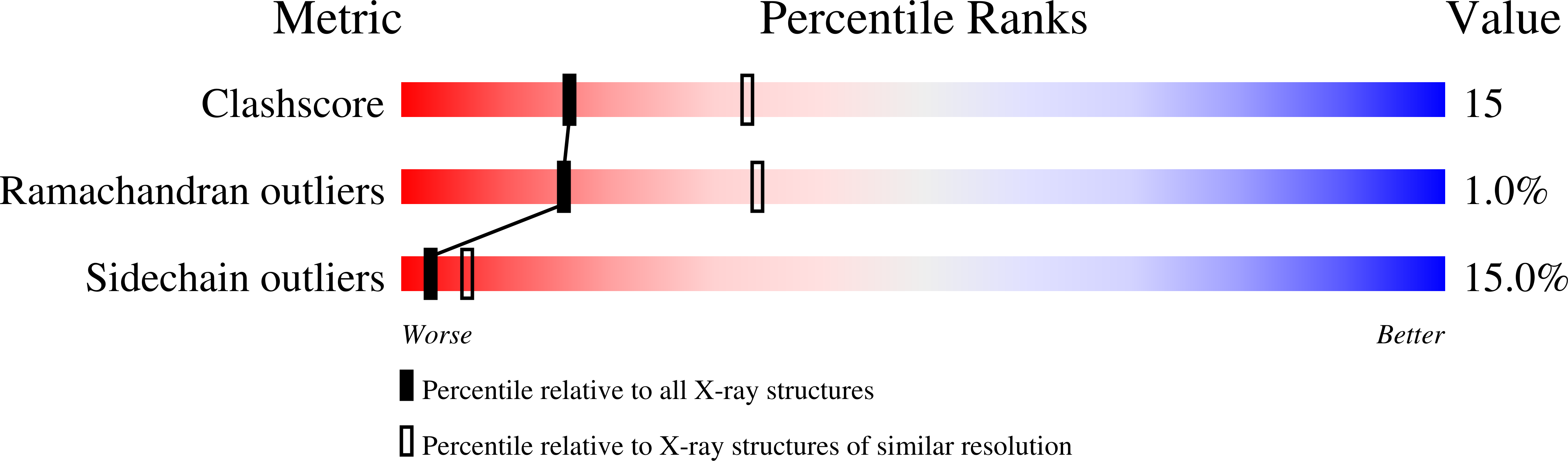
Method Details:
Experimental Method:
Resolution:
2.67 Å
R-Value Free:
0.27
R-Value Work:
0.21
R-Value Observed:
0.21
Space Group:
C 1 2 1
Macromolecular Entities
Protein Blast
Polymer Type:polypeptide(L)
Molecule:ANTIBODY 14D9
Chain IDs:A (auth: H), D (auth: V), F (auth: Y)
Chain Length:218
Number of Molecules:3
Biological Source:MUS MUSCULUS, Homo sapiens
Protein Blast
Polymer Type:polypeptide(L)
Molecule:ANTIBODY 14D9
Chain IDs:B (auth: L), C (auth: U), E (auth: X)
Chain Length:213
Number of Molecules:3
Biological Source:MUS MUSCULUS, Homo sapiens
Primary Citation
Molecular Mechanism of Enantioselective Proton Transfer to Carbon in Catalytic Antibody 14D9
Proc. Natl. Acad. Sci. U.S.A. 101 3387 ? (2004)
PMID: 14988504 DOI: 10.1073/PNAS.0400263101

Abstact

Catalytic antibody 14D9 catalyzes the enantioselective protonation of prochiral enol ethers with high enantioselectivity (>99% ee) and a practical turnover (k(cat) = 0.4 s(-1)), allowing for preparative scale applications. This antibody represents one of the rare examples of catalytic antibodies promoting acid-catalyzed processes. Antibody 14D9 was cloned and expressed as a chimeric Fab fragment in Escherichia coli. Crystal structures of Fab 14D9 as apo form and of its close analog 19C9 in complex with the transition state analog were determined at 2.8-A resolution. A series of site-directed mutagenesis experiments was carried out to probe the role of individual active-site amino acids. Proton transfer to carbon is catalyzed by a hydrogen bond network formed by the side chains of Asp(H101) and Tyr(L36) with a water molecule serving as a relay. The intermediate oxocarbonium ion formed during the protonation step is trapped by the same water molecule, resulting in an overall syn-addition of water to the enol ether's double bond. The enantioselectivity is caused by steric crowding at the active site, mainly because of the side chain of Phe(H84). The 20-fold lower activity of 19C9 compared with 14D9 was traced down to residue Thr(L46), which forms a nonproductive hydrogen bond with the catalytic residue Asp(H101), which competes with the critical Asp(H101)-Tyr(L36) hydrogen bond and therefore reduces catalytic efficiency. The catalytic activity of 19C9 was restored to that of 14D9 by using either site-directed mutagenesis (Thr(L46)Ala) or chain shuffling.

Legend

Protein

Chemical

Disease

Primary Citation of related structures
Feedback Form
Name
Email
Institute
Feedback