

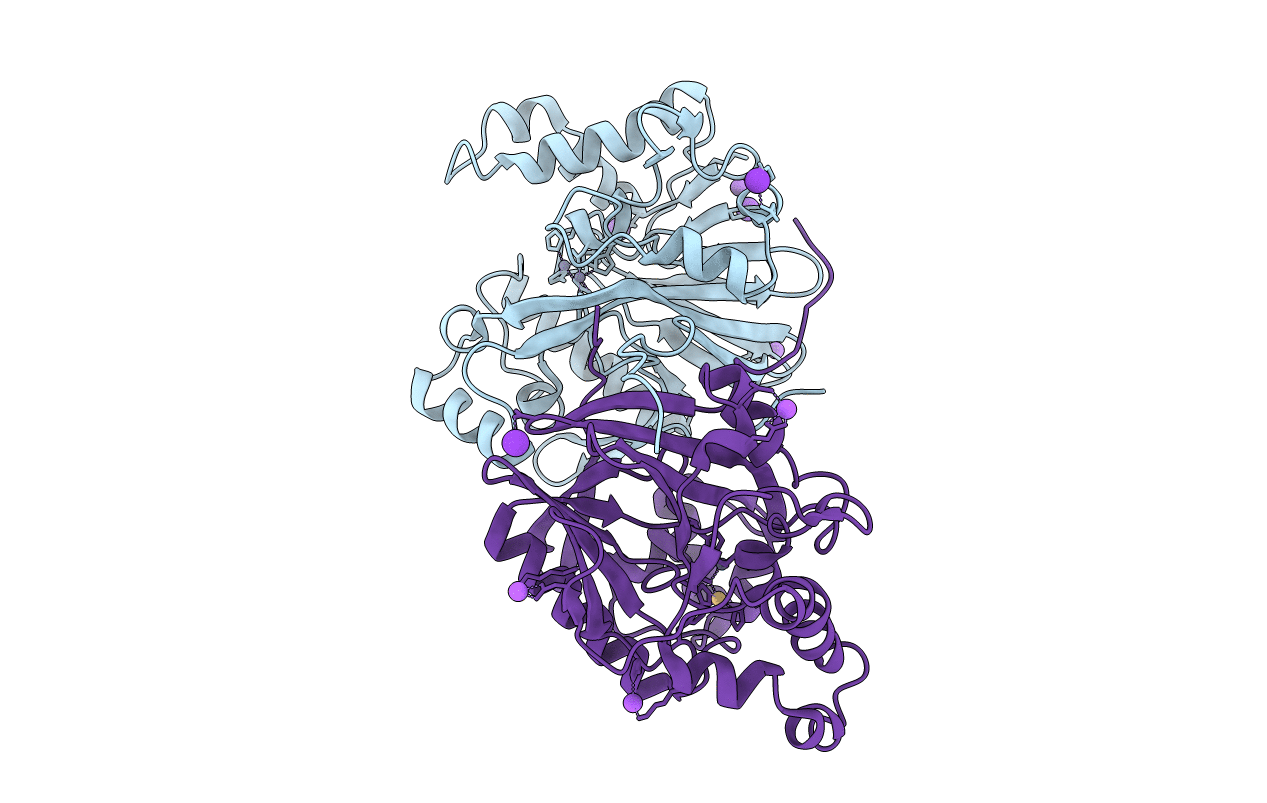
1P9E image
Deposition Date 2003-05-11
Release Date 2004-05-25
Last Version Date 2024-12-04
Entry Detail
PDB ID:
1P9E
Keywords:
Title:
Crystal Structure Analysis of Methyl Parathion Hydrolase from Pseudomonas sp WBC-3
Biological Source:
Source Organism(s):
Method Details:
Experimental Method:
Resolution:
2.40 Å
R-Value Free:
0.25
R-Value Work:
0.21
Space Group:
P 43 21 2
Macromolecular Entities
Structures with similar UniProt ID
Protein Blast
Polymer Type:polypeptide(L)
Molecule:Methyl Parathion Hydrolase
Chain IDs:A, B
Chain Length:331
Number of Molecules:2
Biological Source:Pseudomonas sp.
Primary Citation
Crystal structure of methyl parathion hydrolase from Pseudomonas sp. WBC-3.
J. Mol. Biol. 353 655 663 (2005)
PMID: 16181636 DOI: 10.1016/j.jmb.2005.08.057

Abstact

Methyl parathion hydrolase (MPH, E.C.3.1.8.1), isolated from the soil-dwelling bacterium Pseudomonas sp. WBC-3, is a Zn(II)-containing enzyme that catalyzes the degradation of the organophosphate pesticide methyl parathion. We have determined the structure of MPH from Pseudomonas sp. WBC-3 to 2.4 angstroms resolution. The enzyme is dimeric and each subunit contains a mixed hybrid binuclear zinc center, in which one of the zinc ions is replaced by cadmium. In both subunits, the more solvent-exposed beta-metal ion is substituted for Cd2+ due to high cadmium concentration in the crystallization condition. Both ions are surrounded by ligands in an octahedral arrangement. The ions are separated by 3.5 angstroms and are coordinated by the amino acid residues His147, His149, Asp151, His152, His234 and His302 and a water molecule. Asp255 and a water molecule serve to bridge the zinc ions together. MPH is homologous with other metallo-beta-lactamases but does not show any similarity to phosphotriesterase that can also catalyze the degradation of methyl parathion with lower rate, despite the lack of sequence homology. Trp179, Phe196 and Phe119 form an aromatic cluster at the entrance of the catalytic center. Replacement of these three amino acids by alanine resulted in a significant increase of K(m) and loss of catalytic activity, indicating that the aromatic cluster has an important role to facilitate affinity of enzyme to the methyl parathion substrates.

Legend

Protein

Chemical

Disease

Primary Citation of related structures
Feedback Form
Name
Email
Institute
Feedback