

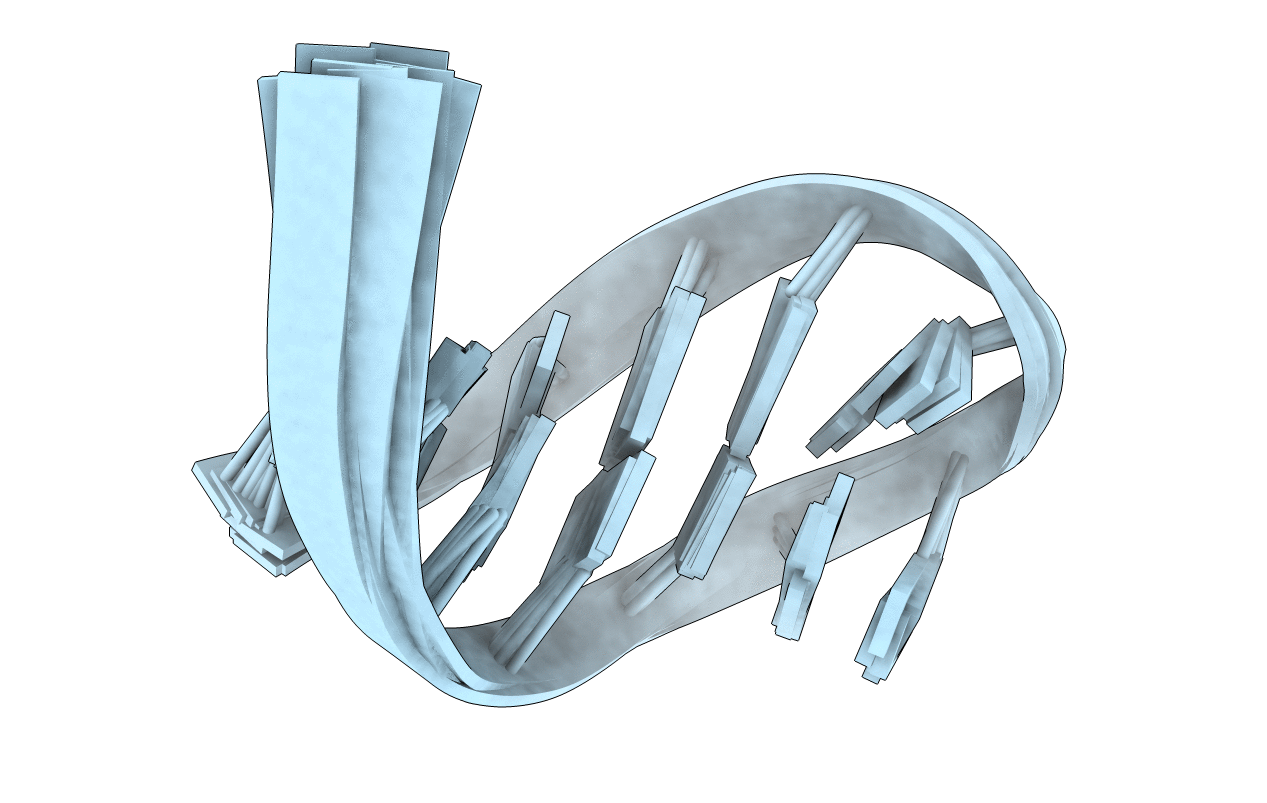
1P0U image
Deposition Date 2003-04-11
Release Date 2003-06-03
Last Version Date 2024-05-29
Entry Detail
PDB ID:
1P0U
Keywords:
Title:
Sheared G/C Base Pair
Method Details:
Experimental Method:
Conformers Submitted:
10

Macromolecular Entities
Polymer Type:polydeoxyribonucleotide
Molecule:5'-D(*GP*CP*AP*TP*CP*GP*AP*CP
Chain IDs:A
Chain Length:13
Number of Molecules:1
Biological Source:
Ligand Molecules
Primary Citation
Sheared-type G(anti).C(syn) Base-pair: A Unique d(GXC) Loop Closure Motif.
J. Mol. Biol. 329 351 361 (2003)
PMID: 12758081 DOI: 10.1016/S0022-2836(03)00440-6

Abstact

Stable DNA loop structures closed by a novel G.C base-pair have been determined for the single-residue d(GXC) loops (X=A, T, G or C) in low-salt solution by high-resolution nuclear magnetic resonance (NMR) techniques. The closing G.C base-pair in these loops is not of the canonical Watson-Crick type, but adopts instead a unique sheared-type (trans Watson-Crick/sugar-edge) pairing, like those occurring in the sheared mismatched G.A or A.C base-pair, to draw the two opposite strands together. The cytidine residue in the closing base-pair is transformed into the rare syn domain to form two H-bonds with the guanine base and to prevent the steric clash between the G 2NH(2) and the C H-5 protons. Besides, the sugar pucker of the syn cytidine is still located in the regular C2'-endo domain, unlike the C3'-endo domain adopted for the pyrimidines of the out-of-alternation left-handed Z-DNA structure. The facile formation of the compact d(GXC) loops closed by a unique sheared-type G(anti).C(syn) base-pair demonstrates the great potential of the single-stranded d(GXC) triplet repeats to fold into stable hairpins.

Legend

Protein

Chemical

Disease

Primary Citation of related structures
Feedback Form
Name
Email
Institute
Feedback