

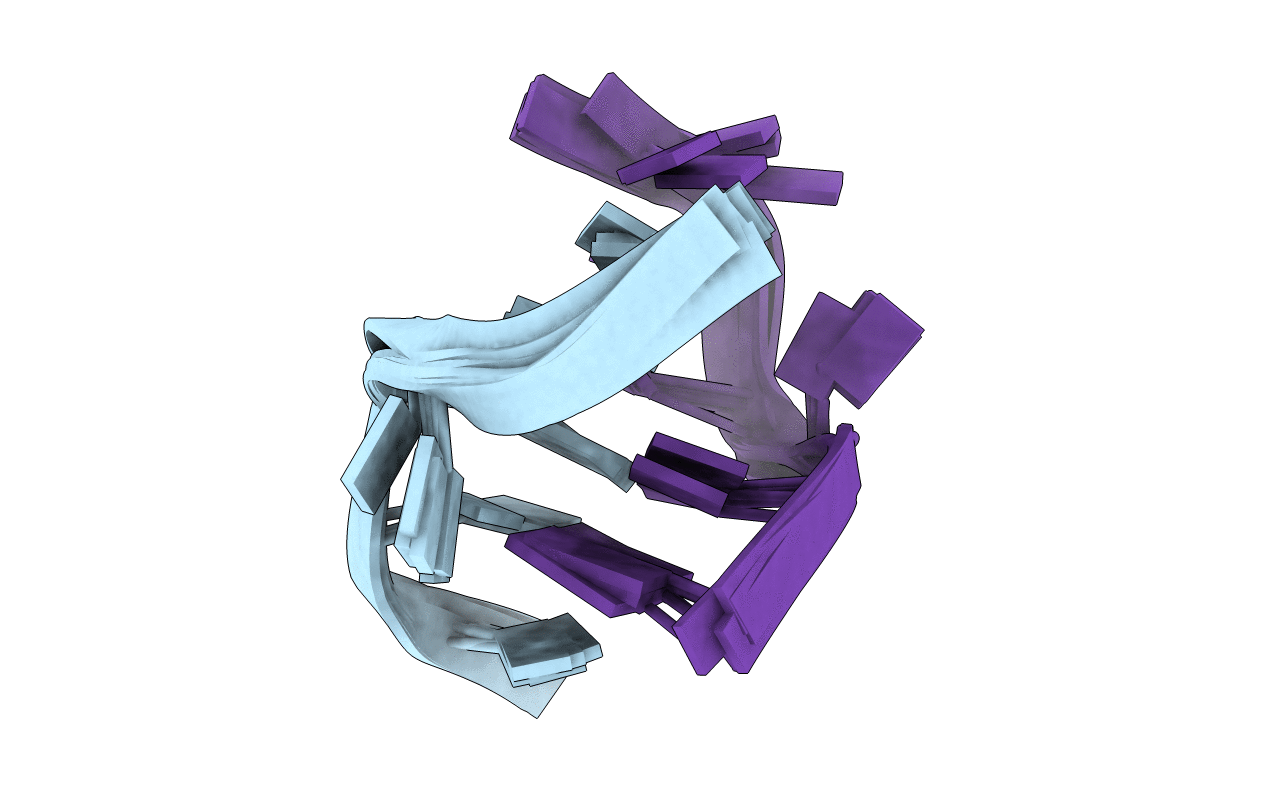
1NOQ image
Deposition Date 2003-01-16
Release Date 2003-02-11
Last Version Date 2024-05-22
Entry Detail
PDB ID:
1NOQ
Keywords:
Title:
e-motif structure
Method Details:
Experimental Method:
Conformers Calculated:
6
Conformers Submitted:
6
Selection Criteria:
all calculated structures submitted

Macromolecular Entities
Polymer Type:polydeoxyribonucleotide
Molecule:5'-D(*CP*CP*GP*CP*CP*G)-3'
Chain IDs:A, B
Chain Length:6
Number of Molecules:2
Biological Source:
Ligand Molecules
Primary Citation
Genetically unstable CXG repeats are structurally dynamic and have a high propensity for folding. An NMR and UV spectroscopic study.
J. Mol. Biol. 264 323 336 (1996)
PMID: 8951379 DOI: 10.1006/jmbi.1996.0643

Abstact

Recent molecular genetics studies have revealed a correlation between spontaneous, progressive expansion of several DNA trinucleotide repeats and certain hereditary neurodegenerative diseases. Triplet repeat (TR) sequences may be present in structured forms that can mediate the processes interrupting normal cellular replication, transcription, or repair activities, eventually leading to gene mutation. Using high resolution NMR spectroscopy and other biophysical methods, we probed the solution structures and properties of single-stranded TR sequences. These studies have led to the discovery of a new duplex motif (e-motif), present in CCG repeats, and to the elucidation of the structure of the (CTG)3 duplex. In this paper we provide a global picture of the solution behavior of the human disease-related CXG (X = A, C, G, or T) and the comparison GXC (X = A, or T) TR sequences. All six triplet repeats form antiparallel duplexes. The mismatched bases in CAG and CGG repeat duplexes are rather flexible and they do not appear to form stable, paired conformations. By comparison, GAC repeat duplexes and their mismatched A residues are well-structured. Most interestingly, the structures of the disease-related CXG repeats exhibit a propensity for folding at chain lengths as short as 12 residues. Furthermore, the energy barrier for the formation of homo-duplexes from the corresponding complementary hetero-duplexes are much lower for the CXG TR sequences than for the GAC or GTC TR sequences. These results provide insights into the conformation and physiochemical properties of TR sequences. Thus, a basis is provided for further studies of the behavior of long TR sequences in an effort to elucidate the molecular mechanisms of in vivo expansion and function of TR sequences.

Legend

Protein

Chemical

Disease

Primary Citation of related structures
Feedback Form
Name
Email
Institute
Feedback