

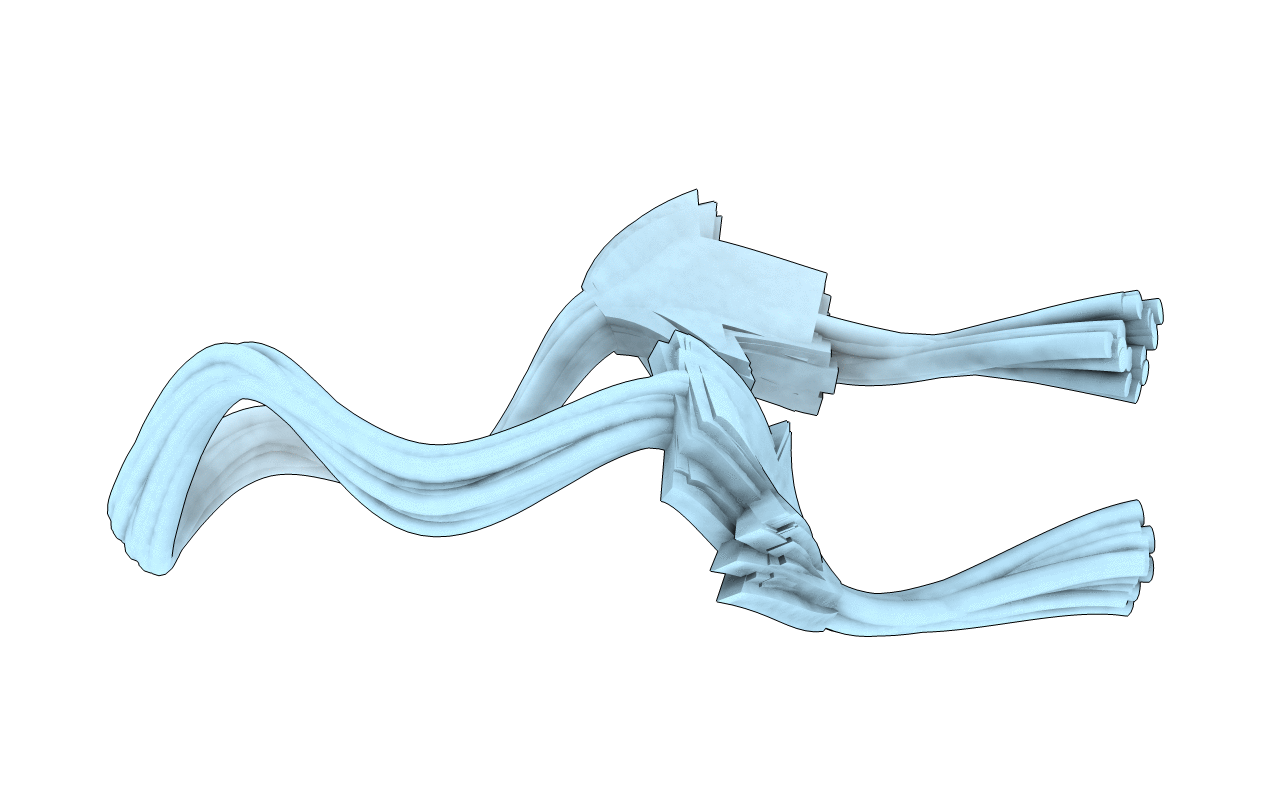
1N0A image
Deposition Date 2002-10-11
Release Date 2003-10-21
Last Version Date 2024-11-13
Entry Detail
PDB ID:
1N0A
Keywords:
Title:
Turn stability in beta-hairpin peptides: 3:5 type I G1 bulge turns
Method Details:
Experimental Method:
Conformers Calculated:
80
Conformers Submitted:
21
Selection Criteria:
structures with the least restraint violations

Macromolecular Entities
Polymer Type:polypeptide(L)
Molecule:bhpw_pdg, beta-hairpin peptid
Chain IDs:A
Chain Length:13
Number of Molecules:1
Biological Source:
Ligand Molecules
Primary Citation
Turn stability in beta-hairpin peptides: Investigation of peptides containing 3:5 type I G1 bulge turns
Protein Sci. 12 237 247 (2003)
PMID: 12538887 DOI: 10.1110/ps.0228603

Abstact

The turn-forming ability of a series of three-residue sequences was investigated by substituting them into a well-characterized beta-hairpin peptide. The starting scaffold, bhpW, is a disulfide-cyclized 10-residue peptide that folds into a stable beta-hairpin with two antiparallel strands connected by a two-residue reverse turn. Substitution of the central two residues with the three-residue test sequences leads to less stable hairpins, as judged by thiol-disulfide equilibrium measurements. However, analysis of NMR parameters indicated that each molecule retains a significant folded population, and that the type of turn adopted by the three-residue sequence is the same in all cases. The solution structure of a selected peptide with a PDG turn contained an antiparallel beta-hairpin with a 3:5 type I + G1 bulge turn. Analysis of the energetic contributions of individual turn residues in the series of peptides indicates that substitution effects have significant context dependence, limiting the predictive power of individual amino acid propensities for turn formation. The most stable and least stable sequences were also substituted into a more stable disulfide-cyclized scaffold and a linear beta-hairpin scaffold. The relative stabilities remained the same, suggesting that experimental measurements in the bhpW context are a useful way to evaluate turn stability for use in protein design projects. Moreover, these scaffolds are capable of displaying a diverse set of turns, which can be exploited for the mimicry of protein loops or for generating libraries of reverse turns.

Legend

Protein

Chemical

Disease

Primary Citation of related structures
Feedback Form
Name
Email
Institute
Feedback