

1L6R image
Deposition Date 2002-03-13
Release Date 2003-01-21
Last Version Date 2024-02-14
Entry Detail
PDB ID:
1L6R
Title:
Crystal Structure of Thermoplasma acidophilum 0175 (APC0014)
Biological Source:
Source Organism(s):
Expression System(s):
Method Details:
Experimental Method:
Resolution:
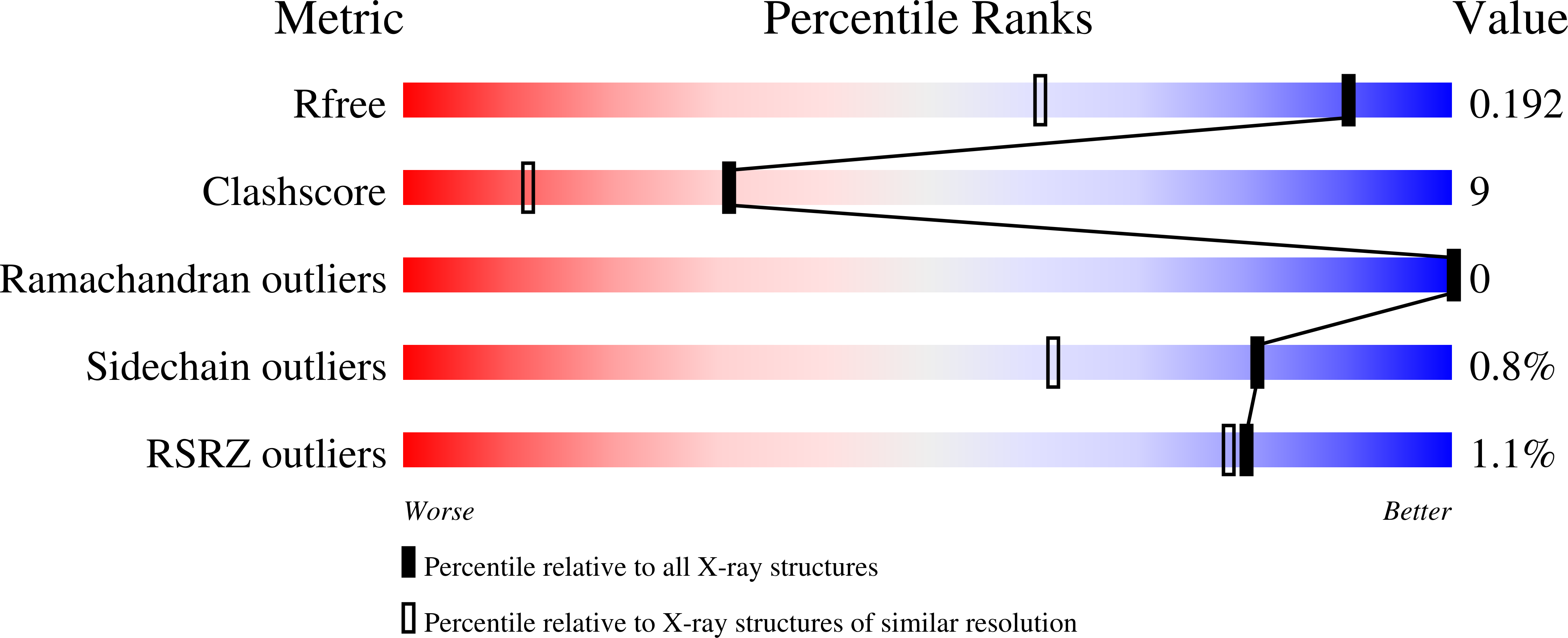
1.40 Å
R-Value Free:
0.19
R-Value Work:
0.17
R-Value Observed:
0.17
Space Group:
I 2 2 2
Macromolecular Entities
Structures with similar UniProt ID
Protein Blast
Polymer Type:polypeptide(L)
Molecule:HYPOTHETICAL PROTEIN TA0175
Gene (Uniprot):Ta0175
Chain IDs:A, B
Chain Length:227
Number of Molecules:2
Biological Source:Thermoplasma acidophilum
Primary Citation
Structure- and function-based characterization of a new phosphoglycolate phosphatase from Thermoplasma acidophilum.
J. Biol. Chem. 279 517 526 (2004)
PMID: 14555659 DOI: 10.1074/jbc.M306054200

Abstact

The protein TA0175 has a large number of sequence homologues, most of which are annotated as unknown and a few as belonging to the haloacid dehalogenase superfamily, but has no known biological function. Using a combination of amino acid sequence analysis, three-dimensional crystal structure information, and kinetic analysis, we have characterized TA0175 as phosphoglycolate phosphatase from Thermoplasma acidophilum. The crystal structure of TA0175 revealed two distinct domains, a larger core domain and a smaller cap domain. The large domain is composed of a centrally located five-stranded parallel beta-sheet with strand order S10, S9, S8, S1, S2 and a small beta-hairpin, strands S3 and S4. This central sheet is flanked by a set of three alpha-helices on one side and two helices on the other. The smaller domain is composed of an open faced beta-sandwich represented by three antiparallel beta-strands, S5, S6, and S7, flanked by two oppositely oriented alpha-helices, H3 and H4. The topology of the large domain is conserved; however, structural variation is observed in the smaller domain among the different functional classes of the haloacid dehalogenase superfamily. Enzymatic assays on TA0175 revealed that this enzyme catalyzed the dephosphorylation of phosphoglycolate in vitro with similar kinetic properties seen for eukaryotic phosphoglycolate phosphatase. Activation by divalent cations, especially Mg2+, and competitive inhibition behavior with Cl- ions are similar between TA0175 and phosphoglycolate phosphatase. The experimental evidence presented for TA0175 is indicative of phosphoglycolate phosphatase.

Legend

Protein

Chemical

Disease

Primary Citation of related structures
Feedback Form
Name
Email
Institute
Feedback