

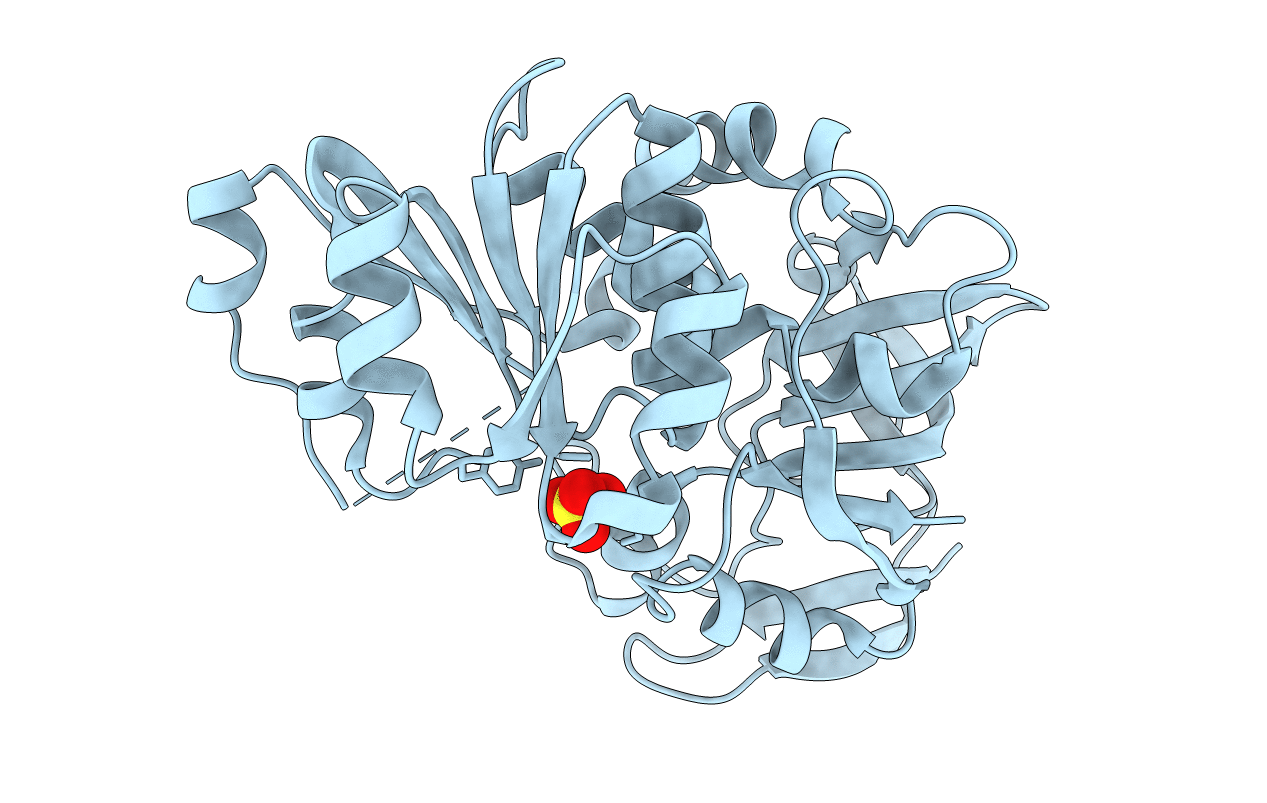
1IZ0 image
Deposition Date 2002-09-17
Release Date 2003-07-15
Last Version Date 2024-10-30
Entry Detail
PDB ID:
1IZ0
Keywords:
Title:
Crystal Structures of the Quinone Oxidoreductase from Thermus thermophilus HB8 and Its Complex with NADPH
Biological Source:
Source Organism(s):
Expression System(s):
Method Details:
Experimental Method:
Resolution:
2.30 Å
R-Value Free:
0.24
R-Value Work:
0.22
Space Group:
P 61 2 2

Macromolecular Entities
Polymer Type:polypeptide(L)
Molecule:QUINONE OXIDOREDUCTASE
Chain IDs:A
Chain Length:302
Number of Molecules:1
Biological Source:Thermus thermophilus
Modified Residue
Compound ID Chain ID Parent Comp ID Details 2D Image
MSE A MET SELENOMETHIONINE
Ligand Molecules
Primary Citation
Crystal Structures of the Quinone Oxidoreductase from Thermus thermophilus HB8 and Its Complex with NADPH: Implication for NADPH and Substrate Recognition
J. Bacteriol. 185 4211 4218 (2003)
PMID: 12837796 DOI: 10.1128/JB.185.14.4211-4218.2003

Abstact

The crystal structures of the zeta-crystalline-like soluble quinone oxidoreductase from Thermus thermophilus HB8 (QOR(Tt)) and of its complex with NADPH have been determined at 2.3- and 2.8-A resolutions, respectively. QOR(Tt) is composed of two domains, and its overall fold is similar to the folds of Escherichia coli quinone oxidoreductase (QOR(Ec)) and horse liver alcohol dehydrogenase. QOR(Tt) forms a homodimer in the crystal by interaction of the betaF-strands in domain II, forming a large beta-sheet that crosses the dimer interface. High thermostability of QOR(Tt) was evidenced by circular dichroic measurement. NADPH is located between the two domains in the QOR(Tt)-NADPH complex. The disordered segment involved in the coenzyme binding of apo-QOR(Tt) becomes ordered upon NADPH binding. The segment covers an NADPH-binding cleft and may serve as a lid. The 2'-phosphate group of the adenine of NADPH is surrounded by polar and positively charged residues in QOR(Tt), suggesting that QOR(Tt) binds NADPH more readily than NADH. The putative substrate-binding site of QOR(Tt), unlike that of QOR(Ec), is largely blocked by nearby residues, permitting access only to small substrates. This may explain why QOR(Tt) has weak p-benzoquinone reduction activity and is inactive with such large substrates of QOR(Ec) as 5-hydroxy-1,4-naphthoquinone and phenanthraquinone.

Legend

Protein

Chemical

Disease

Primary Citation of related structures
Feedback Form
Name
Email
Institute
Feedback