

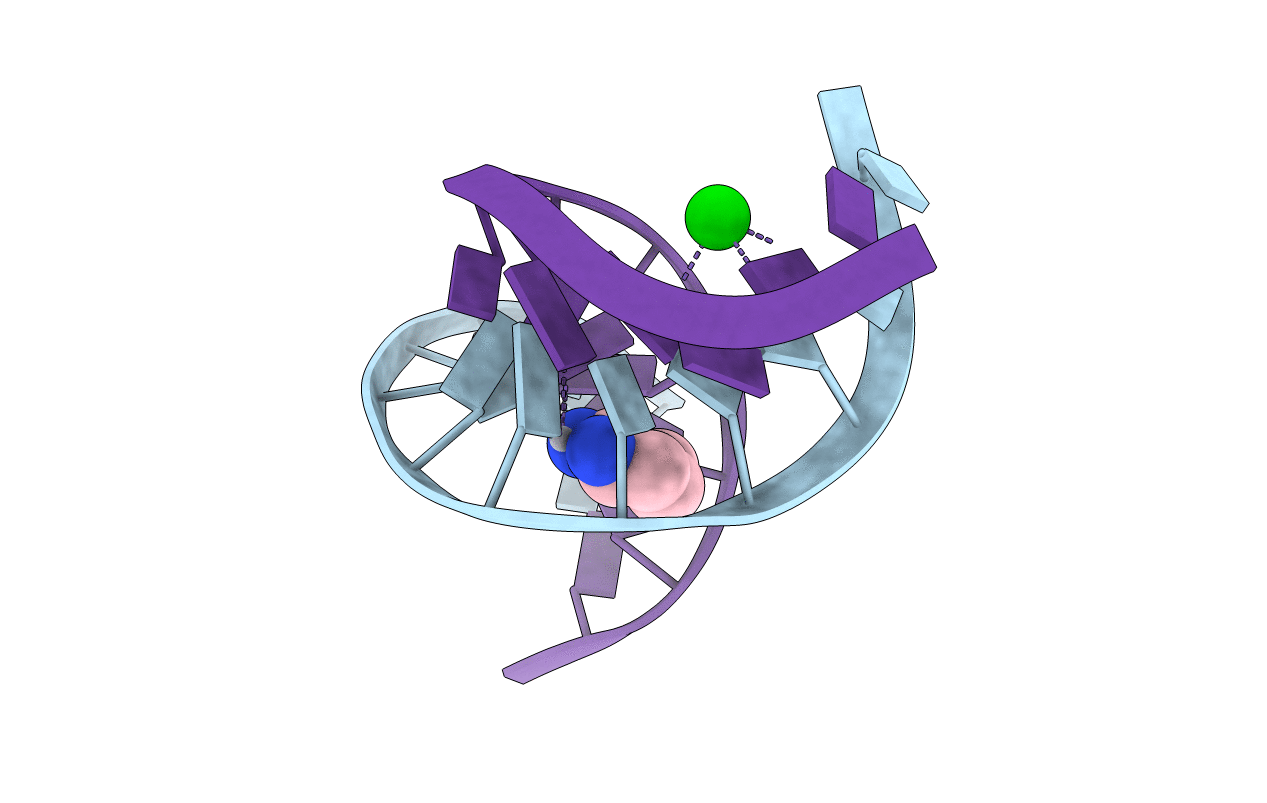
1IHH image
Deposition Date 2001-04-19
Release Date 2001-10-26
Last Version Date 2024-02-07
Entry Detail
PDB ID:
1IHH
Keywords:
Title:
2.4 ANGSTROM CRYSTAL STRUCTURE OF AN OXALIPLATIN 1,2-D(GPG) INTRASTRAND CROSS-LINK IN A DNA DODECAMER DUPLEX
Method Details:
Experimental Method:
Resolution:
2.40 Å
R-Value Free:
0.25
R-Value Work:
0.20
Space Group:
I 2 2 2

Macromolecular Entities
Polymer Type:polydeoxyribonucleotide
Molecule:5'-D(*CP*CP*TP*CP*TP*GP*GP*TP
Chain IDs:A
Chain Length:12
Number of Molecules:1
Biological Source:
Polymer Type:polydeoxyribonucleotide
Molecule:5'-D(*GP*GP*AP*GP*AP*CP*CP*AP
Chain IDs:B
Chain Length:12
Number of Molecules:1
Biological Source:
Primary Citation
2.4 A crystal structure of an oxaliplatin 1,2-d(GpG) intrastrand cross-link in a DNA dodecamer duplex.
Inorg Chem 40 5596 5602 (2001)
PMID: 11599959 DOI: 10.1021/ic010790t

Abstact

(1R,2R-Diaminocyclohexane)oxalatoplatinum(II) (oxaliplatin) is a third-generation platinum anticancer compound that produces the same type of inter- and intrastrand DNA cross-links as cisplatin. In combination with 5-fluorouracil, oxaliplatin has been recently approved in Europe, Asia, and Latin America for the treatment of metastatic colorectal cancer. We present here the crystal structure of an oxaliplatin adduct of a DNA dodecanucleotide duplex having the same sequence as that previously reported for cisplatin (Takahara, P. M.; Rosenzweig, A. C.; Frederick, C. A.; Lippard, S. J. Nature 1995, 377, 649-652). Pt-MAD data were used to solve this first X-ray structure of a platinated DNA duplex derived from an active platinum anticancer drug other than cisplatin. The overall geometry and crystal packing of the complex, refined to 2.4 A resolution, are similar to those of the cisplatin structure, despite the fact that the two molecules crystallize in different space groups. The platinum atom of the [Pt(R,R-DACH)](2+) moiety forms a 1,2-intrastrand cross-link between two adjacent guanosine residues in the sequence 5'-d(CCTCTGGTCTCC), bending the double helix by approximately 30 degrees toward the major groove. Both end-to-end and end-to-groove packing interactions occur in the crystal lattice. The latter is positioned in the minor groove opposite the platinum cross-link. A novel feature of the present structure is the presence of a hydrogen bond between the pseudoequatorial NH hydrogen atom of the (R,R)-DACH ligand and the O6 atom of the 3'-G of the platinated d(GpG) lesion. This finding provides structural evidence for the importance of chirality in mediating the interaction between oxaliplatin and duplex DNA, calibrating previously published models used to explain the reactivity of enantiomerically pure vicinal diamine platinum complexes with DNA in solution. It also provides a new kind of chiral recognition between an enantiomerically pure metal complex and the DNA double helix.

Legend

Protein

Chemical

Disease

Primary Citation of related structures
Feedback Form
Name
Email
Institute
Feedback