

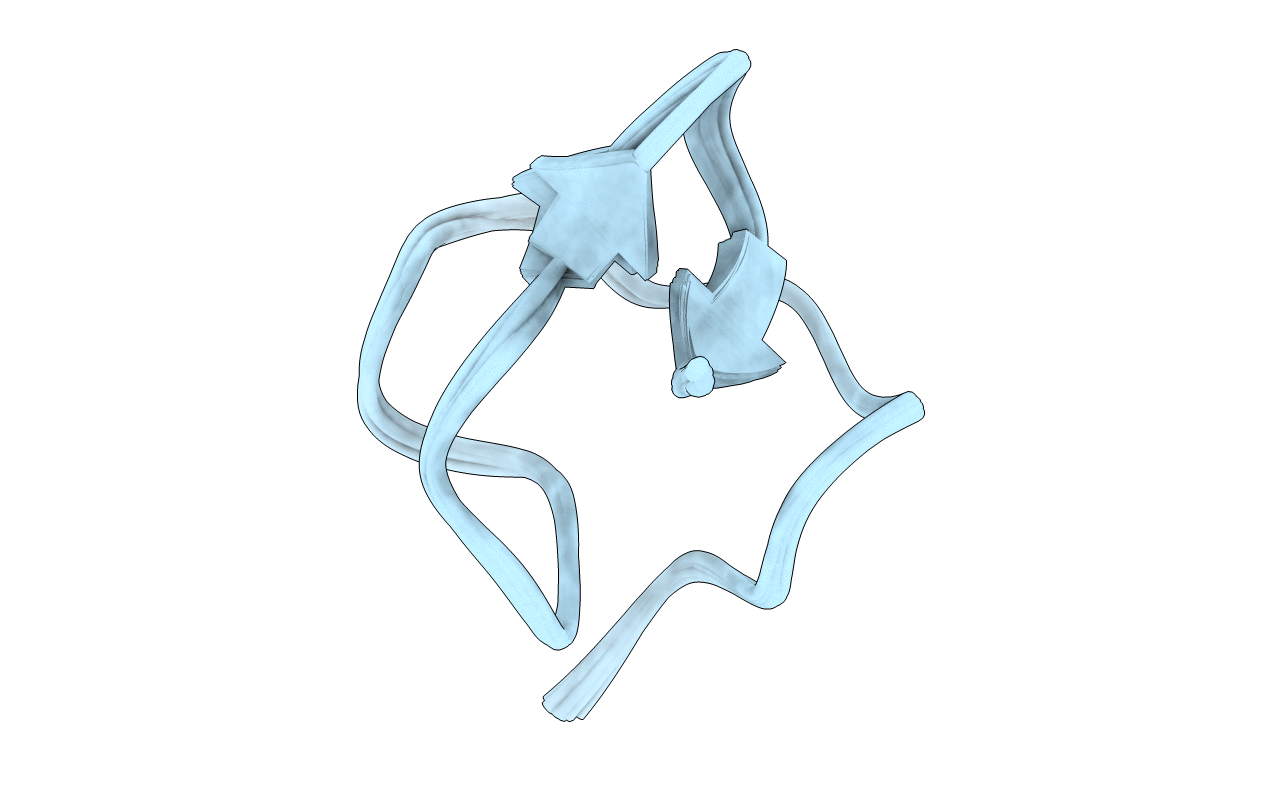
1HVW image
Deposition Date 2001-01-08
Release Date 2001-01-17
Last Version Date 2024-11-06
Entry Detail
PDB ID:
1HVW
Keywords:
Title:
HAIRPINLESS MUTANT OF OMEGA-ATRACOTOXIN-HV1A
Method Details:
Experimental Method:
Conformers Calculated:
100
Conformers Submitted:
20
Selection Criteria:
structures with the lowest energy
Macromolecular Entities
Structures with similar UniProt ID
Protein Blast
Polymer Type:polypeptide(L)
Molecule:OMEGA-ATRACOTOXIN-HV1A
Chain IDs:A
Chain Length:25
Number of Molecules:1
Biological Source:
Ligand Molecules
Primary Citation
Functional significance of the beta hairpin in the insecticidal neurotoxin omega-atracotoxin-Hv1a.
J. Biol. Chem. 276 26568 26576 (2001)
PMID: 11313356 DOI: 10.1074/jbc.M102199200

Abstact

omega-Atracotoxin-Hv1a is an insect-specific neurotoxin whose phylogenetic specificity derives from its ability to antagonize insect, but not vertebrate, voltage-gated calcium channels. In order to help understand its mechanism of action and to enhance its utility as a lead compound for insecticide development, we used a combination of protein engineering and site-directed mutagenesis to probe the toxin for key functional regions. First, we constructed a Hairpinless mutant in which the C-terminal beta-hairpin, which is highly conserved in this family of neurotoxins, was excised without affecting the fold of the residual disulfide-rich core of the toxin. The Hairpinless mutant was devoid of insecticidal activity, indicating the functional importance of the hairpin. We subsequently developed a highly efficient system for production of recombinant toxin and then probed the hairpin for key functional residues using alanine-scanning mutagenesis followed by a second round of mutagenesis based on initial "hits" from the alanine scan. This revealed that two spatially proximal residues, Asn(27) and Arg(35), form a contiguous molecular surface that is essential for toxin activity. We propose that this surface of the beta-hairpin is a key site for interaction of the toxin with insect calcium channels.

Legend

Protein

Chemical

Disease

Primary Citation of related structures
Feedback Form
Name
Email
Institute
Feedback