

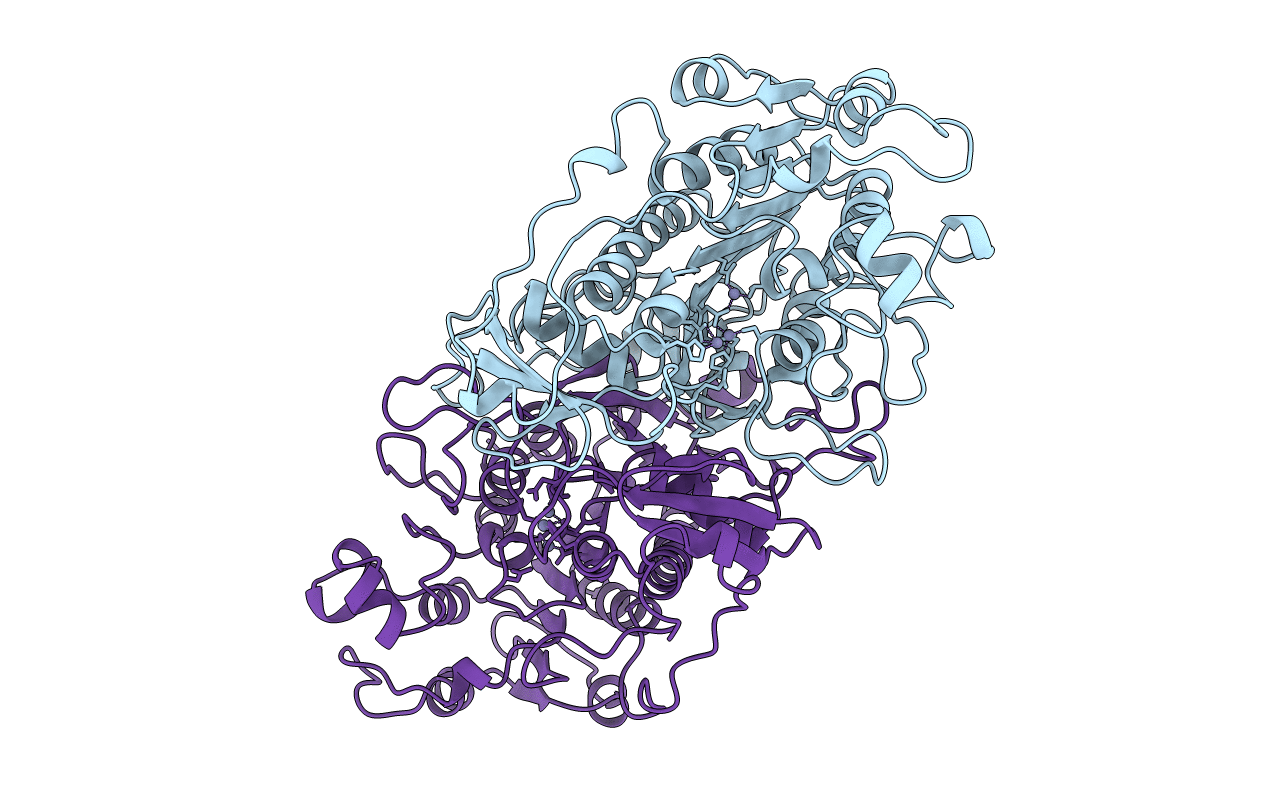
1HQA image
Deposition Date 1995-11-30
Release Date 1996-03-08
Last Version Date 2024-10-16
Entry Detail
PDB ID:
1HQA
Title:
ALKALINE PHOSPHATASE (H412Q)
Biological Source:
Source Organism(s):
Escherichia coli (Taxon ID: 562)
Expression System(s):
Method Details:
Experimental Method:
Resolution:
2.25 Å
R-Value Work:
0.16
R-Value Observed:
0.16
Space Group:
I 2 2 2

Macromolecular Entities
Polymer Type:polypeptide(L)
Molecule:ALKALINE PHOSPHATASE
Gene (Uniprot):phoA
Mutagens:H412Q
Chain IDs:A, B
Chain Length:449
Number of Molecules:2
Biological Source:Escherichia coli
Ligand Molecules
Primary Citation
Kinetic and X-ray structural studies of a mutant Escherichia coli alkaline phosphatase (His-412-->Gln) at one of the zinc binding sites.
Biochemistry 35 2394 2402 (1996)
PMID: 8652582 DOI: 10.1021/bi9523421

Abstact

Site-specific mutagenesis has been used to replace His-412 with glutamine in Escherichia coli alkaline phosphatase. In the wild-type enzyme His-412 is a direct ligand to one of the catalytically important zinc atoms (Zn1) in the active site. The mutant enzyme (H412Q) exhibited about the same k(cat), but a 50-fold increase in K(m) compared to the corresponding kinetic parameters for the wild-type enzyme. Furthermore, the H412Q enzyme had a lower zinc content than the wild-type enzyme. In contrast to the wild-type enzyme, Tris was less effective in the transferase reaction and dramatically inhibited the hydrolysis reaction of the H412Q enzyme. The addition of zinc to the mutant enzyme increased the k(cat) value above that of the wild-type enzyme, partially restored the weak substrate and phosphate binding, and also alleviated the inhibition by Tris. The structure of the H412Q enzyme was also determined by X-ray crystallography. The overall structure of the H412Q enzyme was very similar to that of the wild-type enzyme; the only alpha-carbon displacements over 1 angstrom were observed near the mutation site. In the H412Q structure no phosphate was bound in the active site of the enzyme; however, two water molecules were observed where phosphate normally binds in the wild-type enzyme. Close examination of the active site of the H412Q structure revealed structural changes in Ser-102 as well as at the mutation site. For example, the carbonyl oxygen of the side chain of Gln-412 rotated away from the position of His-412 in the wild-type structure, although too far away (3.2 angstroms) to coordinate to Zn1. Studies on the H412Q enzyme, and a comparison of the H412Q and H412N structures, suggest that the structure and electostatics of the imidazole ring of histidine are critical for its function as a zinc ligand in alkaline phosphatase.

Legend

Protein

Chemical

Disease

Primary Citation of related structures
Feedback Form
Name
Email
Institute
Feedback