

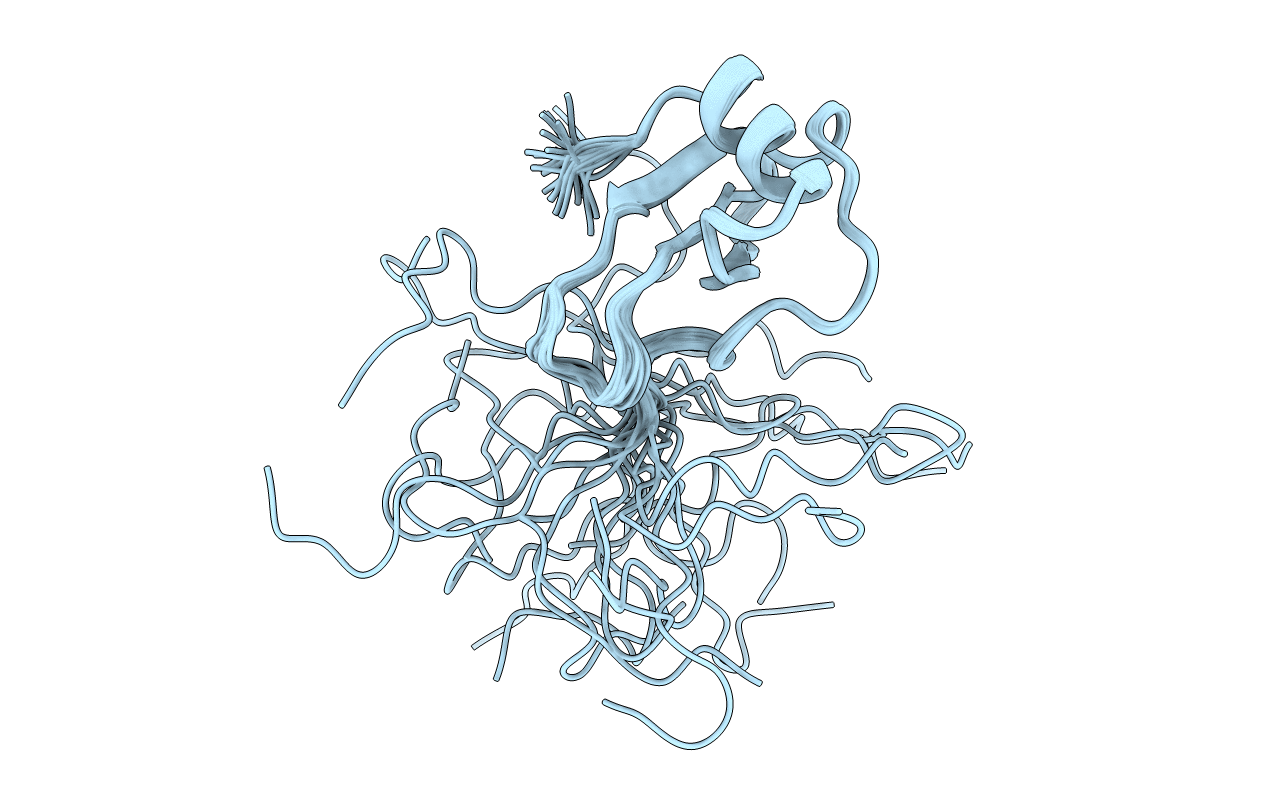
1HHV image
Deposition Date 1998-12-06
Release Date 2003-09-16
Last Version Date 2024-10-30
Entry Detail
PDB ID:
1HHV
Keywords:
Title:
SOLUTION STRUCTURE OF VIRUS CHEMOKINE VMIP-II
Method Details:
Experimental Method:
Conformers Calculated:
80
Conformers Submitted:
25
Selection Criteria:
LEAST RESTRAINT VIOLATION AND LOWEST ENERGY

Macromolecular Entities
Polymer Type:polypeptide(L)
Molecule:VIRUS CHEMOKINE VMIP-II
Gene (Uniprot):vCCL2
Chain IDs:A
Chain Length:74
Number of Molecules:1
Biological Source:
Modified Residue
Compound ID Chain ID Parent Comp ID Details 2D Image
MSE A MET SELENOMETHIONINE
Ligand Molecules
Primary Citation
CCR2 and CCR5 receptor-binding properties of herpesvirus-8 vMIP-II based on sequence analysis and its solution structure
Eur. J. Biochem. 268 2948 2959 (2001)
PMID: 11358512 DOI: 10.1046/j.1432-1327.2001.02184.x

Abstact

Human herpesvirus-8 (HHV-8) is the infectious agent responsible for Kaposi's sarcoma and encodes a protein, macrophage inflammatory protein-II (vMIP-II), which shows sequence similarity to the human CC chemokines. vMIP-II has broad receptor specificity that crosses chemokine receptor subfamilies, and inhibits HIV-1 viral entry mediated by numerous chemokine receptors. In this study, the solution structure of chemically synthesized vMIP-II was determined by nuclear magnetic resonance. The protein is a monomer and possesses the chemokine fold consisting of a flexible N-terminus, three antiparallel beta strands, and a C-terminal alpha helix. Except for the N-terminal residues (residues 1-13) and the last two C-terminal residues (residues 73-74), the structure of vMIP-II is well-defined, exhibiting average rmsd of 0.35 and 0.90 A for the backbone heavy atoms and all heavy atoms of residues 14-72, respectively. Taking into account the sequence differences between the various CC chemokines and comparing their three-dimensional structures allows us to implicate residues that influence the quaternary structure and receptor binding and activation of these proteins in solution. The analysis of the sequence and three-dimensional structure of vMIP-II indicates the presence of epitopes involved in binding two receptors CCR2 and CCR5. We propose that vMIP-II was initially specific for CCR5 and acquired receptor-binding properties to CCR2 and other chemokine receptors.

Legend

Protein

Chemical

Disease

Primary Citation of related structures
Feedback Form
Name
Email
Institute
Feedback