

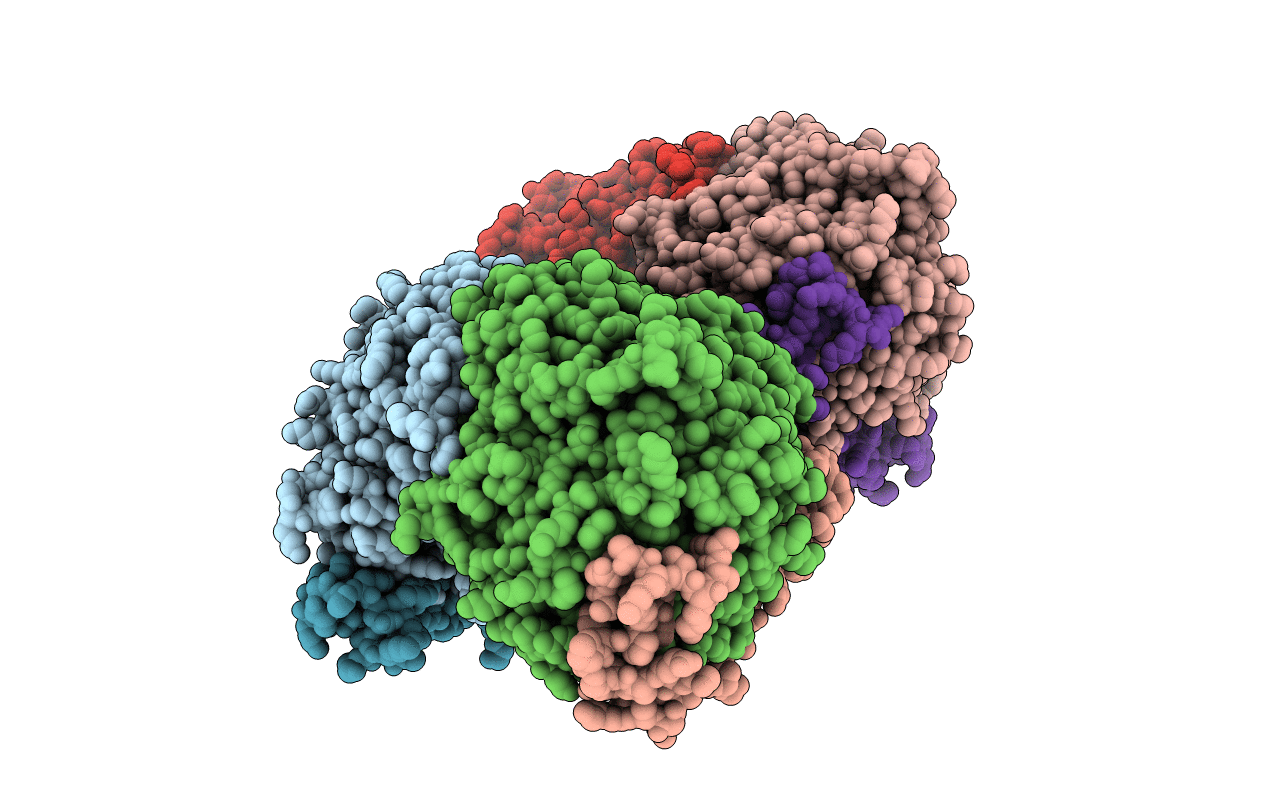
1H4J image
Deposition Date 2001-05-11
Release Date 2001-08-23
Last Version Date 2024-11-13
Entry Detail
PDB ID:
1H4J
Keywords:
Title:
Methylobacterium extorquens methanol dehydrogenase D303E mutant
Biological Source:
Source Organism(s):
Expression System(s):
Method Details:
Experimental Method:
Resolution:
3.00 Å
R-Value Free:
0.21
R-Value Work:
0.18
R-Value Observed:
0.18
Space Group:
P 1 21 1

Macromolecular Entities
Structures with similar UniProt ID
Protein Blast
Polymer Type:polypeptide(L)
Molecule:Methanol dehydrogenase [cytoc
Gene (Uniprot):moxF
Mutagens:D303E
Chain IDs:A, C, E, G
Chain Length:599
Number of Molecules:4
Biological Source:Methylobacterium extorquens
Structures with similar UniProt ID
Protein Blast
Polymer Type:polypeptide(L)
Molecule:Methanol dehydrogenase [cytoc
Gene (Uniprot):moxI
Chain IDs:B, D, F, H
Chain Length:74
Number of Molecules:4
Biological Source:Methylobacterium extorquens
Primary Citation
Site-Directed Mutagenesis and X-Ray Crystallography of the Pqq-Containing Quinoprotein Methanol Dehydrogenase and its Electron Acceptor, Cytochrome C(L)(,)
Biochemistry 40 9799 9809 (2001)
PMID: 11502173 DOI: 10.1021/BI002932L

Abstact

Two proteins specifically involved in methanol oxidation in the methylotrophic bacterium Methylobacterium extorquens have been modified by site-directed mutagenesis. Mutation of the proposed active site base (Asp303) to glutamate in methanol dehydrogenase (MDH) gave an active enzyme (D303E-MDH) with a greatly reduced affinity for substrate and with a lower activation energy. Results of kinetic and deuterium isotope studies showed that the essential mechanism in the mutant protein was unchanged, and that the step requiring activation by ammonia remained rate limiting. No spectrally detectable intermediates could be observed during the reaction. The X-ray structure, determined to 3 A resolution, of D303E-MDH showed that the position and coordination geometry of the Ca2+ ion in the active site was altered; the larger Glu303 side chain was coordinated to the Ca2+ ion and also hydrogen bonded to the O5 atom of pyrroloquinoline quinone (PQQ). The properties and structure of the D303E-MDH are consistent with the previous proposal that the reaction in MDH is initiated by proton abstraction involving Asp303, and that the mechanism involves a direct hydride transfer reaction. Mutation of the two adjacent cysteine residues that make up the novel disulfide ring in the active site of MDH led to an inactive enzyme, confirming the essential role of this remarkable ring structure. Mutations of cytochrome c(L), which is the electron acceptor from MDH was used to identify Met109 as the sixth ligand to the heme.

Legend

Protein

Chemical

Disease

Primary Citation of related structures
Feedback Form
Name
Email
Institute
Feedback