

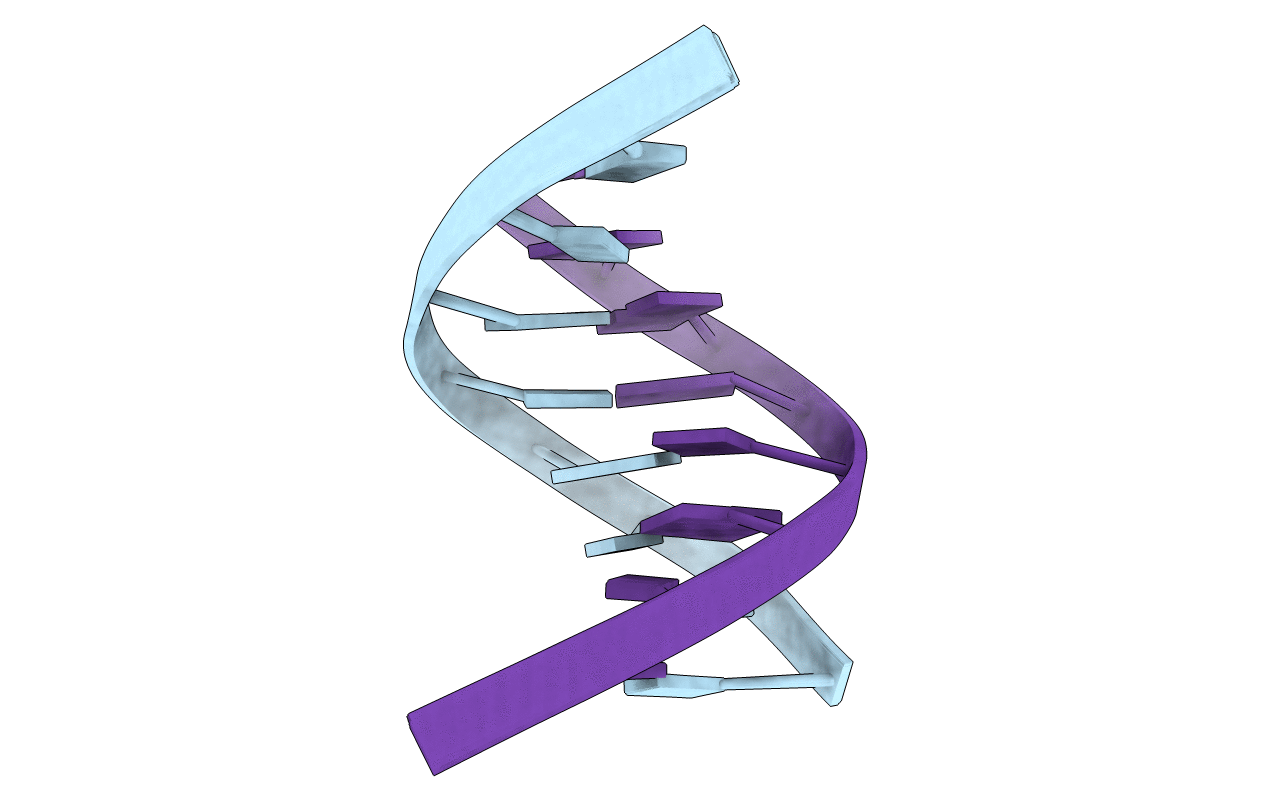
1G80 image
Deposition Date 2000-11-15
Release Date 2001-03-28
Last Version Date 2024-05-22
Entry Detail
PDB ID:
1G80
Keywords:
Title:
NMR SOLUTION STRUCTURE OF D(GCGTACGC)2
Method Details:
Experimental Method:
Conformers Calculated:
20
Conformers Submitted:
20
Selection Criteria:
back calculated data agree with experimental NOESY spectrum

Macromolecular Entities
Polymer Type:polydeoxyribonucleotide
Molecule:5'-D(*GP*CP*GP*TP*AP*CP*GP*C)
Chain IDs:A, B
Chain Length:8
Number of Molecules:2
Biological Source:
Ligand Molecules
Primary Citation
Relationship of DNA structure to internal dynamics: correlation of helical parameters from NOE-based NMR solution structures of d(GCGTACGC)(2) and d(CGCTAGCG)(2) with (13)C order parameters implies conformational coupling in dinucleotide units.
J. Mol. Biol. 307 525 540 (2001)
PMID: 11254380 DOI: 10.1006/jmbi.2001.4498

Abstact

The coupling between the conformational properties of double-stranded DNA and its internal dynamics has been examined. The solution structures of the isomeric DNA oligomers d(GCGTACGC)(2) (UM) and d(CGCTAGCG)(2) (CTSYM) were determined with (1)H NMR spectroscopy by utilizing distance restraints from total relaxation matrix analysis of NOESY cross-peak intensities in restrained molecular dynamics calculations. The root-mean-square deviation of the coordinates for the ensemble of structures was 0.13 A for UM and 0.49 A for CTSYM, with crystallographic equivalent R(c)=0.41 and 0.39 and sixth-root residual R(x)=0.11 and 0.10 for UM and CTSYM, respectively. Both UM and CTSYM are B-form with straight helical axes and show sequence-dependent variations in conformation. The internal dynamics of UM and CTSYM were previously determined by analysis of (13)C relaxation parameters in the context of the Lipari & Szabo model-free formalism. Helical parameters for the two DNA oligomers were examined for linear correlations with the order parameters (S(2)) of groups of (13)C spins in base-pairs and dinucleotide units of UM and CTSYM. Correlations were found for six interstrand base-pair parameters tip, y-displacement, inclination, buckle and stretch with various combinations of S(2) for atoms in Watson-Crick base-pairs and for two inter-base-pair parameters, rise and roll with various combinations of S(2) for atoms in dinucleotides. The correlations for the interstrand base-pair helical parameters indicate that the conformations of the deoxyribose residues of each strand are dynamically coupled. Also, the inter-base-pair separation has a profound effect on the local internal motions available to the DNA, supporting the idea that rise is a principal degree of freedom for DNA conformational variability. The correlations indicate collective atomic motions of spins that may represent specific motional modes in DNA, and that base sequence has a predictable effect on the relative order of groups of spins both in the bases and in the deoxyribose ring of the DNA backbone. These observations suggest that an important functional outcome of DNA base sequence is the modulation of both the conformation and dynamic behavior of the DNA backbone.

Legend

Protein

Chemical

Disease

Primary Citation of related structures
Feedback Form
Name
Email
Institute
Feedback