

1E5R image
Deposition Date 2000-07-28
Release Date 2001-07-26
Last Version Date 2024-05-08
Entry Detail
PDB ID:
1E5R
Keywords:
Title:
Proline 3-hydroxylase (type II) -apo form
Biological Source:
Source Organism(s):
Method Details:
Experimental Method:
Resolution:
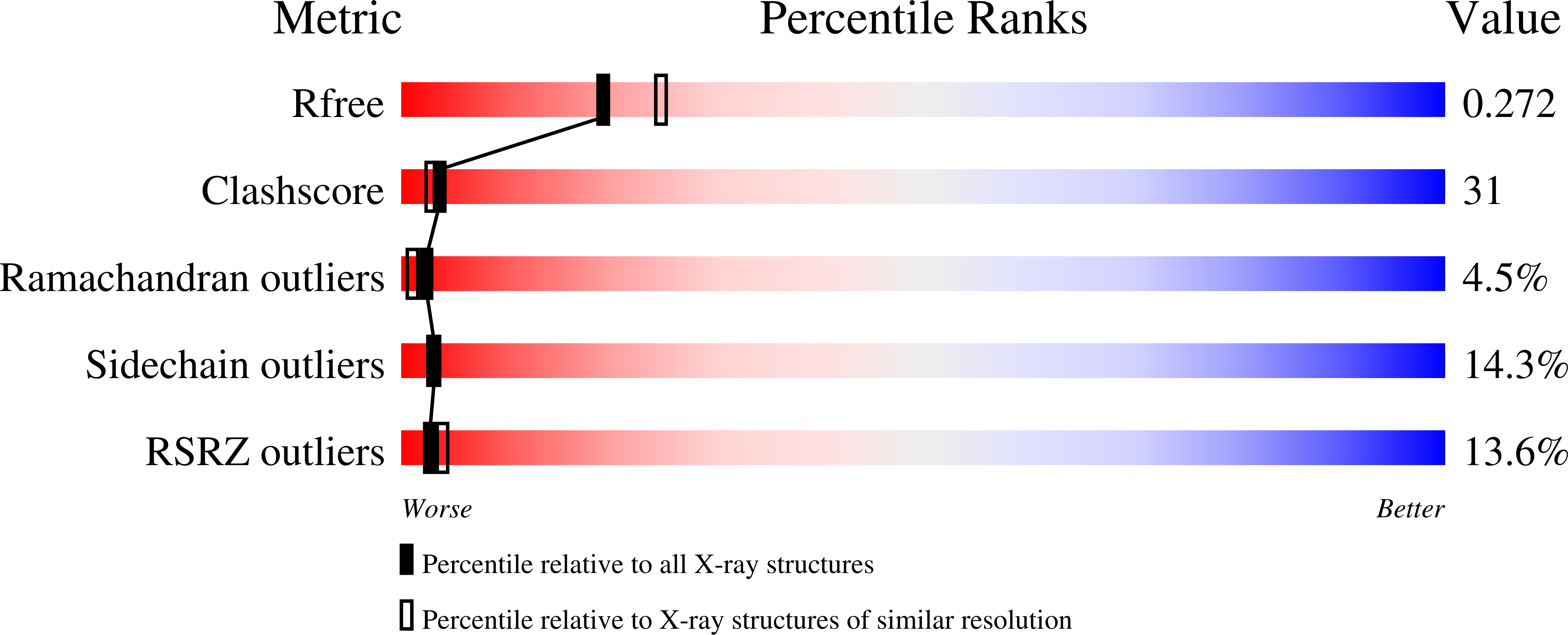
2.30 Å
R-Value Free:
0.27
R-Value Work:
0.22
R-Value Observed:
0.22
Space Group:
P 31 2 1
Macromolecular Entities
Structures with similar UniProt ID
Protein Blast
Polymer Type:polypeptide(L)
Molecule:PROLINE OXIDASE
Chain IDs:A, B
Chain Length:290
Number of Molecules:2
Biological Source:STREPTOMYCES SP.
Primary Citation
Structure of proline 3-hydroxylase. Evolution of the family of 2-oxoglutarate dependent oxygenases.
Eur. J. Biochem. 268 6625 6636 (2001)
PMID: 11737217 DOI: 10.1046/j.0014-2956.2001.02617.x

Abstact

Iron (II)/2-oxoglutarate (2-OG)-dependent oxygenases catalyse oxidative reactions in a range of metabolic processes including the hydroxylation of proline and lysine residues during the post-translational modification of collagen. 2-OG oxygenases commonly require ascorbate for full activity. In the vitamin C deficient disease, scurvy, reduced activity of 2-OG oxygenases results in impaired formation of collagen. Here we report the crystal structure of bacterial proline 3-hydroxylase from Streptomyces sp., an enzyme which hydroxylates proline at position 3, the first of a 2-OG oxygenase catalysing oxidation of a free alpha-amino acid. Structures were obtained for the enzyme in the absence of iron (to 2.3A resolution, R=20.2%, Rfree=25.3%) and that complexed to iron (II) (to 2.4A resolution, R=19.8%, Rfree=22.6%). The structure contains conserved motifs present in other 2-OG oxygenases including a 'jelly roll' beta strand core and residues binding iron and 2-oxoglutarate, consistent with divergent evolution within the extended family. The structure differs significantly from many other 2-OG oxygenases in possessing a discrete C-terminal helical domain. Analysis of the structure suggests a model for proline binding and a mechanism for uncoupling of proline and 2-OG turnover.

Legend

Protein

Chemical

Disease

Primary Citation of related structures
Feedback Form
Name
Email
Institute
Feedback