

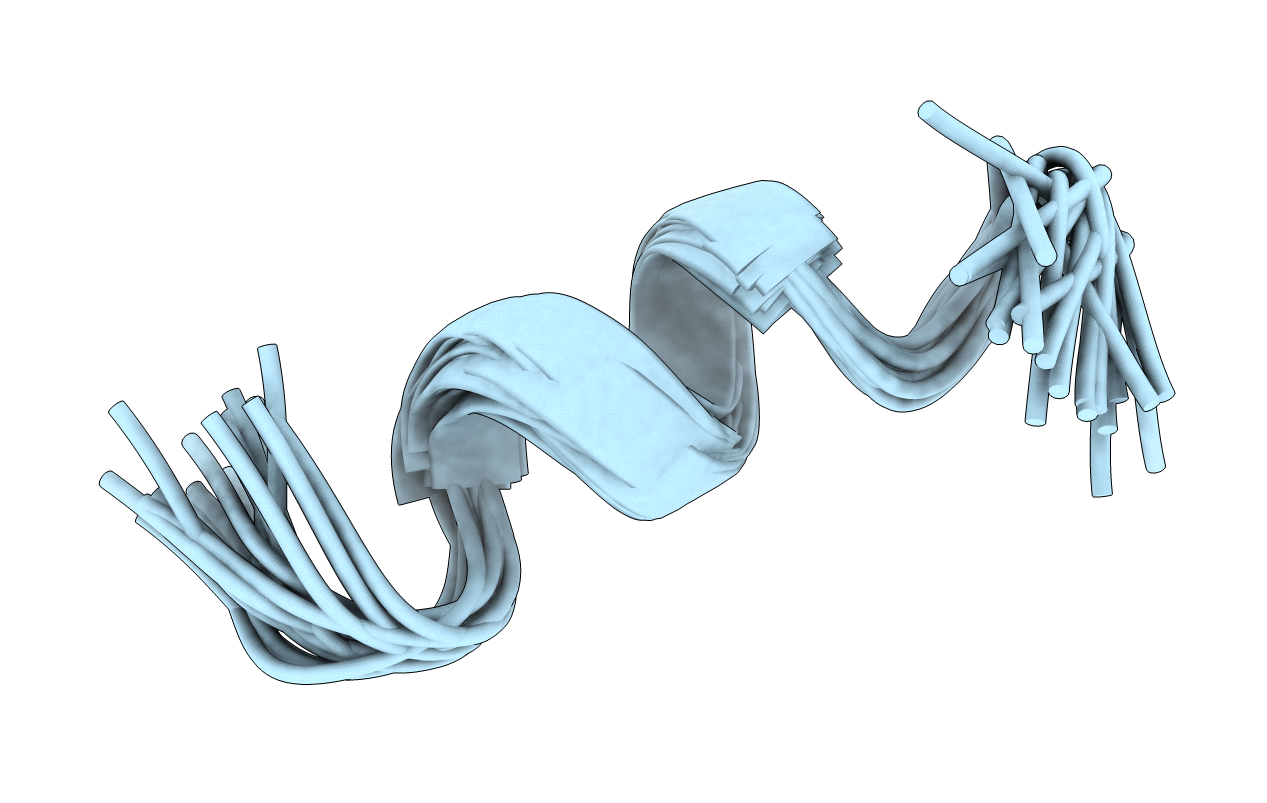
1D0W image
Deposition Date 1999-09-14
Release Date 2000-06-16
Last Version Date 2022-02-16
Entry Detail
PDB ID:
1D0W
Keywords:
Title:
SOLUTION STRUCTURE OF LACTAM-BRIDGED C-TERMINAL ANALOGUE-I OF NEUROPEPTIDE Y
Method Details:
Experimental Method:
Conformers Calculated:
100
Conformers Submitted:
20
Selection Criteria:
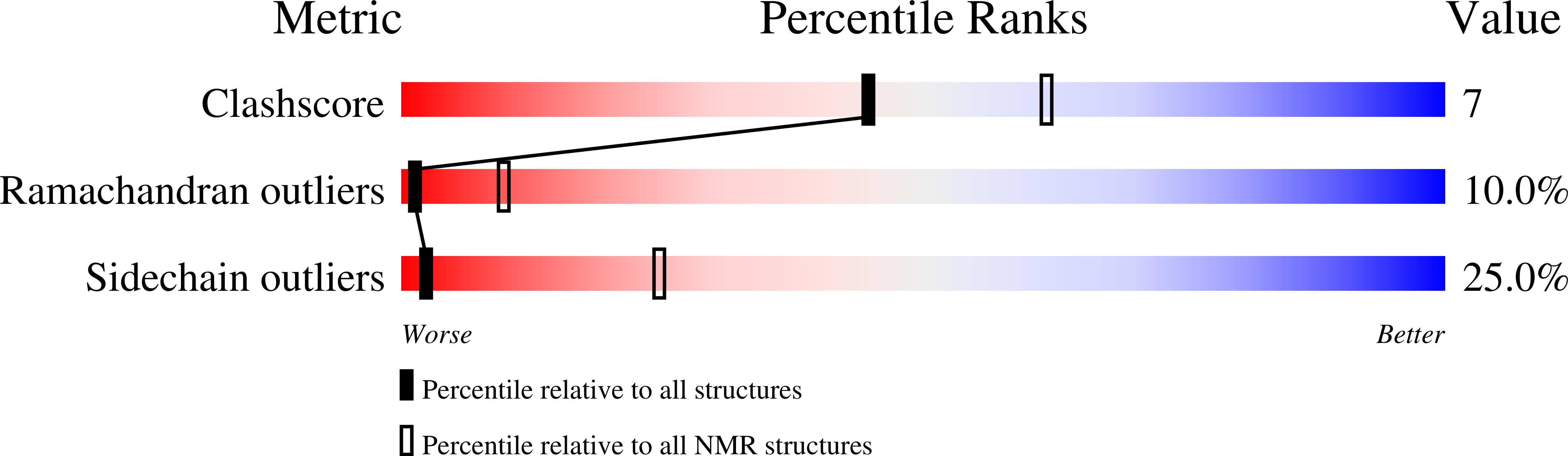
structures with the lowest energy
Macromolecular Entities
Protein Blast
Polymer Type:polypeptide(L)
Molecule:C-TERMINAL ANALOGUE OF NEUROP
Mutagens:L24A, I28K, I31L, T32E, A LACTAM-BRIDGE WAS INTRODUCED BETWEEN POSITIONS (28) AND (32)
Chain IDs:A
Chain Length:14
Number of Molecules:1
Biological Source:
Modified Residue
Compound ID Chain ID Parent Comp ID Details 2D Image
AYA A ALA N-ACETYLALANINE
Ligand Molecules
Primary Citation
Stabilization of the helical structure of Y2-selective analogues of neuropeptide Y by lactam bridges.
J. Med. Chem. 45 2310 2318 (2002)
PMID: 12014969 DOI: 10.1021/jm010543z

Abstact

The importance of helical structure in an analogue of NPY selective for the Y2 receptor, Ac[Leu28,31]NPY24-36, has been investigated by introducing a lactam bridge between positions 28 and 32. The resulting analogue, Ac-cyclo28/32[Ala24,Lys28,Leu31,Glu32]NPY24-36, is a potent Y2-selective agonist. Structural analysis by NMR shows that this analogue forms a helical structure in a 40% trifluoroethanol/water mixture, whereas in water only the region around the lactam bridge (Lys28-Glu32) adopts helical-like structure, with both N- and C-termini being poorly defined. The observation of well-defined helical structure in aqueous TFE contrasts with that reported for a similar analogue, Ac-cyclo28/32[Lys28,Glu32]NPY25-36 (Rist et al. FEBS Lett. 1996, 394, 169-173), which consisted of a hairpin-like structure that brought the N- and C-termini into proximity. We have therefore determined the structures of this analogue, as well as those of Ac-cyclo28/32[Ala24,Lys28,Leu31,Glu32]NPY24-36 and Ac-cyclo28/32[Ala24,Lys28,Glu32]NPY24-36, under identical solution conditions (30% TFE/H2O mixture at 308 K) and find essentially the same helical structure in all three peptides. These findings support the proposal that these Y2-selective analogues adopt a helical structure when bound to the Y2 receptor.

Legend

Protein

Chemical

Disease

Primary Citation of related structures
Feedback Form
Name
Email
Institute
Feedback