

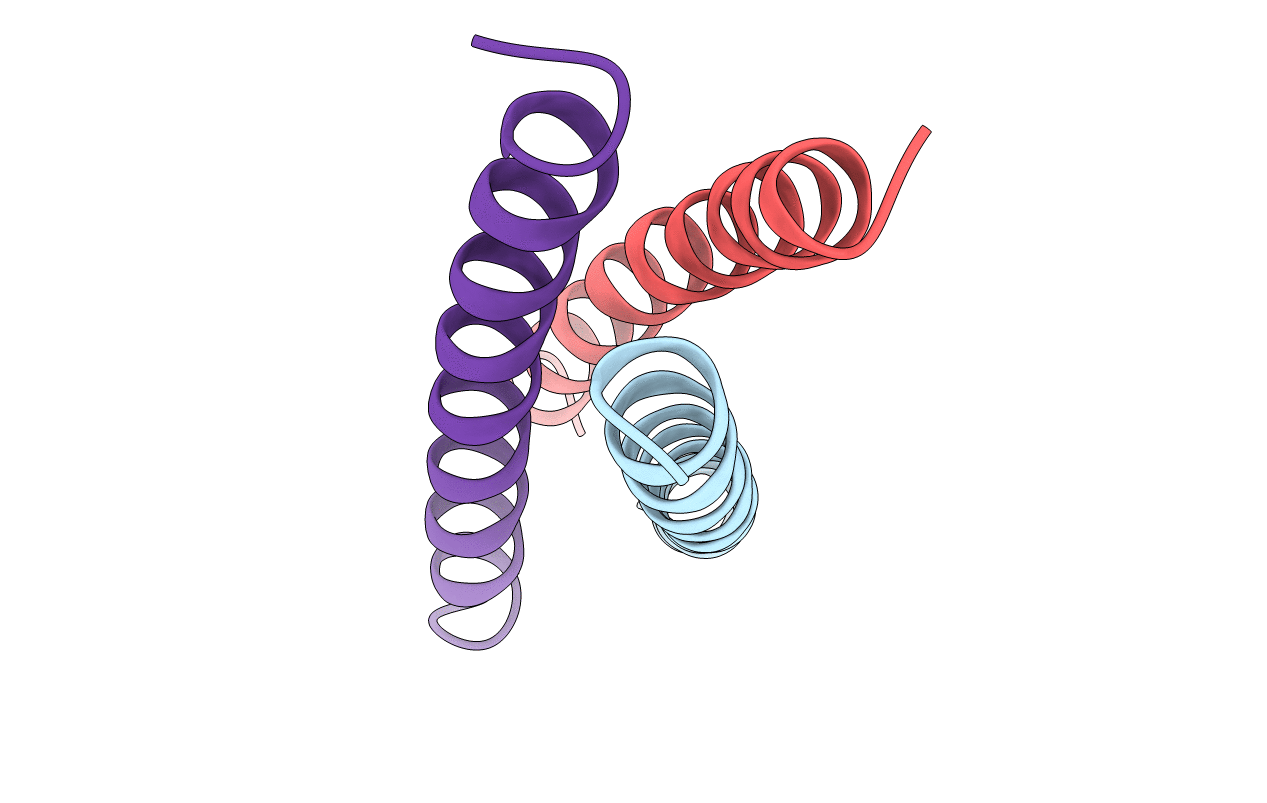
1BB1 image
Deposition Date 1998-04-28
Release Date 1999-02-02
Last Version Date 2024-10-16
Entry Detail
PDB ID:
1BB1
Title:
CRYSTAL STRUCTURE OF A DESIGNED, THERMOSTABLE HETEROTRIMERIC COILED COIL
Biological Source:
Source Organism(s):
Method Details:
Experimental Method:
Resolution:
1.80 Å
R-Value Free:
0.26
R-Value Work:
0.20
R-Value Observed:
0.20
Space Group:
P 1 21 1
Macromolecular Entities
Polymer Type:polypeptide(L)
Molecule:DESIGNED, THERMOSTABLE HETERO
Chain IDs:A
Chain Length:36
Number of Molecules:1
Biological Source:synthetic construct
Polymer Type:polypeptide(L)
Molecule:DESIGNED, THERMOSTABLE HETERO
Chain IDs:B
Chain Length:36
Number of Molecules:1
Biological Source:synthetic construct
Polymer Type:polypeptide(L)
Molecule:DESIGNED, THERMOSTABLE HETERO
Chain IDs:C
Chain Length:36
Number of Molecules:1
Biological Source:synthetic construct
Ligand Molecules
Primary Citation
Crystal structure of a designed, thermostable, heterotrimeric coiled coil.
Protein Sci. 8 84 90 (1999)
PMID: 10210186

Abstact

Electrostatic interactions are often critical for determining the specificity of protein-protein complexes. To study the role of electrostatic interactions for assembly of helical bundles, we previously designed a thermostable, heterotrimeric coiled coil, ABC, in which charged residues were employed to drive preferential association of three distinct, 34-residue helices. To investigate the basis for heterotrimer specificity, we have used multiwavelength anomalous diffraction (MAD) analysis to determine the 1.8 A resolution crystal structure of ABC. The structure shows that ABC forms a heterotrimeric coiled coil with the intended arrangement of parallel chains. Over half of the ion pairs engineered to restrict helix associations were apparent in the experimental electron density map. As seen in other trimeric coiled coils, ABC displays acute knobs-into-holes packing and a buried anion coordinated by core polar amino acids. These interactions validate the design strategy and illustrate how packing and polar contacts determine structural uniqueness.

Legend

Protein

Chemical

Disease

Primary Citation of related structures
Feedback Form
Name
Email
Institute
Feedback