

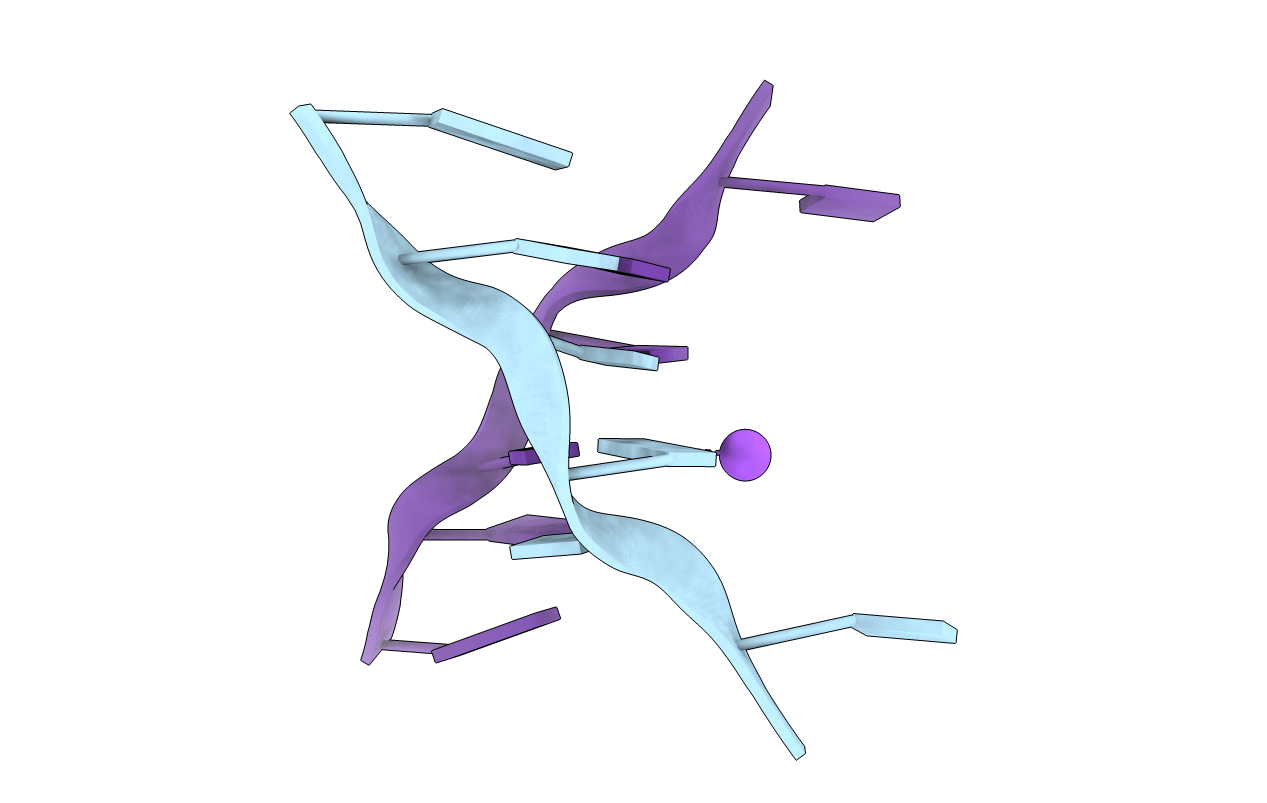
192D image
Deposition Date 1994-09-22
Release Date 1995-02-07
Last Version Date 2024-02-07
Entry Detail
PDB ID:
192D
Keywords:
Title:
RECOMBINATION-LIKE STRUCTURE OF D(CCGCGG)
Method Details:
Experimental Method:
Resolution:
1.92 Å
R-Value Work:
0.18
R-Value Observed:
0.18
Space Group:
C 2 2 21

Macromolecular Entities
Polymer Type:polydeoxyribonucleotide
Molecule:DNA (5'-D(*CP*CP*GP*CP*GP*G)-
Chain IDs:A, B
Chain Length:6
Number of Molecules:2
Biological Source:
Ligand Molecules
Primary Citation
Recombination-like structure of d(CCGCGG).
J. Mol. Biol. 243 484 493 (1994)
PMID: 7966274 DOI: 10.1006/jmbi.1994.1674

Abstact

We have solved the single crystal X-ray structure of the synthetic DNA hexamer d(CCGCGG). The central alternating tetramer forms a Z-DNA duplex. The initial cytosine of each strand of the duplex swings out and forms a Watson-Crick base-pair with the terminal guanine of a symmetry-related molecule. Thus, two symmetry-related DNA molecules form a twin with intermolecular base-pairs at both ends. Such a twin is additionally stabilized by a sodium ion located on a dyad axis between two DNA duplexes. The total structure has recombination-like features. It also provides a model for B/Z junctions. The crystal used in this study belongs to space group C222(1) with a = 34.33 A, b = 44.04 A and c = 38.27 A. The structure was solved by molecular replacement using partial models, and refined by molecular dynamics simulated annealing and positional treatment. The refinement has been concluded with an R-factor of 18.5% for 2377 reflections with F > or = 2 sigma (F) in the resolution region 8.0 to 1.92 A. The asymmetric unit contains two strands of d(CCGCGG) and 38 water molecules.

Legend

Protein

Chemical

Disease

Primary Citation of related structures
Feedback Form
Name
Email
Institute
Feedback