

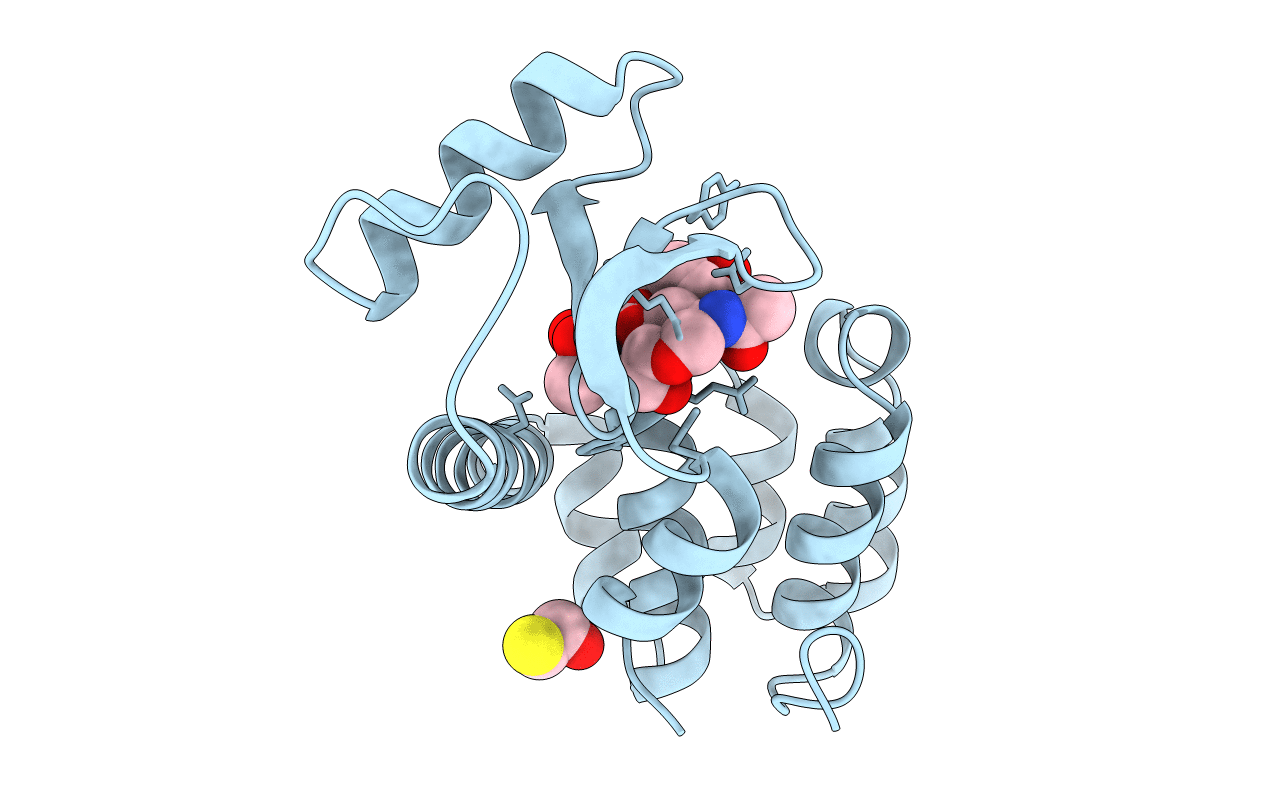
148L image
Deposition Date 1993-10-27
Release Date 1994-04-30
Last Version Date 2023-11-15
Entry Detail
PDB ID:
148L
Title:
A COVALENT ENZYME-SUBSTRATE INTERMEDIATE WITH SACCHARIDE DISTORTION IN A MUTANT T4 LYSOZYME
Biological Source:
Source Organism(s):
Method Details:
Experimental Method:
Resolution:
1.90 Å
R-Value Observed:
0.16
Space Group:
P 21 21 2
Macromolecular Entities
Structures with similar UniProt ID
Protein Blast
Polymer Type:polypeptide(L)
Molecule:T4 LYSOZYME
Gene (Uniprot):E
Chain IDs:A (auth: E)
Chain Length:164
Number of Molecules:1
Biological Source:Enterobacteria phage T4
Protein Blast
Polymer Type:polypeptide(L)
Molecule:SUBSTRATE CLEAVED FROM CELL W
Chain IDs:B (auth: S)
Chain Length:4
Number of Molecules:1
Biological Source:ESCHERICHIA COLI
Modified Residue
Compound ID Chain ID Parent Comp ID Details 2D Image
API B LYS 2,6-DIAMINOPIMELIC ACID
Ligand Molecules
Primary Citation
A covalent enzyme-substrate intermediate with saccharide distortion in a mutant T4 lysozyme.
Science 262 2030 2033 (1993)
PMID: 8266098

Abstact

The glycosyl-enzyme intermediate in lysozyme action has long been considered to be an oxocarbonium ion, although precedent from other glycosidases and theoretical considerations suggest it should be a covalent enzyme-substrate adduct. The mutation of threonine 26 to glutamic acid in the active site cleft of phage T4 lysozyme (T4L) produced an enzyme that cleaved the cell wall of Escherichia coli but left the product covalently bound to the enzyme. The crystalline complex was nonisomorphous with wild-type T4L, and analysis of its structure showed a covalent linkage between the product and the newly introduced glutamic acid 26. The covalently linked sugar ring was substantially distorted, suggesting that distortion of the substrate toward the transition state is important for catalysis, as originally proposed by Phillips. It is also postulated that the adduct formed by the mutant is an intermediate, consistent with a double displacement mechanism of action in which the glycosidic linkage is cleaved with retention of configuration as originally proposed by Koshland. The peptide part of the cell wall fragment displays extensive hydrogen-bonding interactions with the carboxyl-terminal domain of the enzyme, consistent with previous studies of mutations in T4L.

Legend

Protein

Chemical

Disease

Primary Citation of related structures
Feedback Form
Name
Email
Institute
Feedback