

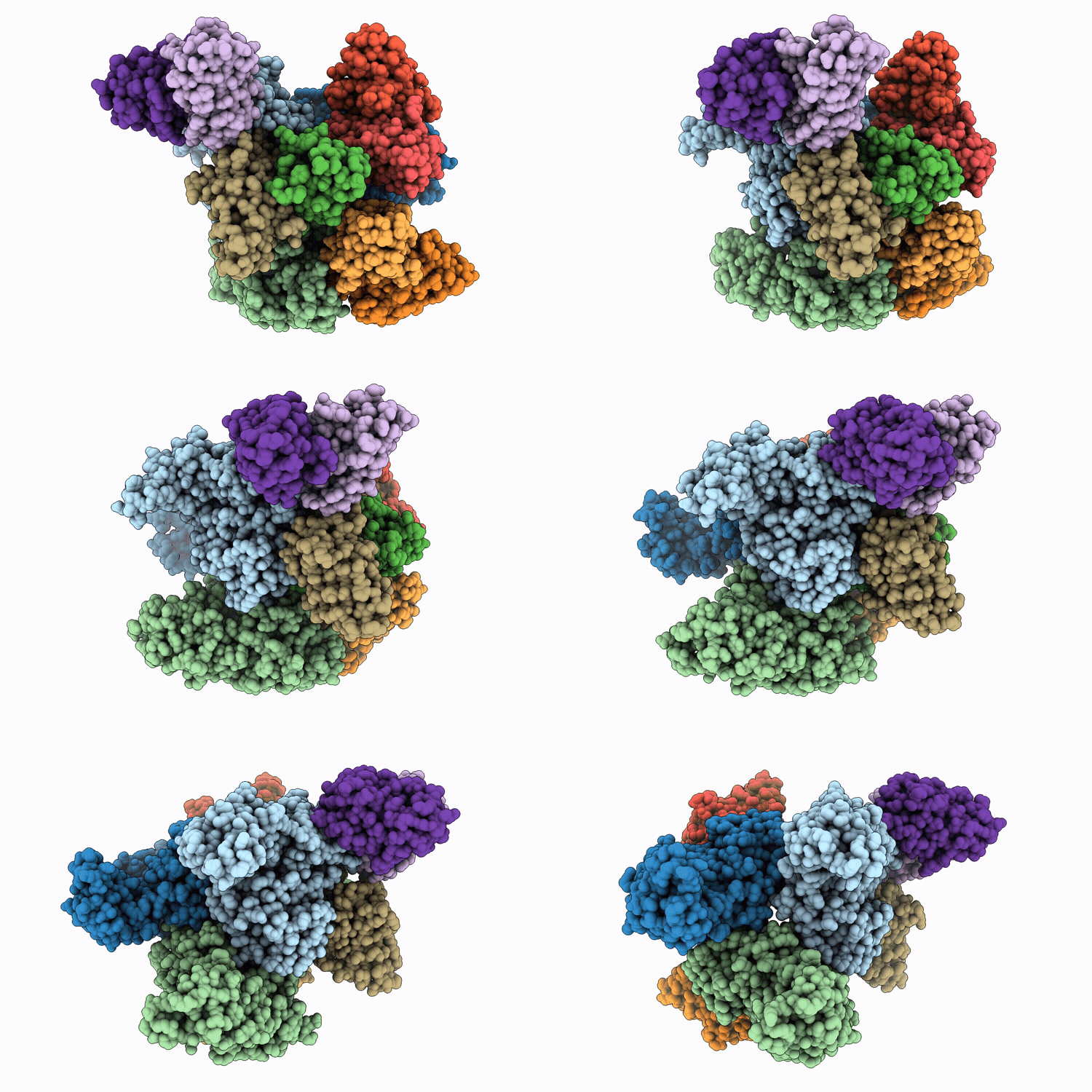
11IW image
Deposition Date 2026-02-26
Release Date 2026-08-19
Last Version Date 2026-09-30
Entry Detail
PDB ID:
11IW
Title:
Mouse monoclonal antibody A2 in complex with rabies virus glycoprotein
Biological Source:
Source Organism(s):
Lyssavirus rabies (Taxon ID: 11292)
Homo sapiens (Taxon ID: 9606)
Mus musculus (Taxon ID: 10090)
Expression System(s):
Method Details:
Experimental Method:
Resolution:
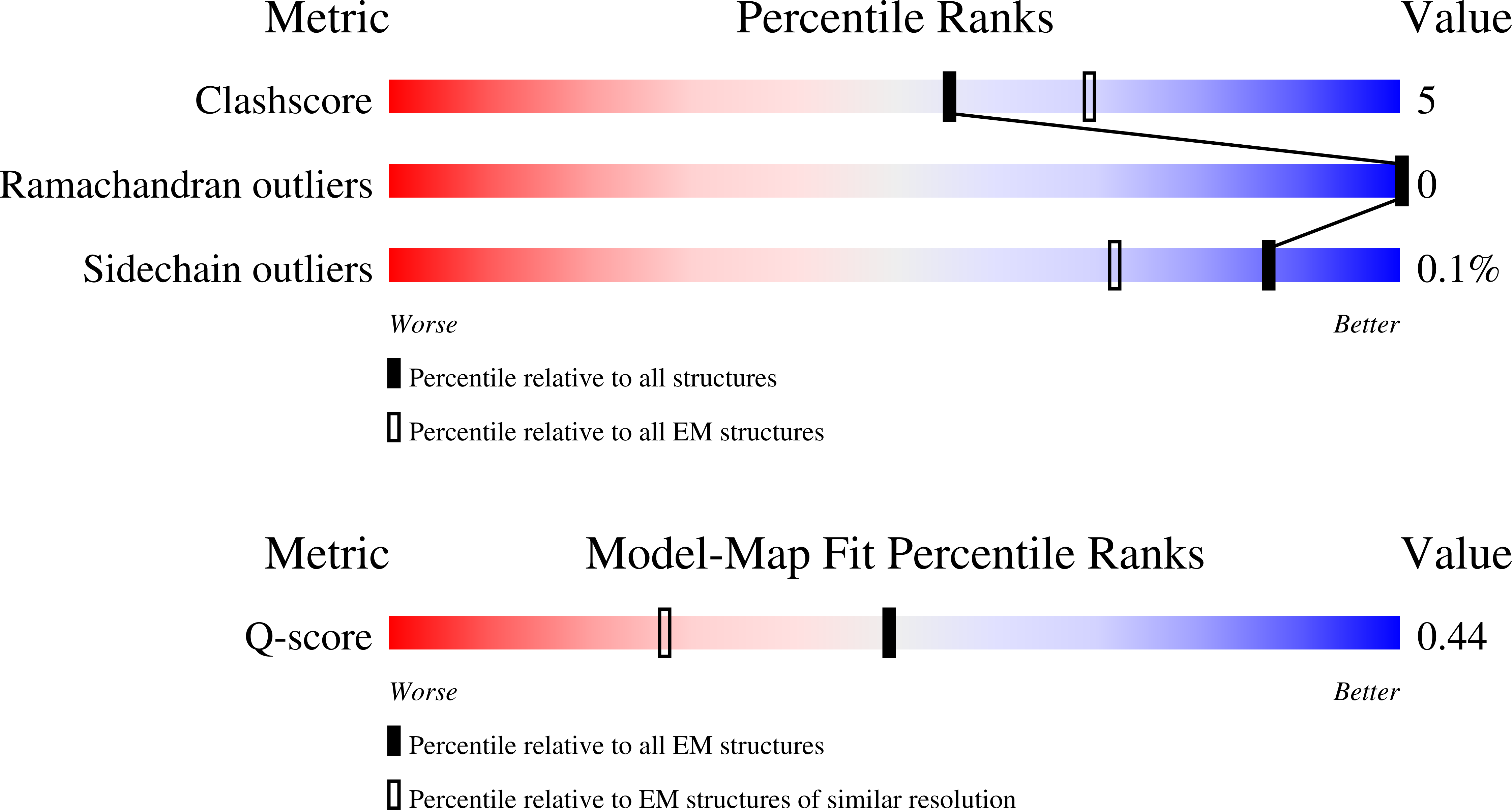
3.01 Å
Aggregation State:
PARTICLE
Reconstruction Method:
SINGLE PARTICLE
Macromolecular Entities
Polymer Type:polypeptide(L)
Molecule:Glycoprotein
Gene (Uniprot):G
Chain IDs:A, I (auth: B), J (auth: C)
Chain Length:468
Number of Molecules:3
Biological Source:Lyssavirus rabies
Polymer Type:polypeptide(L)
Molecule:Antibody RVA122 Light Chain
Chain IDs:B (auth: D), G (auth: F), H
Chain Length:217
Number of Molecules:3
Biological Source:Homo sapiens
Polymer Type:polypeptide(L)
Molecule:Antibody RVA122 Heavy Chain
Chain IDs:D (auth: E), E (auth: I), F (auth: G)
Chain Length:265
Number of Molecules:3
Biological Source:Homo sapiens
Polymer Type:polypeptide(L)
Molecule:Antibody A2 Light Chain
Chain IDs:C (auth: J)
Chain Length:213
Number of Molecules:1
Biological Source:Mus musculus
Polymer Type:polypeptide(L)
Molecule:Antibody A2 Heavy Chain
Chain IDs:K
Chain Length:262
Number of Molecules:1
Biological Source:Mus musculus
Ligand Molecules
Primary Citation
Antigenic landscape of rabies and related lyssaviruses revealed by cryo-EM.
Cell Rep 45 117993 117993 (2026)
PMID: 42758589 DOI: 10.1016/j.celrep.2026.117993

Abstact

Rabies continues to kill over 60,000 people per year despite life-saving vaccines and post-exposure treatments and costs billions of dollars in prevention and treatment. Preventing rabies deaths and reducing the global economic burden of the virus will require both developing a monoclonal antibody cocktail to replace human serum in treatment and improving rabies vaccines to elicit long-lasting protection. Here, we solve nine cryo-electron microscopy (cryo-EM) structures of neutralizing monoclonal antibodies (mAbs) in complex with the rabies virus glycoprotein (RABV-G). The nine structures span three known antigenic sites plus two additional antigenic sites, not among the five classically identified sites. We find that these antigenic sites, V and VI, are broadly cross-reactive across lyssaviruses, whereas immunodominant sites II/IV and III are rabies specific. Across the mAb panel, fusion inhibition and binding affinity correlate best with neutralization. Together, these results provide a roadmap for structure-guided vaccine and therapeutic antibody design for rabies and related lyssaviruses.

Legend

Protein

Chemical

Disease

Primary Citation of related structures
Feedback Form
Name
Email
Institute
Feedback