

11HU image
Deposition Date 2026-02-25
Release Date 2026-06-03
Last Version Date 2026-07-01
Entry Detail
PDB ID:
11HU
Title:
Engineered IscB and wRNA bound to Target ssDNA
Biological Source:
Source Organism(s):
Method Details:
Experimental Method:
Resolution:
2.90 Å
Aggregation State:
PARTICLE
Reconstruction Method:
SINGLE PARTICLE
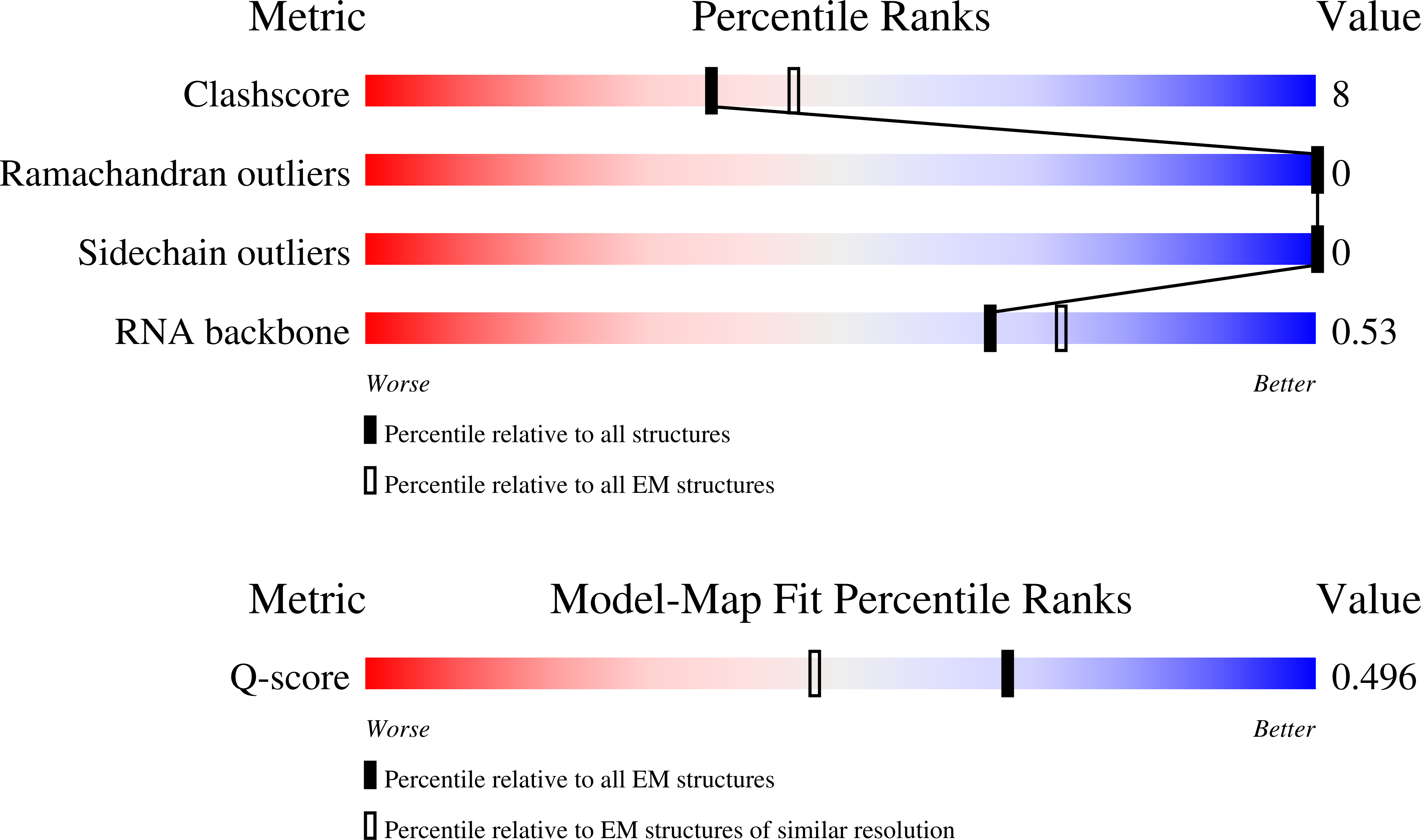
Macromolecular Entities
Structural Superimposition Protein Blast
Polymer Type:polypeptide(L)
Molecule:IscB
Chain IDs:A
Chain Length:495
Number of Molecules:1
Biological Source:synthetic construct
Polymer Type:polyribonucleotide
Molecule:RNA (233-MER)
Chain IDs:C (auth: B)
Chain Length:233
Number of Molecules:1
Biological Source:synthetic construct
Polymer Type:polydeoxyribonucleotide
Molecule:Target ssDNA
Chain IDs:B (auth: D)
Chain Length:28
Number of Molecules:1
Biological Source:synthetic construct
Primary Citation
Structure basis for single-strand nucleic acid targeting by IscB and variants.
Nucleic Acids Res. 54 ? ? (2026)
PMID: 42328786 DOI: 10.1093/nar/gkag607

Abstact

Transposon-encoded IscB was defined as the evolutionary ancestor of CRISPR-Cas9. This compact RNA-guided endonuclease has since been engineered for genome-editing applications. We previously repurposed IscB and related Cas9s as efficient RNA editors by removing their double-stranded DNA (dsDNA) recognition module, the target-adjacent motif (TAM)/protospacer adjacent motif-interacting domain. Here, we report four cryo-electron microscopy structures of IscB, with or without TAM-interaction domain (TID), in complex with single-stranded nucleic acid (ssNA) targets. Structures reveal that, regardless of TID presence, IscB engages ssNA using the same mechanism. IscB initially facilitates formation of a 10-nt seed duplex with ssNA; further base-pairing is blocked by an alternatively positioned HNH nuclease that acts as a roadblock. In this intermediate state, neither HNH nor RuvC is competent for target cleavage. Only upon full duplex formation is the HNH roadblock dislodged by the duplex extension between guide RNA and ssNA. HNH and RuvC nuclease active sites become exposed as the result. A similar set of conformational rearrangements likely governs IscB activity during dsDNA target interrogation. Guided by the structural and mechanistic insights, we introduced mutations to either improve ssNA binding or ease HNH dislodging. Both approaches improved the RNA-targeting efficiency of IscB in vitro and in human cells.

Legend

Protein

Chemical

Disease

Primary Citation of related structures
Feedback Form
Name
Email
Institute
Feedback