

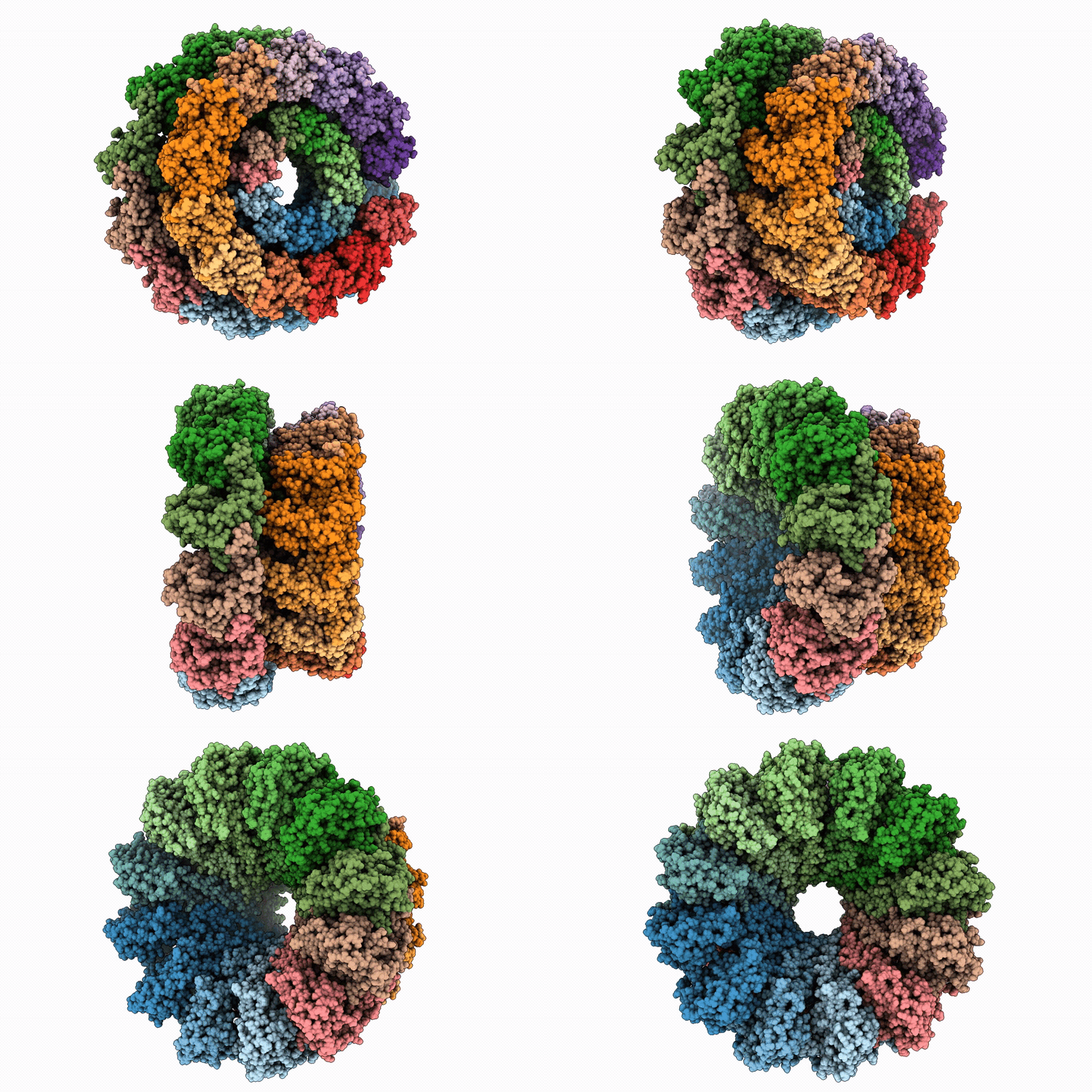
11CQ image
Deposition Date 2026-02-17
Release Date 2026-05-20
Last Version Date 2026-06-03
Entry Detail
PDB ID:
11CQ
Keywords:
Title:
KpSwz in complex with bacteriophage Bas14 Portal
Biological Source:
Source Organism(s):
Expression System(s):
Method Details:
Experimental Method:
Resolution:
2.53 Å
Aggregation State:
PARTICLE
Reconstruction Method:
SINGLE PARTICLE
Macromolecular Entities
Polymer Type:polypeptide(L)
Molecule:Portal protein
Gene (Uniprot):bas14_0003
Chain IDs:A, B, C, D, E, F, G, H, I, J, K, L
Chain Length:514
Number of Molecules:12
Biological Source:Escherichia phage TheodorHerzl
Structural Superimposition Protein Blast
Polymer Type:polypeptide(L)
Molecule:KpSwz
Chain IDs:M (auth: a), N (auth: b), O (auth: c), P (auth: d), Q (auth: e), R (auth: f), S (auth: g), T (auth: h), U (auth: i), V (auth: j), W (auth: k), X (auth: l), Y (auth: m)
Chain Length:514
Number of Molecules:13
Biological Source:Klebsiella pneumoniae
Ligand Molecules
Primary Citation
TIR-like NADases act in bacterial immunity and the RNA vault.
Biorxiv ? ? ? (2026)
PMID: 42146377 DOI: 10.64898/2026.05.01.722283

Abstact

Across all domains of life, organisms exploit NAD(+) metabolism as a central line of defense against invading pathogens. Here, we show that domain of unknown function 4062 (DUF4062) is a widespread family of TIR-like NADases that hydrolyze NAD(+) to ADP-ribose and nicotinamide. In bacteria, DUF4062 homologs form a previously unrecognized antiphage defense system, which we name Swarozyc, that assembles with the phage portal into a supramolecular NADase complex to induce abortive infection. In eukaryotes, DUF4062 is found in TEP1, which we demonstrate functions as an active NADase within the RNA vault, an enigmatic organelle-like structure. Single-particle cryo-electron microscopy reveals ADP-ribose bound within the shoulder of both reconstituted and human brain vaults, while cryo-electron tomography positions TEP1 along the central axis at the shoulder. Thus, TEP1, like bacterial Swarozyc, functions by depleting NAD(+), providing new insight into the long-standing mystery of vault function.

Legend

Protein

Chemical

Disease

Primary Citation of related structures
Feedback Form
Name
Email
Institute
Feedback