

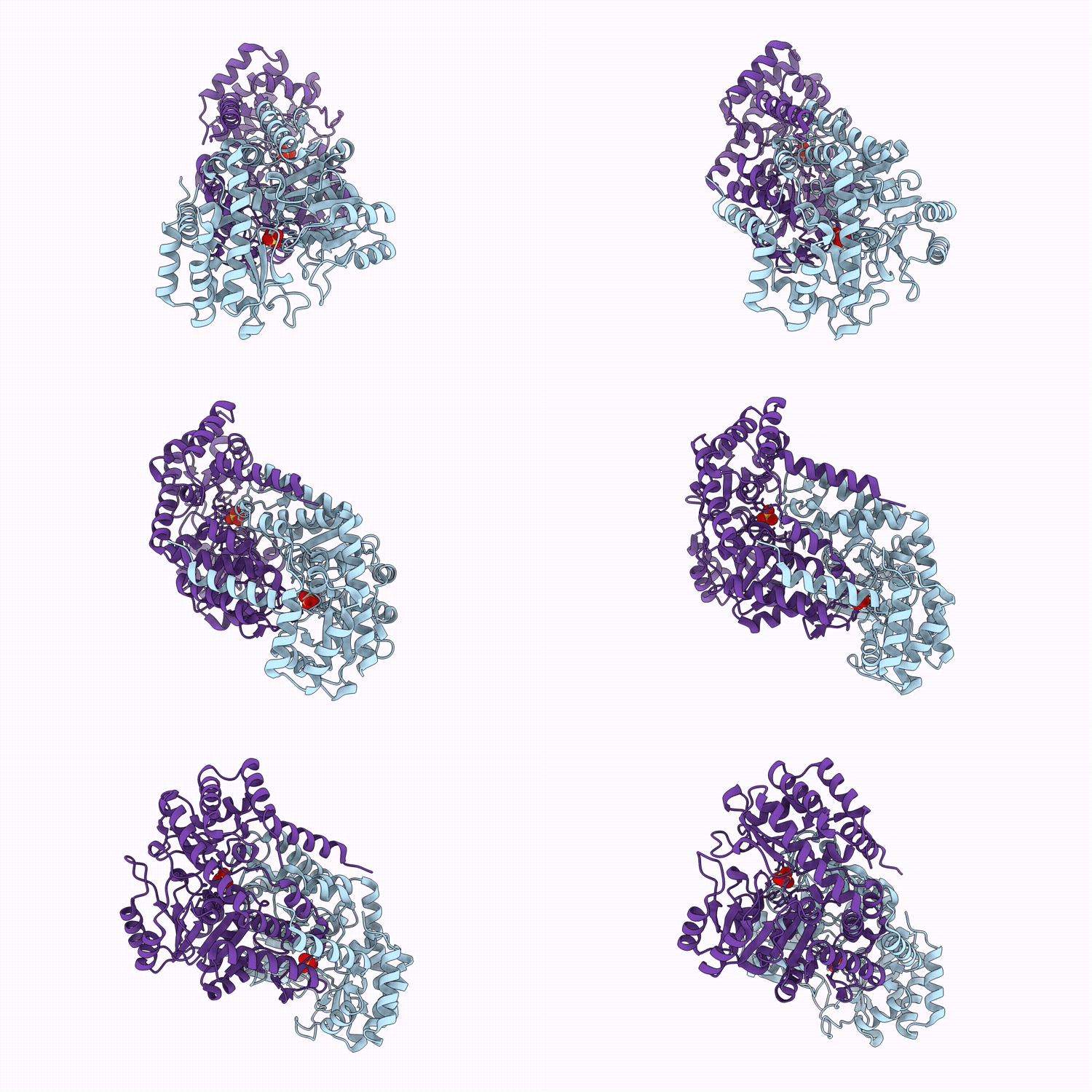
10YN image
Deposition Date 2026-02-12
Release Date 2026-05-20
Last Version Date 2026-06-10
Entry Detail
PDB ID:
10YN
Keywords:
Title:
Joint X-ray/neutron structure of E53Q mutant of Thermus thermophilus serine hydroxymethyltransferase (TthSHMT)
Biological Source:
Source Organism(s):
Expression System(s):
Method Details:
R-Value Free:
['0.26
R-Value Work:
['0.23
R-Value Observed:
['?', '?'].00
Space Group:
P 1 21 1

Macromolecular Entities
Structures with similar UniProt ID
Protein Blast
Polymer Type:polypeptide(L)
Molecule:Serine hydroxymethyltransfera
Gene (Uniprot):glyA
Mutagens:E53Q
Chain IDs:A, B
Chain Length:405
Number of Molecules:2
Biological Source:Thermus thermophilus
Modified Residue
Compound ID Chain ID Parent Comp ID Details 2D Image
LLP A LYS modified residue
Primary Citation
Mutation of active site glutamate in serine hydroxymethyltransferase allows trapping a reactive intermediate: a combined neutron and X-ray crystallography study.
Rsc Adv 16 22600 22609 (2026)
PMID: 42112277 DOI: 10.1039/d6ra01814a

Abstact

Serine hydroxymethyltransferase (SHMT) is a pyridoxal-5'-phosphate (PLP) dependent enzyme that catalyzes a chemical transformation essential for the one-carbon (1C) metabolism. SHMT reversibly converts l-Ser into Gly and transfers a 1C unit to tetrahydrofolate (THF) to give 5,10-methylene-THF (5,10-MTHF). 5,10-MTHF, a 1C-unit donor, plays a crucial role in the downstream biomolecular syntheses required for the cell homeostasis and proliferation. SHMT is a prominent target for the drug discovery to battle bacterial and parasitic infections, and to treat various types of cancer. SHMT-catalyzed chemistry is governed by the general acid-base catalysis. Knowledge of the catalytic mechanism can aid drug design but can only be achieved when the atomic details of each reaction step are mapped, including accurate determination of hydrogen atom positions. Here we utilized the inactive E53Q mutant of Thermus thermophilus (Tth) SHMT to directly determine protonation states with room-temperature neutron crystallography and to capture a reactive intermediate containing the PLP-l-Ser external aldimine and THF in the enzyme active site. We observed protonation of the Schiff base nitrogen (N(SB)) in the PLP internal aldimine but no change in the protonation states of other ionizable PLP groups and active site residues compared to wild-type TthSHMT. X-ray structural analysis of the ternary intermediate complex E53Q-Ser-THF that eluded previous structural characterization shows the strategic positioning of the E53Q side chain in close proximity to the external aldimine and THF and reinforces the proposed role for E53 as the driver of proton transfer events along the reaction pathway.

Legend

Protein

Chemical

Disease

Primary Citation of related structures
Feedback Form
Name
Email
Institute
Feedback