

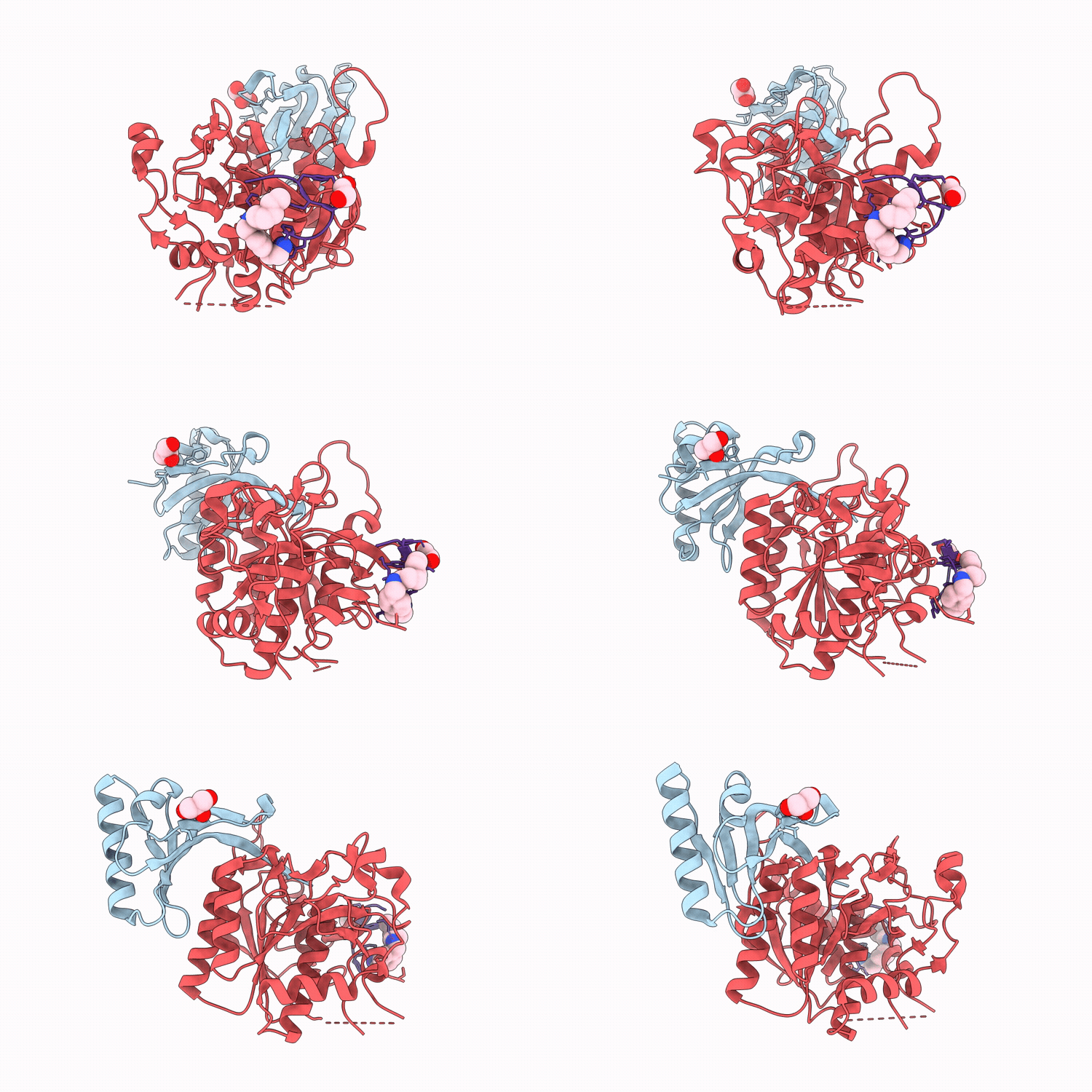
10SB image
Deposition Date 2026-02-04
Release Date 2026-06-03
Last Version Date 2026-06-03
Entry Detail
PDB ID:
10SB
Keywords:
Title:
PCSK9 in complex with cyclic peptide 21
Biological Source:
Source Organism(s):
Expression System(s):
Method Details:
Experimental Method:
Resolution:
1.83 Å
R-Value Free:
0.23
R-Value Work:
0.19
R-Value Observed:
0.19
Space Group:
P 32 2 1

Macromolecular Entities
Structures with similar UniProt ID
Protein Blast
Polymer Type:polypeptide(L)
Molecule:Propeptide of Proprotein conv
Gene (Uniprot):PCSK9
Chain IDs:A
Chain Length:122
Number of Molecules:1
Biological Source:Homo sapiens
Structures with similar UniProt ID
Protein Blast
Polymer Type:polypeptide(L)
Molecule:Proprotein convertase subtili
Gene (Uniprot):PCSK9
Chain IDs:B
Chain Length:308
Number of Molecules:1
Biological Source:Homo sapiens
Protein Blast
Polymer Type:polypeptide(L)
Molecule:Cyclic peptide 21
Chain IDs:C (auth: D)
Chain Length:9
Number of Molecules:1
Biological Source:synthetic construct
Primary Citation

Abstact

Herein, we report the discovery process of enlicitide (MK-0616, compound 18), an orally active macrocyclic peptide therapeutic against PCSK9 for LDL-C reduction. To overcome development bottlenecks in a prior lead (compound 1a) in a timely manner (sulfur oxidation liability, low solubility, azido potential manufacturing hazard, and alkene isomeric complexity), we deployed a novel scalable solution-phase modular fragment assembly (North/East/South/West/tail), which allowed us to accelerate the design-make-test-analyze (DMTA) cycle and preclinical profiling. Design solutions were quickly validated through this approach (a northern lactam staple, an N-benzylamide southern spacer, an RCM-derived cross-link in conjunction with solvent-exposed motifs to modulate solubility) and delivered compounds with low picomolar potency, improved solubility, stability, and PK from which enlicitide (MK-0616, compound 18) was selected for clinical progression. This modular strategy may act as a template to accelerate late-stage issue-driven SAR in highly engineered macrocyclic peptides.

Legend

Protein

Chemical

Disease

Primary Citation of related structures
Feedback Form
Name
Email
Institute
Feedback