

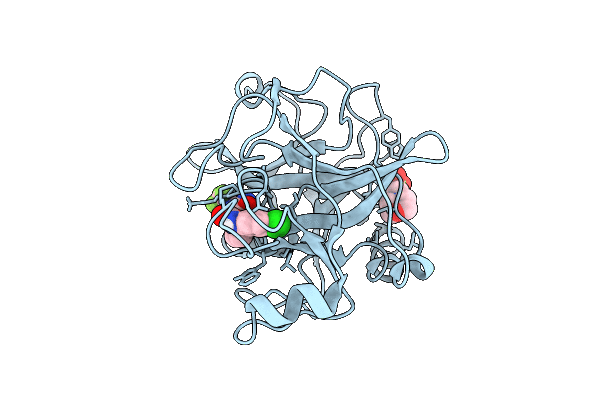
10QS image
Deposition Date 2026-02-02
Release Date 2026-03-11
Last Version Date 2026-04-01
Entry Detail
PDB ID:
10QS
Title:
N-Alkyl & N-Aryl Aminopyrazole Spirocarbamates: A Two-Pronged Lead Optimization Strategy to Identify Orally Bioavailable Plasma Kallikrein Inhibitors Compound 13 ((3'R)-1'-{5-amino-1-[(2S)-1,1,1-trifluorobutan-2-yl]-1H-pyrazole-4-carbonyl}-6-chloro-5-fluorospiro[[3,1]benzoxazine-4,3'-piperidin]-2(1H)-one)
Biological Source:
Source Organism(s):
Homo sapiens (Taxon ID: 9606)
Expression System(s):
Method Details:
Experimental Method:
Resolution:
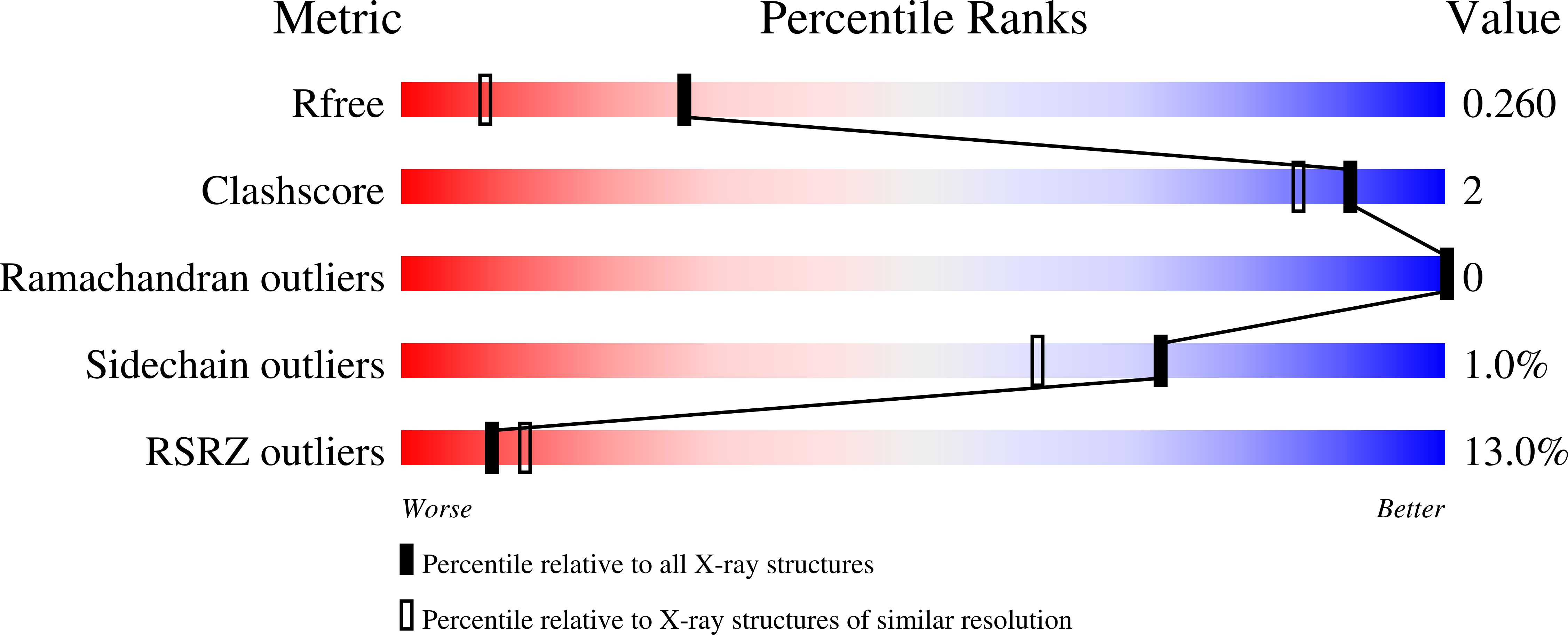
1.73 Å
R-Value Free:
0.25
R-Value Work:
0.21
R-Value Observed:
0.21
Space Group:
P 21 21 2
Macromolecular Entities
Structures with similar UniProt ID
Protein Blast
Polymer Type:polypeptide(L)
Molecule:Plasma kallikrein
Gene (Uniprot):KLKB1
Mutagens:C383S. C503S
Chain IDs:A
Chain Length:275
Number of Molecules:1
Biological Source:Homo sapiens
Primary Citation
N ‐Alkyl and N ‐Aryl Aminopyrazole Spirocarbamates: A Two-Pronged Lead Optimization Strategy to Identify Orally Bioavailable Plasma Kallikrein Inhibitors.
Acs Med.Chem.Lett. 17 744 749 (2026)
PMID: 41847638 DOI: 10.1021/acsmedchemlett.6c00066

Abstact

Plasma kallikrein (pKal) is a trypsin-like serine protease involved in the kallikrein-kinin, renin-angiotensin, and complement pathways, making it an attractive target for diseases, such as hereditary angioedema, diabetic mellitus complications, and cerebrovascular disorders. As part of an internal program to develop orally bioavailable small-molecule pKal inhibitors, we report lead optimization efforts within the spirocarbamate scaffold, highlighting a structure-based drug design strategy to engineer hydrogen bond interactions with N-benzyl aminopyrazoles. Additionally, mitigation of time-dependent inhibition (TDI) liability and optimization of the overall profile were achieved through a two-pronged strategy: (1) incorporating increased Fsp(3) modifications via N-alkylation and (2) leveraging torsional strain in N-aryl analogs.

Legend

Protein

Chemical

Disease

Primary Citation of related structures
Feedback Form
Name
Email
Institute
Feedback