

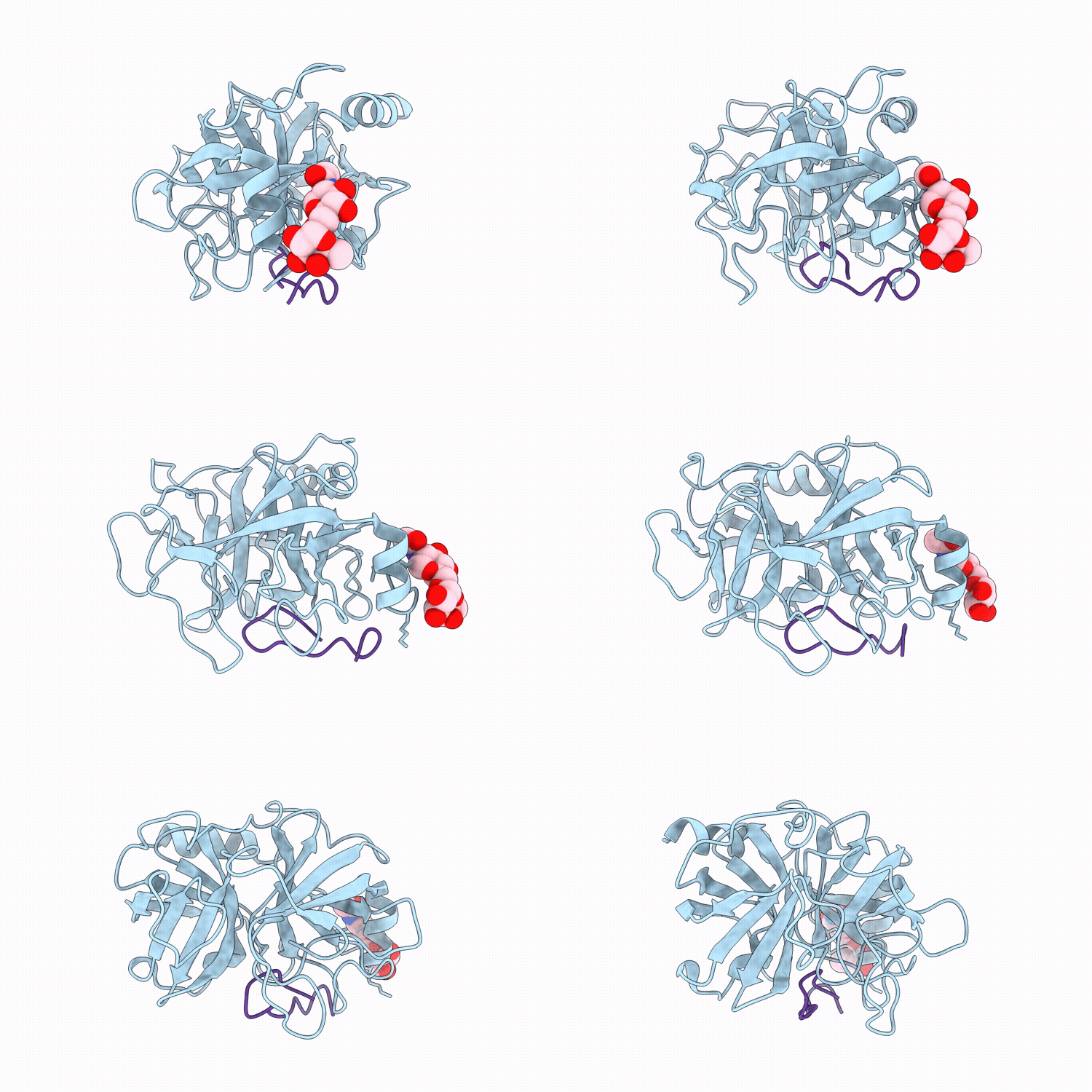
10KV image
Deposition Date 2026-01-25
Release Date 2026-07-08
Last Version Date 2026-07-15
Entry Detail
PDB ID:
10KV
Keywords:
Title:
Structure of hNSP4 bound to MCP4 at 2.75 A resolution
Biological Source:
Source Organism(s):
Expression System(s):
Method Details:
Experimental Method:
Resolution:
2.75 Å
R-Value Free:
0.27
R-Value Work:
0.24
R-Value Observed:
0.25
Space Group:
P 41 21 2
Macromolecular Entities
Polymer Type:polypeptide(L)
Molecule:Serine protease 57
Gene (Uniprot):PRSS57
Chain IDs:A (auth: B)
Chain Length:250
Number of Molecules:1
Biological Source:Homo sapiens
Polymer Type:polypeptide(L)
Molecule:MCP4
Chain IDs:B (auth: E)
Chain Length:16
Number of Molecules:1
Biological Source:synthetic construct
Primary Citation
Novel Macrocyclic Peptides as Potent and Selective Inhibitors of Human Neutrophil Serine Protease 4.
J.Mol.Biol. 438 169894 169894 (2026)
PMID: 42264133 DOI: 10.1016/j.jmb.2026.169894

Abstact

Neutrophil serine protease 4 (NSP4) is the most ancient member of the NSP family, which includes neutrophil elastase, proteinase 3 and cathepsin G, but is unique in its strong preference for cleavage after an arginine residue. NSP4 is highly expressed in myeloid precursor cells and regulates the levels of vasoactive histamine during mast cell maturation. Neutrophils store active NSP4 in azurophilic granules, but its function in neutrophil biology remains unknown. To advance the understanding of NSP4's biological role, we aimed to generate potent and selective inhibitors by using large mRNA-displayed libraries each encoding up to 10(13) unique macrocyclic peptides (MCPs) containing both natural and non-natural amino acids. Library screening yielded six MCPs, which strongly inhibited the activity of recombinant and endogenous cell-derived NSP4, but did not inhibit 13 structurally related proteases. In agreement with biochemical studies with activity-based probes, crystal structures of the two most potent inhibitors MCP-3 and MCP-4 (K(D) = 6.5 nM and 1.0 nM, respectively) revealed that these MCPs bind to the NSP4 active site region. Remarkably, the two MCPs resembled the plant-derived sunflower trypsin inhibitor-1 in respect to ring conformation, substrate-like interaction with the active site and resistance to hydrolysis. Therefore, these de novo generated MCPs recapitulated the standard mechanism used by natural serine protease inhibitors. This study highlights the power of mRNA display technology to generate potent and highly selective protease inhibitors, such as the macrocyclic NSP4 inhibitors identified in this work, which serve as valuable tools to study the biological functions of this elusive protease.

Legend

Protein

Chemical

Disease

Primary Citation of related structures
Feedback Form
Name
Email
Institute
Feedback