

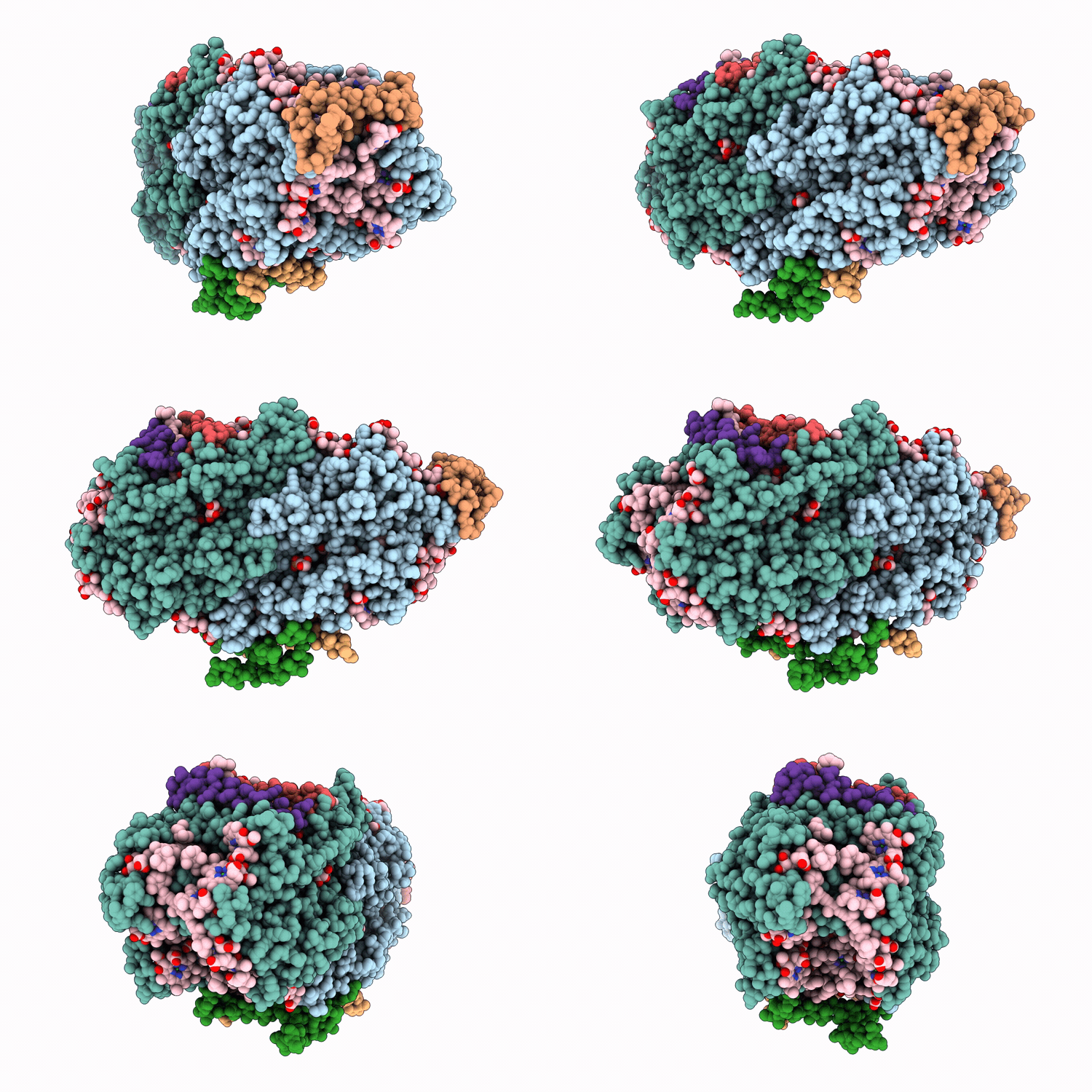
10KF image
Deposition Date 2026-01-23
Release Date 2026-09-02
Last Version Date 2026-09-02
Entry Detail
PDB ID:
10KF
Keywords:
Title:
Cryo-EM structure of a chemically treated Cyanobacterial Photosystem I core with bound platinum nanoparticles
Biological Source:
Source Organism(s):
Method Details:
Experimental Method:
Resolution:
3.57 Å
Aggregation State:
PARTICLE
Reconstruction Method:
SINGLE PARTICLE

Macromolecular Entities
Polymer Type:polypeptide(L)
Molecule:Photosystem I P700 chlorophyl
Chain IDs:A
Chain Length:763
Number of Molecules:1
Biological Source:Synechococcus elongatus PCC 6301
Polymer Type:polypeptide(L)
Molecule:Photosystem I P700 chlorophyl
Chain IDs:B
Chain Length:734
Number of Molecules:1
Biological Source:Synechococcus elongatus PCC 6301
Polymer Type:polypeptide(L)
Molecule:Photosystem I reaction center
Chain IDs:C (auth: F)
Chain Length:159
Number of Molecules:1
Biological Source:Synechococcus elongatus PCC 6301
Polymer Type:polypeptide(L)
Molecule:Photosystem I reaction center
Chain IDs:D (auth: I)
Chain Length:38
Number of Molecules:1
Biological Source:Synechococcus elongatus PCC 6301
Polymer Type:polypeptide(L)
Molecule:Photosystem I reaction center
Chain IDs:E (auth: J)
Chain Length:44
Number of Molecules:1
Biological Source:Synechococcus elongatus PCC 6301
Polymer Type:polypeptide(L)
Molecule:Photosystem I reaction center
Chain IDs:F (auth: K)
Chain Length:80
Number of Molecules:1
Biological Source:Synechococcus elongatus PCC 6301
Polymer Type:polypeptide(L)
Molecule:Photosystem I reaction center
Chain IDs:G (auth: M)
Chain Length:29
Number of Molecules:1
Biological Source:Synechococcus elongatus PCC 6301
Primary Citation
Molecular design principles for Photosystem I-based biohybrid solar fuel catalysts.
Biorxiv ? ? ? (2026)
PMID: 41929101 DOI: 10.64898/2026.03.23.713776

Abstact

Direct solar-to-chemical conversion offers a compelling route to clean, dispatchable energy. Photosystem I (PSI), an evolutionarily optimized light-driven oxidoreductase central to oxygenic photosynthesis, can be repurposed for direct solar-fuel production by efficiently coupling its photochemistry to catalysts, thereby storing sunlight as chemical energy in the H-H bond of H2. One promising architecture integrates PSI with Pt nanoparticle (PtNP) catalysts to create photocatalytic PSI-PtNP biohybrids. Advancing these systems requires molecular-level insight into protein-nanoparticle interactions and the bio-nano electron transfer pathways that govern activity; however, progress has been constrained by limited structural data to guide rational design. Here, we present two molecular structures of active PSI-PtNP assemblies that (a) compare thermophilic and mesophilic PSI scaffolds and (b) probe how removal of the terminal [4Fe-4S] clusters and stromal subunits in PSI reshapes protein-nanoparticle interfaces and photocatalysis. Structural analyses and molecular dynamics simulations define the interface topology, electrostatics, and cofactor-to-nanoparticle distances, revealing key molecular features that control biohybrid formation and electron transfer efficiency. These data establish mechanistic links between scaffold composition, bio-nano interface geometry, and catalytic performance, yielding design principles for optimizing PSI-PtNP architectures. The resulting structure-function insights provide a blueprint for engineering PSI-based solar-fuels systems and, more broadly, inform the design of protein-nanomaterial interfaces for light-driven catalysis.

Legend

Protein

Chemical

Disease

Primary Citation of related structures
Feedback Form
Name
Email
Institute
Feedback