

10IK image
Deposition Date 2026-01-21
Release Date 2026-03-11
Last Version Date 2026-03-11
Entry Detail
PDB ID:
10IK
Keywords:
Title:
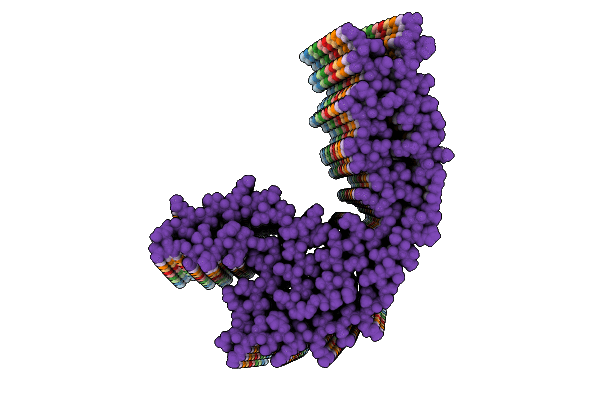
S305I Frontotemporal Lobar Degeneration (FTLD) type II tau filament
Biological Source:
Source Organism(s):
Homo sapiens (Taxon ID: 9606)
Expression System(s):
Method Details:
Experimental Method:
Resolution:
3.20 Å
Aggregation State:
TISSUE
Reconstruction Method:
HELICAL
Macromolecular Entities
Structures with similar UniProt ID
Protein Blast
Polymer Type:polypeptide(L)
Molecule:Microtubule-associated protei
Gene (Uniprot):MAPT
Mutagens:S305I
Chain IDs:A, B, C, D, E, F, G, H, I, J
Chain Length:107
Number of Molecules:10
Biological Source:Homo sapiens
Ligand Molecules
Primary Citation
Distinct tau filament folds in familial frontotemporal dementia due to the MAPT S305I mutation.
Biorxiv ? ? ? (2026)
PMID: 41726928 DOI: 10.64898/2026.02.12.705620

Abstact

Frontotemporal lobar degeneration with tau inclusions (FTLD-tau) comprise a class of fatal heterogeneous neurodegenerative diseases. Approximately 10% arise from pathogenic MAPT mutations and often cause severe, early-onset disease with pathology that is distinct yet partially overlapping with sporadic cases. Here, we evaluated post-mortem tissue from a patient with FTLD-tau due to MAPT S305I showing neuropathology most consistent with argyrophilic grain disease (AGD), a prevalent limbic tauopathy of aging. Structures determined by cryo-electron microscopy reveal tau filament folds that differ from those found in sporadic AGD or other tauopathies and feature a 4-layer architecture stabilized by the Ile substitution within its core. Comparative structural analysis reveals conserved motifs are shared among AGD, corticobasal degeneration, and MAPT P301T. A well-defined density stacks along a cationic cleft, indicative of a bound RNA-like polyanion or small-molecule. In vitro analysis shows the S305I mutation promotes fibrilization relative to normal tau. These results demonstrate that MAPT S305I stabilizes a distinct aggregation-prone tau fold that likely contributes to disease pathology and heterogeneity beyond its known splicing defects, and underscore potential limitations of using the most pathologically similar genetic form as a model for sporadic FTLD-tau.

Legend

Protein

Chemical

Disease

Primary Citation of related structures
Feedback Form
Name
Email
Institute
Feedback