

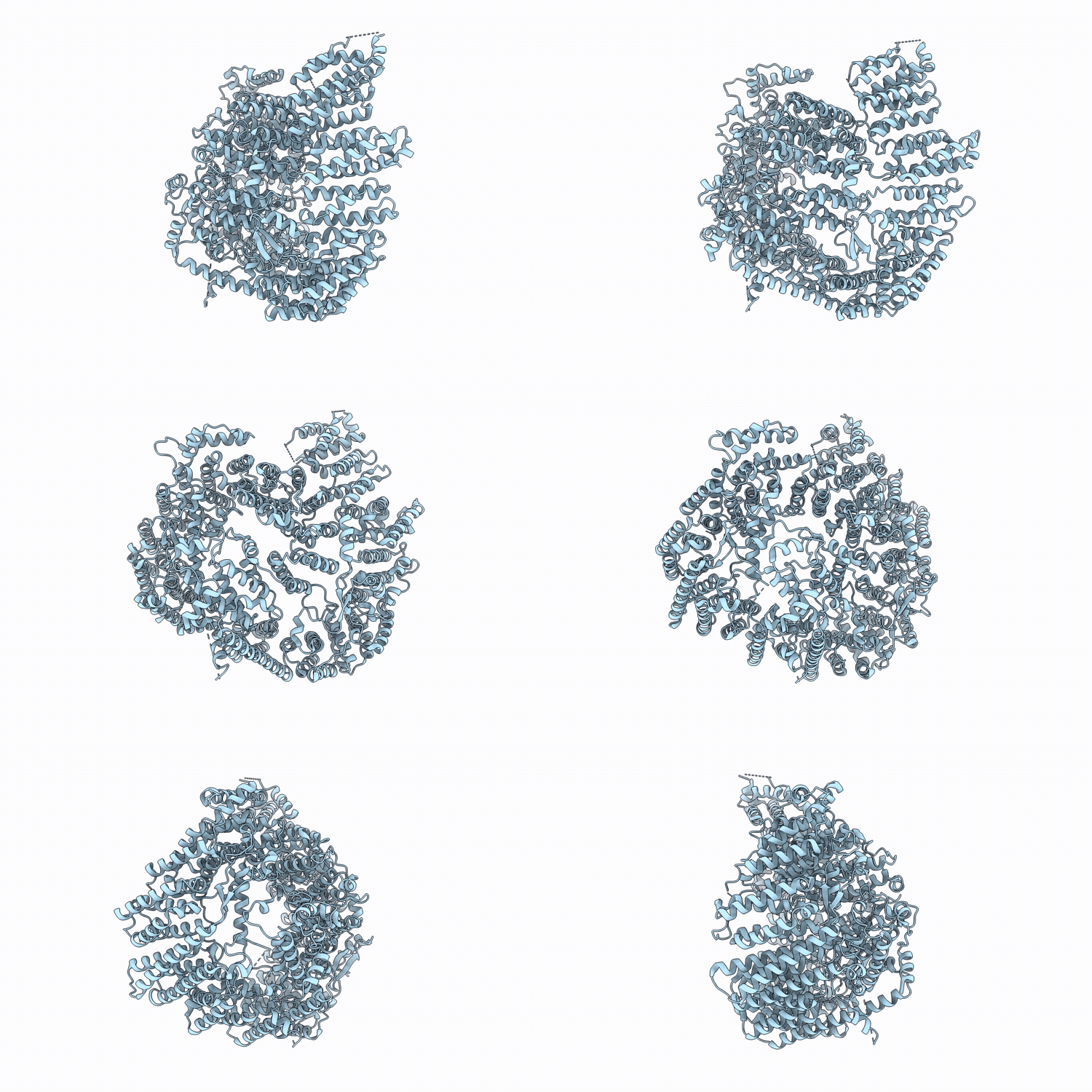
10GX image
Deposition Date 2026-01-19
Release Date 2026-07-22
Last Version Date 2026-08-05
Entry Detail
PDB ID:
10GX
Keywords:
Title:
Yeast Blm10 apo Structure
Biological Source:
Source Organism(s):
Method Details:
Experimental Method:
Resolution:
3.20 Å
Aggregation State:
PARTICLE
Reconstruction Method:
SINGLE PARTICLE
Macromolecular Entities
Polymer Type:polypeptide(L)
Molecule:Proteasome activator BLM10
Gene (Uniprot):BLM10
Chain IDs:A
Chain Length:2167
Number of Molecules:1
Biological Source:Saccharomyces cerevisiae
Ligand Molecules
Primary Citation
Blm10 and PI31 comprise a failsafe mechanism for proteasome inhibition.
Proc.Natl.Acad.Sci.USA 123 e2611708123 e2611708123 (2026)
PMID: 42485378 DOI: 10.1073/pnas.2611708123

Abstact

Blm10 (PA200 in mammals) is an evolutionarily conserved regulator of the proteasome's core particle (CP), a barrel-shaped complex that houses six individual protease subunits. Despite decades of study, Blm10's function has remained unresolved. Here, we provide structural, biochemical, and genetic evidence that yeast Blm10 inhibits the proteasome and that it does so in cooperation with a second proteasome inhibitor, PI31 (also known as Fub1). Both proteins are highly enriched in CPs with abnormal subunit composition, suggesting that Blm10 and PI31 may function to neutralize aberrant proteasomes. We report an unexpected proteasome configuration in which Blm10's dome-like structure completely encases PI31's N-terminal domain, which sits outside and atop the CP, while PI31's C-terminal domain is present inside the CP, simultaneously inhibiting all six active sites. These Blm10/PI31-bound CP are strongly deficient in degradation of both proteins and small peptides, and loss of both proteins results in strongly synergistic genetic phenotypes in vivo. These data suggest that Blm10 and PI31 constitute a partially redundant failsafe system for proteasome inhibition.

Legend

Protein

Chemical

Disease

Primary Citation of related structures
Feedback Form
Name
Email
Institute
Feedback