

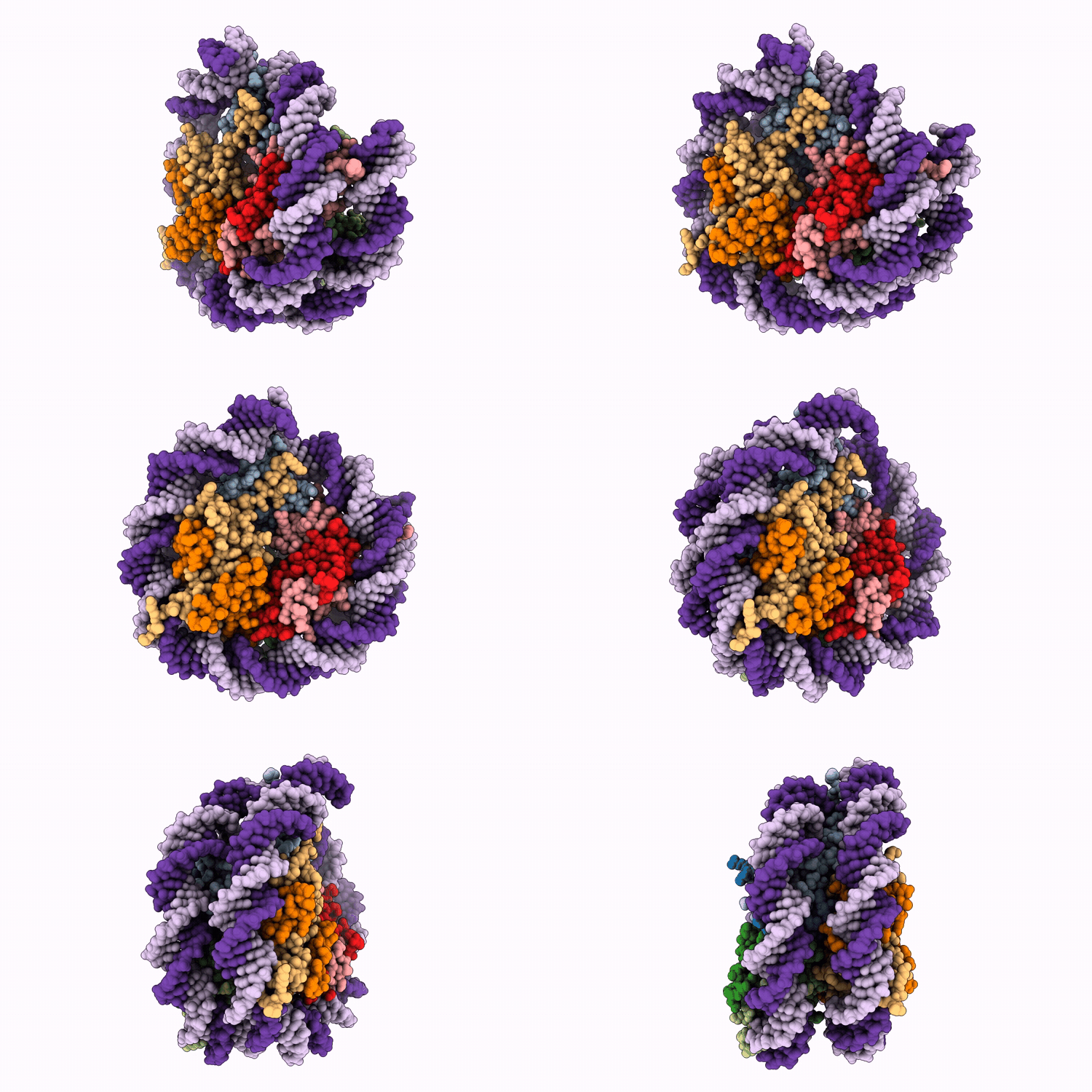
10GN image
Deposition Date 2026-01-19
Release Date 2026-07-22
Last Version Date 2026-08-12
Entry Detail
PDB ID:
10GN
Title:
Nucleosome containing an 8oxoG at SHL+3
Biological Source:
Source Organism(s):
Expression System(s):
Method Details:
Experimental Method:
Resolution:
3.00 Å
Aggregation State:
PARTICLE
Reconstruction Method:
SINGLE PARTICLE
Macromolecular Entities
Polymer Type:polypeptide(L)
Molecule:Histone H3.2
Gene (Uniprot):H3C15, H3C14, H3C13
Chain IDs:A, E
Chain Length:0
Number of Molecules:2
Biological Source:Homo sapiens
Polymer Type:polypeptide(L)
Molecule:Histone H4
Gene (Uniprot):H4C1, H4C2, H4C3, H4C4, H4C5, H4C6, H4C8, H4C9, H4C11, H4C12, H4C13, H4C14, H4C15, H4C16
Chain IDs:B, F
Chain Length:0
Number of Molecules:2
Biological Source:Homo sapiens
Polymer Type:polypeptide(L)
Molecule:Histone H2A type 1
Gene (Uniprot):H2AC11, H2AC13, H2AC15, H2AC16, H2AC17
Chain IDs:C, G
Chain Length:0
Number of Molecules:2
Biological Source:Homo sapiens
Polymer Type:polypeptide(L)
Molecule:Histone H2B type 1-C/E/F/G/I
Gene (Uniprot):H2BC4, H2BC6, H2BC7, H2BC8, H2BC10
Chain IDs:D, H
Chain Length:0
Number of Molecules:2
Biological Source:Homo sapiens
Polymer Type:polydeoxyribonucleotide
Molecule:601 I strand
Chain IDs:I
Chain Length:0
Number of Molecules:1
Biological Source:synthetic construct
Polymer Type:polydeoxyribonucleotide
Molecule:601 J strand
Chain IDs:J
Chain Length:0
Number of Molecules:1
Biological Source:synthetic construct
Ligand Molecules
Primary Citation
8oxoG:A Is Structurally Accommodated in the Nucleosome Core Particle, Yet Inaccessible to MUTYH-Initiated DNA Repair.
Biomolecules 16 ? ? (2026)
PMID: 42509793 DOI: 10.3390/biom16070999

Abstact

Eukaryotic genomic DNA is packaged into chromatin as nucleosomes, where it remains susceptible to reactive oxygen species (ROS) that generate the mutagenic lesion 8-oxo-7,8-dihydroguanine (8oxoG). While 8-oxoguanine DNA glycosylase 1 (OGG1) can initiate repair of 8oxoG base paired with C within the nucleosome core particle (NCP) in a position- dependent manner, it is unknown whether MutY homolog (MUTYH), the DNA glycosylase that excises misincorporated A opposite 8oxoG, can initiate repair of 8oxoG:A base pairs within NCPs. To address this, we combined cryo-EM, molecular dynamics (MD) simulations, and biochemical assays. We determined that MUTYH activity on nucleosomal 8oxoG:A is strongly suppressed, with detectable excision limited to the entry/exit region. Cryo-EM structures at four superhelical locations reveal that 8oxoG adopts the syn conformation and Hoogsteen base pairs with A, as in non-nucleosomal DNA, indicating that lesion presentation is not altered by the histone octamer. MD simulations further reveal that 8oxoG:A base pair dynamics and local DNA backbone perturbations are similar in nucleosomal and non-nucleosomal DNA. Together, these data establish that the NCP sterically excludes MUTYH from 8oxoG:A base pairs, making them largely inaccessible to MUTYH processing. This work ultimately provides mechanistic insight for the elevated G to T transversion rate observed in histone-bound DNA following oxidative stress.

Legend

Protein

Chemical

Disease

Primary Citation of related structures
Feedback Form
Name
Email
Institute
Feedback