

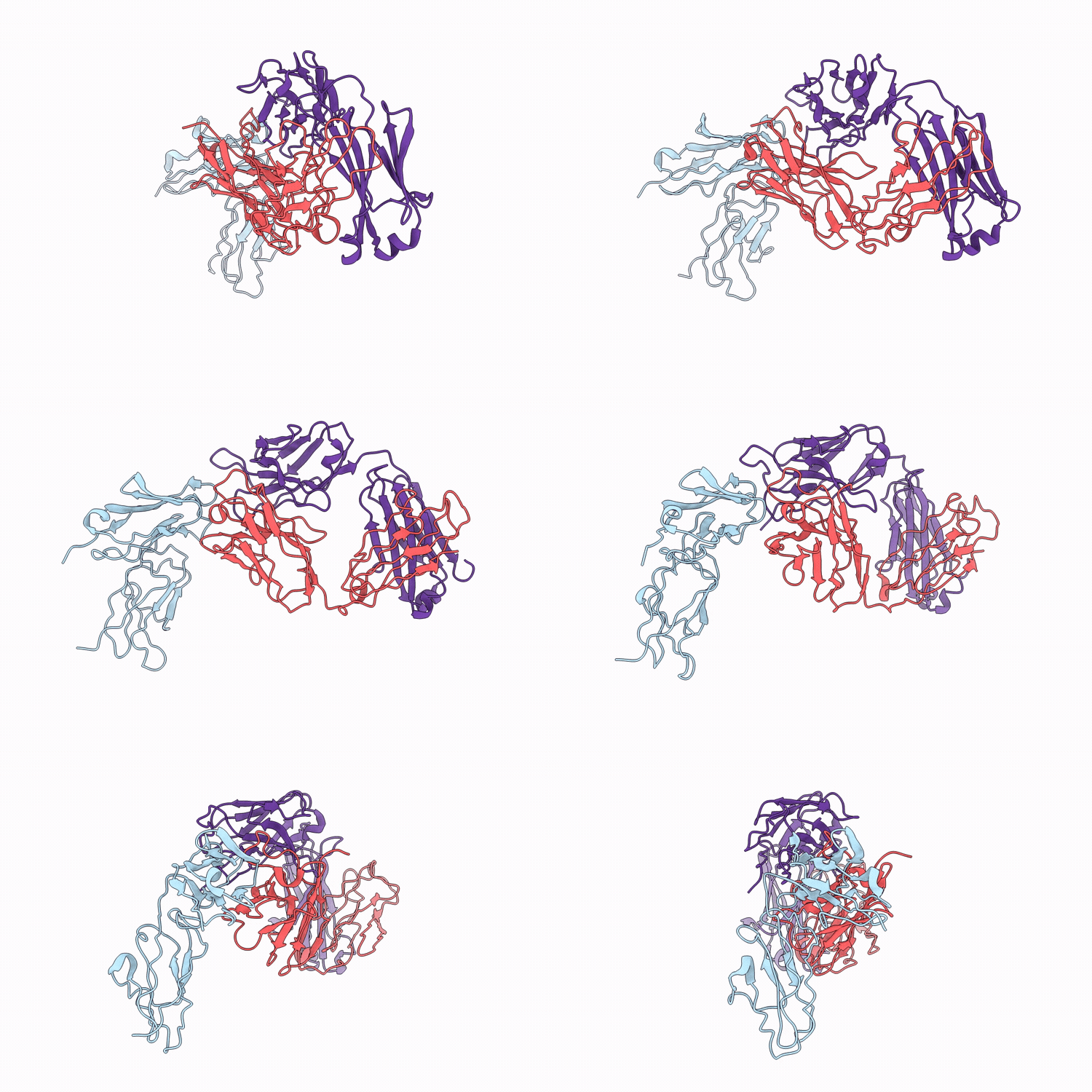
10FJ image
Deposition Date 2026-01-16
Release Date 2026-07-01
Last Version Date 2026-07-01
Entry Detail
PDB ID:
10FJ
Keywords:
Title:
FcgRIIa in complex with IV.3 Fab
Biological Source:
Source Organism(s):
Homo sapiens (Taxon ID: 9606)
Mus musculus (Taxon ID: 10090)
Expression System(s):
Method Details:
Experimental Method:
Resolution:
3.50 Å
Aggregation State:
PARTICLE
Reconstruction Method:
SINGLE PARTICLE
Macromolecular Entities
Structures with similar UniProt ID
Protein Blast
Polymer Type:polypeptide(L)
Molecule:Low affinity immunoglobulin g
Gene (Uniprot):FCGR2A
Chain IDs:A
Chain Length:185
Number of Molecules:1
Biological Source:Homo sapiens
Protein Blast
Polymer Type:polypeptide(L)
Molecule:IV.3 Fab heavy chain
Chain IDs:B (auth: H)
Chain Length:238
Number of Molecules:1
Biological Source:Mus musculus
Protein Blast
Polymer Type:polypeptide(L)
Molecule:IV.3 Fab light chain
Chain IDs:C (auth: L)
Chain Length:238
Number of Molecules:1
Biological Source:Mus musculus
Ligand Molecules
Primary Citation
Mechanistic Basis for the Selective Recognition of the Fc gamma Receptor IIa by Monoclonal Antibody IV.3.
Biorxiv ? ? ? (2026)
PMID: 41867816 DOI: 10.64898/2026.03.05.709909

Abstact

The monoclonal antibody IV.3 selectively binds the platelet Fcgamma receptor IIa (FcgammaRIIa), potently blocking immune complex engagement without cross-reacting with the closely-related FcgammaRIIb. This specificity has made IV.3 invaluable for dissecting FcgammaRIIa-mediated activation in diverse conditions, including infection, autoimmunity, thromboinflammation, and platelet-mediated thrombosis. We combined cryogenic electron microscopy, surface plasmon resonance, alchemical free energy calculations, and molecular dynamics simulations to elucidate IV.3's binding sites on FcgammaRIIa and the mechanistic basis of IV.3 specificity. We find that IV.3 engages a broader FcgammaRIIa epitope than previously recognized, extending beyond residues H/R134 and L135 (R and S in FcgammaRIIb). Simulations of FcgammaIIa-R134 variants bearing either L135 or S135 reveal that IV.3 specificity arises from hydrophobic stabilization mediated by L135 and disruption of an R134-specific interaction network in the presence of S135. These findings provide a mechanistic framework for rational design of FcgammaRIIa-targeted therapeutics.

Legend

Protein

Chemical

Disease

Primary Citation of related structures
Feedback Form
Name
Email
Institute
Feedback