

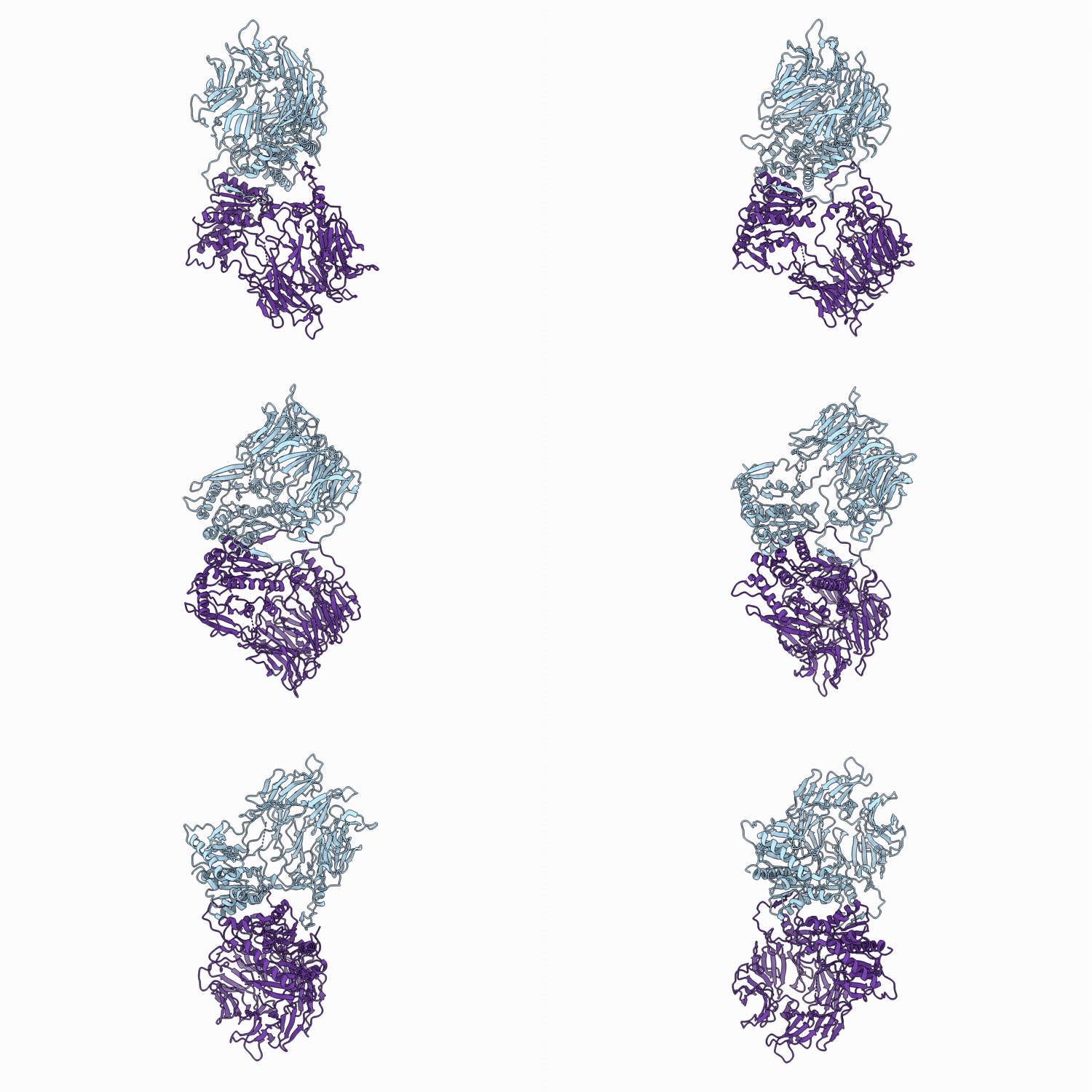
10ER image
Deposition Date 2026-01-15
Release Date 2026-05-27
Last Version Date 2026-05-27
Entry Detail
PDB ID:
10ER
Keywords:
Title:
Chloroplast Glutamyl Peptidase S781R in open-open conformation
Biological Source:
Source Organism(s):
Expression System(s):
Method Details:
Experimental Method:
Resolution:
3.20 Å
Aggregation State:
PARTICLE
Reconstruction Method:
SINGLE PARTICLE
Macromolecular Entities
Structures with similar UniProt ID
Protein Blast
Polymer Type:polypeptide(L)
Molecule:Isoform 2 of Probable glutamy
Gene (Uniprot):GEP
Mutagens:S781R
Chain IDs:A (auth: B), B (auth: A)
Chain Length:907
Number of Molecules:2
Biological Source:Arabidopsis thaliana
Ligand Molecules
Primary Citation
Structural basis for dimerization, catalytic regulation, and substrate selectivity of the chloroplast S9D CGEP protease in Arabidopsis thaliana.
Protein Sci. 35 e70624 e70624 (2026)
PMID: 42144868 DOI: 10.1002/pro.70624

Abstact

S9 proteases are widely distributed across the tree-of-life and play essential roles in protein processing. However, the structural and mechanistic basis for protease activity in the S9D subfamily, restricted to photosynthetic eukaryotes (e.g., plants), cyanobacteria, proteobacteria and flavobacteria, is unknown. Here, we report the first high-resolution cryo-EM structures of an S9D protease, chloroplast glutamyl endopeptidase (CGEP) from the model plant Arabidopsis thaliana. CGEP adopts a dimeric architecture stabilized by two distinct interfaces: hydrophobic interactions between catalytic domains and an interdomain beta-sheet linking the cap and catalytic domains. These interactions create a scaffold that supports a hinge loop, which acts as a steric gate to restrict substrate access and confine catalytic activity to the closed conformation. Unlike S9A-B-C proteases, CGEP maintains an intact catalytic triad in both open and closed states, relying on hinge-loop gating rather than catalytic disruption for regulation. Structural analysis and mutagenesis reveal that the hinge loop forms a conserved pocket favoring glutamate side chains, explaining CGEP's strong glutamate preference at cleavage sites. Together, these findings uncover a unique regulatory paradigm for S9D proteases and provide a structural framework for understanding substrate selectivity and dimerization.

Legend

Protein

Chemical

Disease

Primary Citation of related structures
Feedback Form
Name
Email
Institute
Feedback