

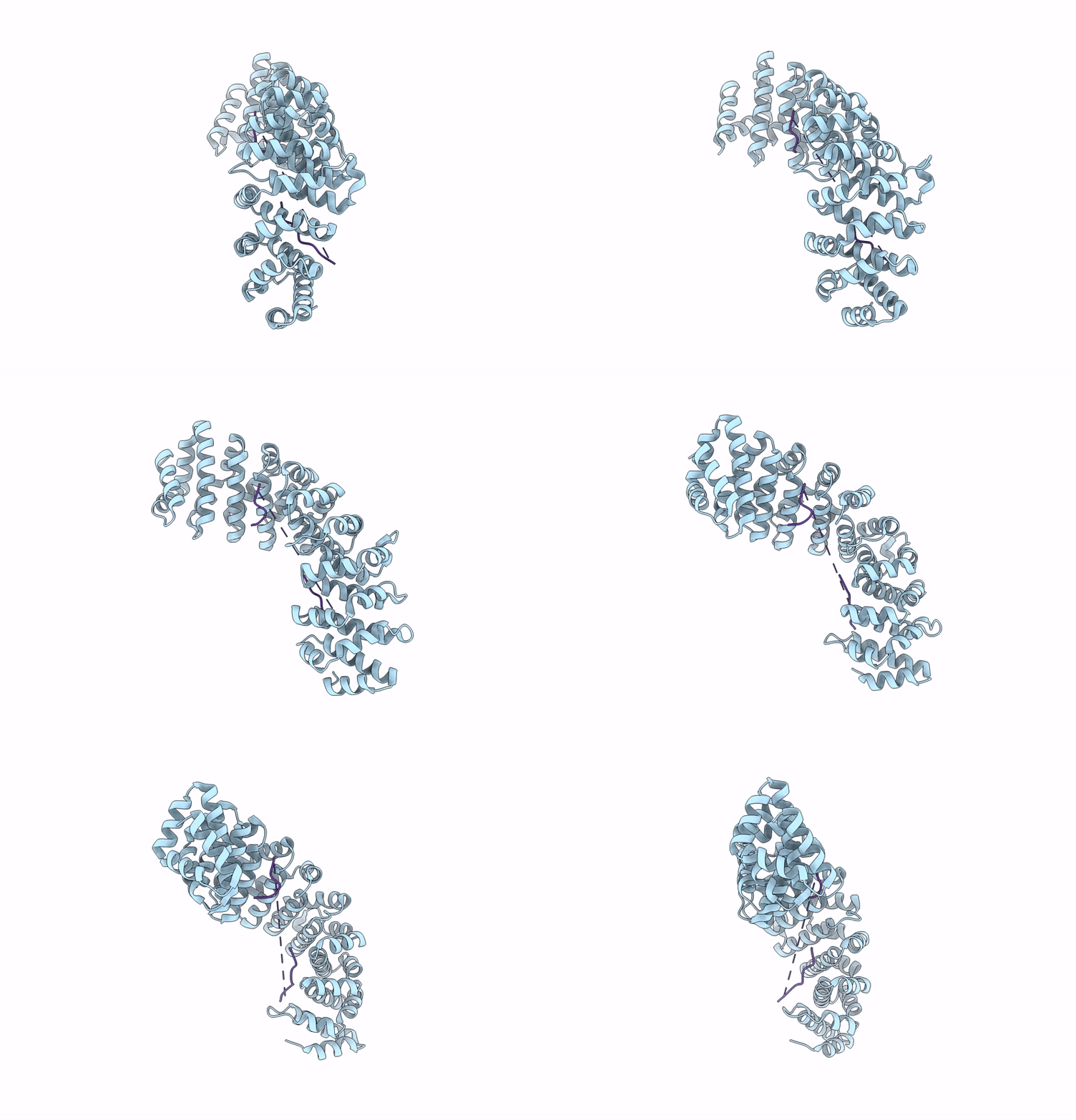
9Y0R image
Deposition Date 2025-08-29
Release Date 2025-09-17
Last Version Date 2026-04-08
Entry Detail
PDB ID:
9Y0R
Title:
Importin alpha 2 in complex with ATF2 basic region
Biological Source:
Source Organism(s):
Mus musculus (Taxon ID: 10090)
Homo sapiens (Taxon ID: 9606)
Expression System(s):
Method Details:
Experimental Method:
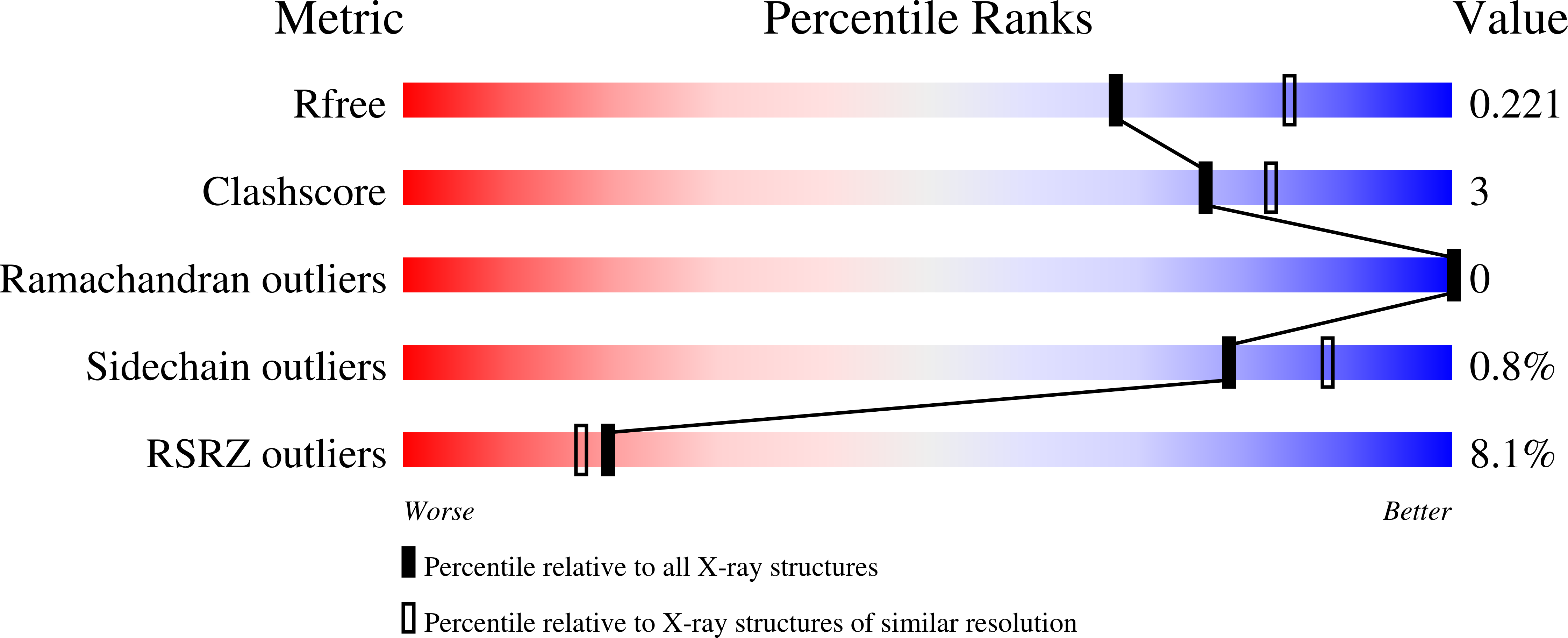
Resolution:
2.20 Å
R-Value Free:
0.22
R-Value Work:
0.19
R-Value Observed:
0.19
Space Group:
P 21 21 21
Macromolecular Entities
Structures with similar UniProt ID
Protein Blast
Polymer Type:polypeptide(L)
Molecule:Importin subunit alpha-1
Gene (Uniprot):Kpna2
Chain IDs:A
Chain Length:510
Number of Molecules:1
Biological Source:Mus musculus
Structures with similar UniProt ID
Protein Blast
Polymer Type:polypeptide(L)
Molecule:Cyclic AMP-dependent transcri
Gene (Uniprot):ATF2
Chain IDs:B
Chain Length:27
Number of Molecules:1
Biological Source:Homo sapiens
Primary Citation
Structural and functional characterisation of ATF2 nuclear import reveals paralogue-selective importin-alpha recognition and a non-canonical NLS formed in trans.
Life Sci Alliance 9 ? ? (2026)
PMID: 41672735 DOI: 10.26508/lsa.202503543

Abstact

Activating transcription factor 2 (ATF2) is a member of the AP-1 superfamily that regulates essential cellular processes through its activity as a nuclear transcription factor. Although ATF2 plays well-established roles in neurodevelopment, inflammation, and cancer, the mechanisms underlying its nuclear localisation remain poorly characterised. Here, we investigate the structural and functional basis of ATF2 nuclear import via the classical importin-alpha/beta1 (IMPalpha/beta1) pathway. Using quantitative in vitro binding assays, we demonstrate that ATF2 interacts with multiple IMPalpha paralogues. Fluorescence polarisation measurements reveal the highest binding affinity for IMPalpha1, with progressively weaker interactions observed for IMPalpha3, IMPalpha5, and IMPalpha7. Crystallographic analysis of ATF2 bound to IMPalpha1 identifies two basic clusters that are important for interaction: site 1 ((353)EKRRK(357)), which binds the major site of IMPalpha1, and site 2 ((372)KRK(374)), which binds the minor site. Mutation of key residues confirms the importance of both motifs, with site 1 contributing more substantially to binding. Quantitative confocal laser scanning microscopy analysis in HEK293A cells supports these findings, showing that mutation of both clusters is required to fully abolish ATF2 nuclear localisation. Inhibition of classical nuclear import using Bimax2 significantly reduces nuclear accumulation, whereas treatment with leptomycin B confirms a role of chromosomal region maintenance 1 (CRM1)-mediated nuclear export. Notably, ATF2 mutants incapable of nuclear import can localise to the nucleus when co-expressed with c-Jun, indicating that c-Jun can facilitate ATF2 nuclear import via heterodimerisation. Together, these results establish that ATF2 enters the nucleus through IMPalpha recognition of two basic clusters and highlight the redundancy and complexity of ATF2 nuclear trafficking mechanisms.

Legend

Protein

Chemical

Disease

Primary Citation of related structures
Feedback Form
Name
Email
Institute
Feedback