

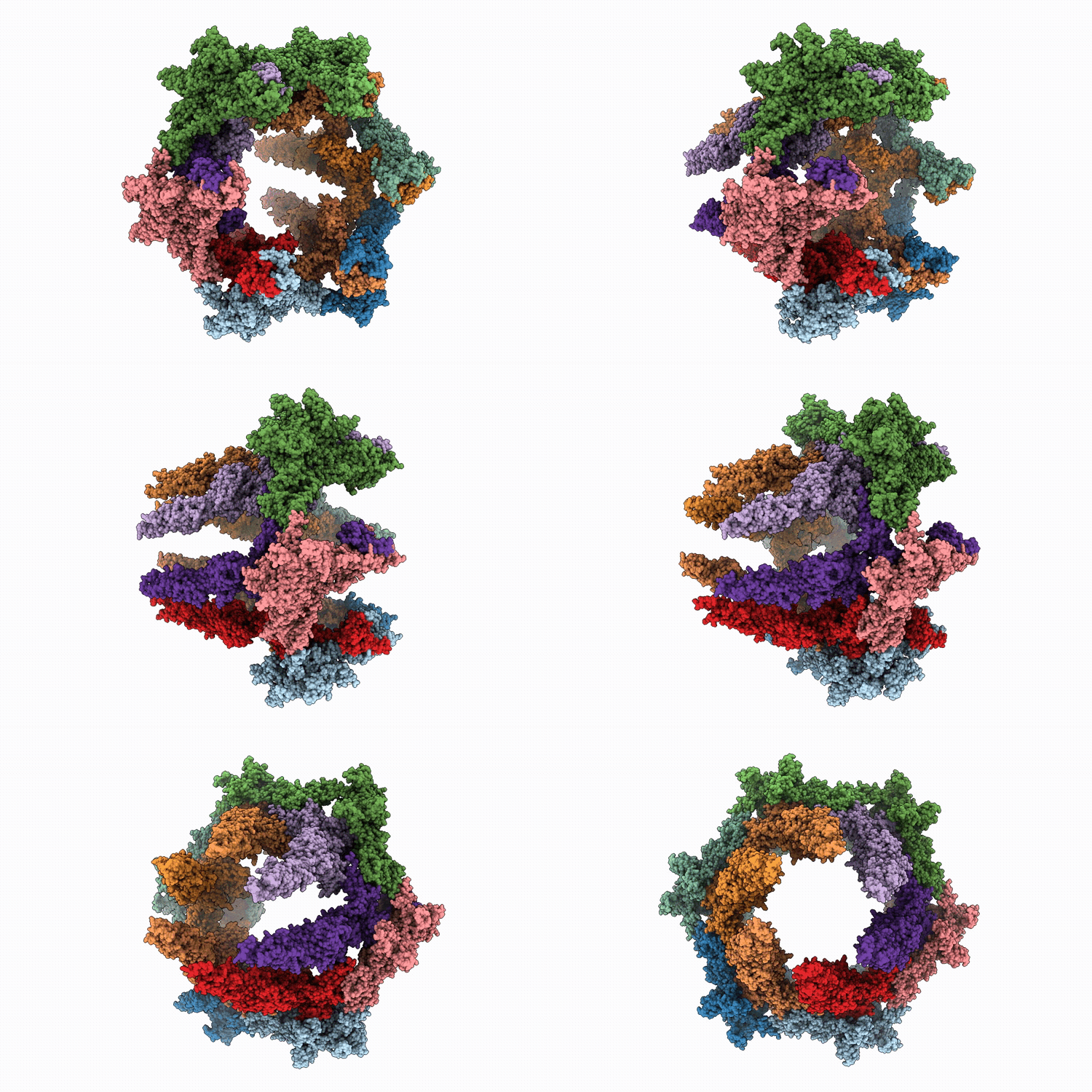
9WSZ image
Deposition Date 2025-09-15
Release Date 2026-05-06
Last Version Date 2026-05-06
Entry Detail
PDB ID:
9WSZ
Title:
CryoEM structure of baseplate iris structure in the contracted AlgoCIS
Biological Source:
Source Organism(s):
Method Details:
Experimental Method:
Resolution:
3.70 Å
Aggregation State:
PARTICLE
Reconstruction Method:
SINGLE PARTICLE
Macromolecular Entities
Structures with similar UniProt ID
Protein Blast
Polymer Type:polypeptide(L)
Molecule:Baseplate protein Alg12
Gene (Uniprot):ALPR1_12710
Chain IDs:A, C (auth: B), E (auth: C), G (auth: D), I (auth: E), K (auth: F)
Chain Length:922
Number of Molecules:6
Biological Source:Algoriphagus machipongonensis
Structures with similar UniProt ID
Protein Blast
Polymer Type:polypeptide(L)
Molecule:Baseplate protein J-like doma
Gene (Uniprot):ALPR1_12715
Chain IDs:B (auth: G), D (auth: H), F (auth: I), H (auth: J), J (auth: K), L
Chain Length:1050
Number of Molecules:6
Biological Source:Algoriphagus machipongonensis
Ligand Molecules
Primary Citation
Stepwise firing mechanism of an extracellular contractile injection system.
Nat Commun ? ? ? (2026)
PMID: 42031783 DOI: 10.1038/s41467-026-72240-y

Abstact

Contractile injection systems (CISs) mediate cell-cell interactions and are widespread among bacteria and archaea. These phage tail-like macromolecular machines puncture their target by a tube that is propelled by a contractile sheath. The mechanism underlying CIS firing, which starts with target binding and ends with sheath contraction, remains unclear. Here, we investigate the extracellular CIS from Algoriphagus machipongonensis (AlgoCIS) by a multimodal cryo-electron microscopy approach and structure-guided engineering, which allowed us to arrest AlgoCIS in multiple intermediate states of firing. Together with the post-firing structure, our data suggest a stepwise firing mechanism involving all structural modules: signal propagation starts with the binding of the tail-fibers, followed by opening of the cage, an expansion of the baseplate iris, and resulting in sheath contraction and the release of cap adaptor. Our study will serve as a framework for understanding the firing mechanism of diverse CISs and will facilitate the engineering of CISs for biomedical applications.

Legend

Protein

Chemical

Disease

Primary Citation of related structures
Feedback Form
Name
Email
Institute
Feedback