

9VM9 image
Deposition Date 2025-06-27
Release Date 2026-05-06
Last Version Date 2026-05-06
Entry Detail
PDB ID:
9VM9
Keywords:
Title:
Crystal structure of FGFR3 in complex with 10s
Biological Source:
Source Organism(s):
Homo sapiens (Taxon ID: 9606)
Expression System(s):
Method Details:
Experimental Method:
Resolution:
2.65 Å
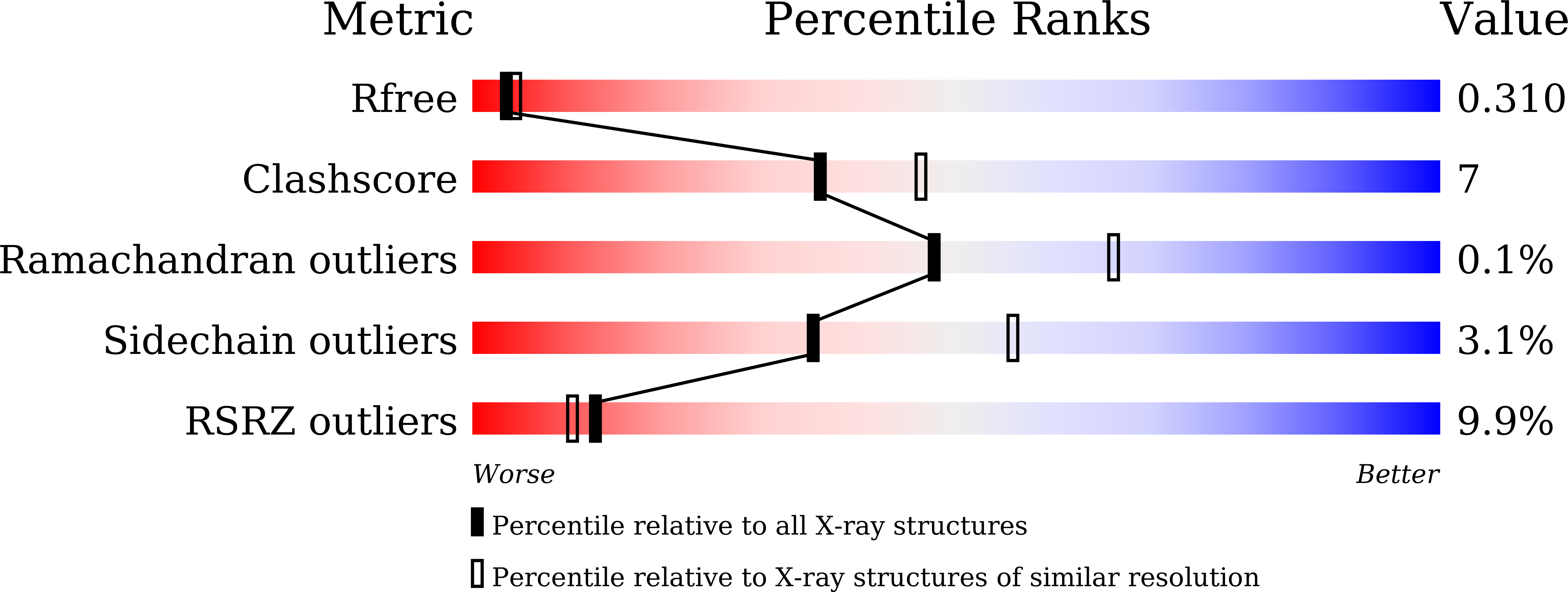
R-Value Free:
0.31
R-Value Work:
0.25
R-Value Observed:
0.26
Space Group:
P 1 21 1
Macromolecular Entities
Structures with similar UniProt ID
Protein Blast
Polymer Type:polypeptide(L)
Molecule:Fibroblast growth factor rece
Gene (Uniprot):FGFR3
Chain IDs:A, B, C, D
Chain Length:292
Number of Molecules:4
Biological Source:Homo sapiens
Primary Citation
Structure-Based Design of 4-(1-Methyl-1 H -indol-3-yl)pyrimidin-2-amine Derivatives as the First Covalent FGFR3 Selective Inhibitors.
J.Med.Chem. 69 5199 5218 (2026)
PMID: 41648938 DOI: 10.1021/acs.jmedchem.5c02552

Abstact

Aberrant fibroblast growth factor receptor 3 (FGFR3) activation drives bladder carcinogenesis in humans, but currently approved pan-FGFR inhibitors lack FGFR3 isoform selectivity and fail to counter clinically acquired resistance mutations (e.g., FGFR3 V555M/L). Herein, we report the structure-based drug design of 4-(1-methyl-1H-indol-3-yl)pyrimidin-2-amine derivatives as the first covalent FGFR3 selective inhibitors. The representative compound 10s displayed high potency against FGFR3 (IC(50) = 6.8 nM) and 5-60-fold selectivity over FGFR1/2/4. It was also effective against the common clinically acquired FGFR3(V555M) resistance mutation with an IC(50) value of 19.2 nM. Furthermore, 10s exhibited strong antiproliferative effects in FGFR3-driven RT112/84 cells (IC(50) = 9.2 nM). Structural characterization using MALDI-TOF-MS and X-ray crystallography confirmed covalent binding of 10s to FGFR3. Compound 10s also showed significant antitumor efficacy in the RT112/84 bladder cancer xenograft model, offering a promising compound to address both selectivity and resistance in FGFR3-targeted therapy.

Legend

Protein

Chemical

Disease

Primary Citation of related structures
Feedback Form
Name
Email
Institute
Feedback