

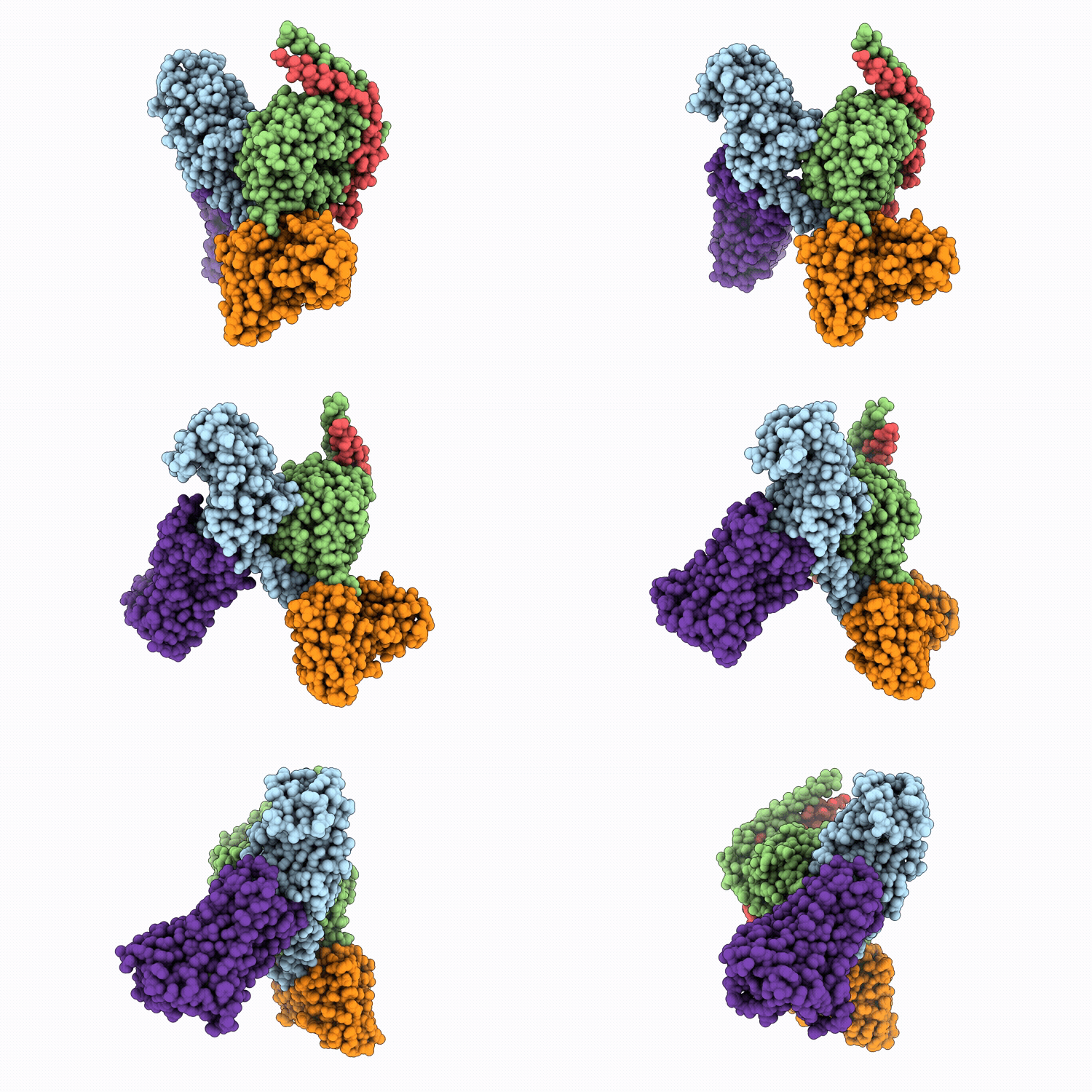
9V81 image
Deposition Date 2025-05-29
Release Date 2026-05-06
Last Version Date 2026-05-06
Entry Detail
PDB ID:
9V81
Title:
cryoEM structure of HEP-50768-bound MRGPRX4-Gq complex
Biological Source:
Source Organism(s):
Homo sapiens (Taxon ID: 9606)
Mus musculus (Taxon ID: 10090)
Escherichia coli (Taxon ID: 562)
Expression System(s):
Method Details:
Experimental Method:
Resolution:
2.63 Å
Aggregation State:
PARTICLE
Reconstruction Method:
SINGLE PARTICLE
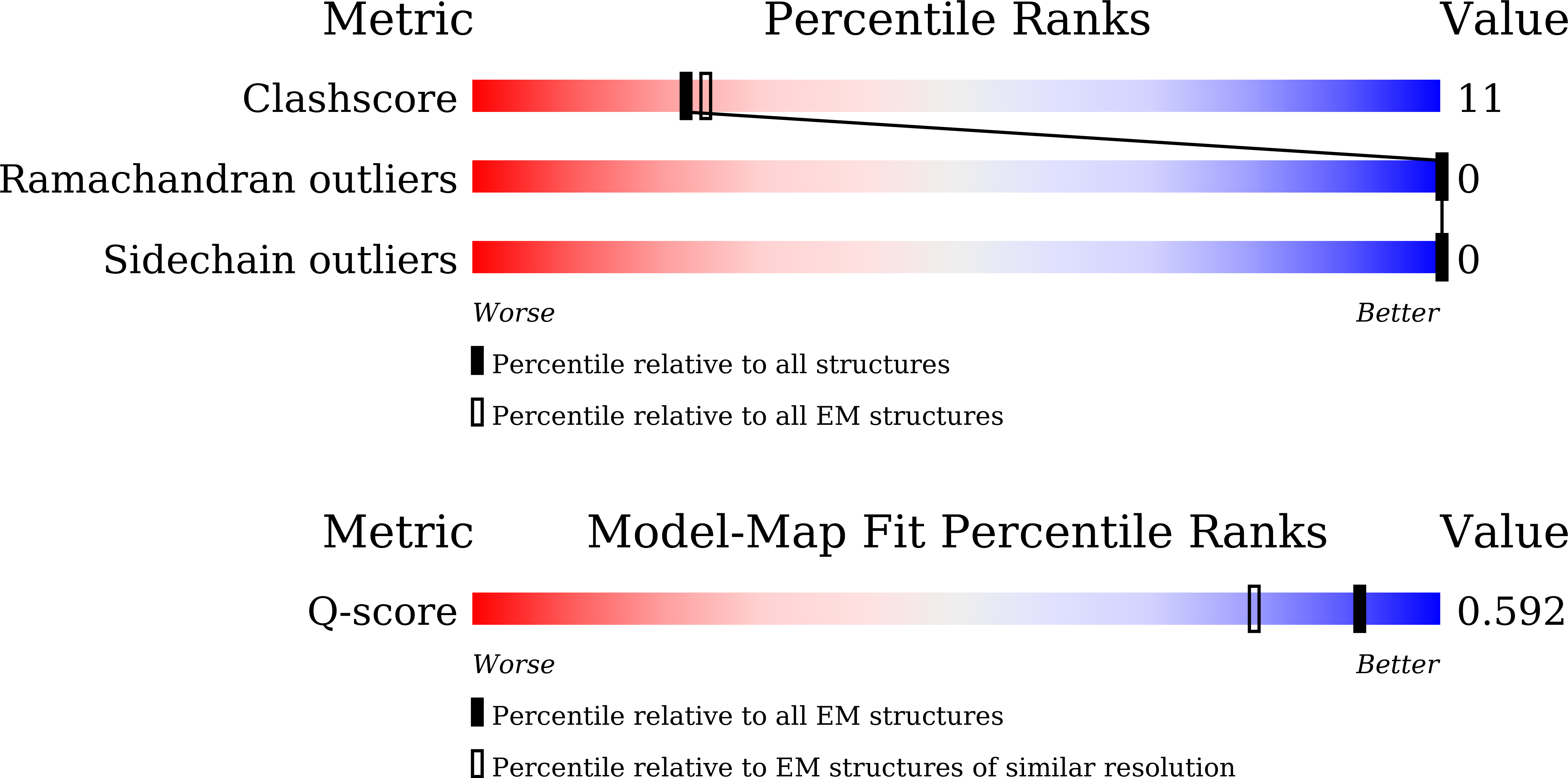
Macromolecular Entities
Structures with similar UniProt ID
Protein Blast
Polymer Type:polypeptide(L)
Molecule:Gs-mini-Gq chimera
Chain IDs:A (auth: B)
Chain Length:246
Number of Molecules:1
Biological Source:Homo sapiens
Structures with similar UniProt ID
Protein Blast
Polymer Type:polypeptide(L)
Molecule:Guanine nucleotide-binding pr
Gene (Uniprot):GNB1
Chain IDs:B (auth: C)
Chain Length:358
Number of Molecules:1
Biological Source:Homo sapiens
Structures with similar UniProt ID
Protein Blast
Polymer Type:polypeptide(L)
Molecule:Guanine nucleotide-binding pr
Gene (Uniprot):GNG2
Chain IDs:C (auth: D)
Chain Length:71
Number of Molecules:1
Biological Source:Homo sapiens
Structures with similar UniProt ID
Protein Blast
Polymer Type:polypeptide(L)
Molecule:scFv16
Chain IDs:D (auth: E)
Chain Length:267
Number of Molecules:1
Biological Source:Mus musculus
Protein Blast
Polymer Type:polypeptide(L)
Molecule:Soluble cytochrome b562,Mas-r
Gene (Uniprot):cybC, MRGPRX4
Chain IDs:E (auth: R)
Chain Length:472
Number of Molecules:1
Biological Source:Escherichia coli, Homo sapiens
Ligand Molecules
Primary Citation
Development of a clinically viable MRGPRX4 inverse agonist for cholestatic itch treatment.
Nat.Chem.Biol. ? ? ? (2026)
PMID: 41957282 DOI: 10.1038/s41589-026-02195-0

Abstact

Chronic itch, particularly in cholestatic and uremic conditions, poses a notable clinical burden, yet treatment options remain inadequate. MRGPRX4 (hX4), a bile-acid-sensing G-protein-coupled receptor predominantly expressed in human sensory neurons, has emerged as a critical mediator of cholestatic pruritus. Here we identified and characterized HEP-50768, a potent and selective small-molecule inverse agonist of hX4 through high-throughput screening and structure-activity optimization. Structural elucidation through cryo-electron microscopy of the hX4-inverse agonist complex structure revealed the unique binding mode and inhibitory mechanism of HEP-50768. In hX4-humanized rats, HEP-50768 robustly suppressed bile-acid-induced pruritic behaviors. Comprehensive preclinical absorption, distribution, metabolism, excretion and safety profiling was performed in both rats and monkeys, and these findings establish HEP-50768 as a promising therapeutic candidate for chronic itch, supporting its advancement to clinical evaluation.

Legend

Protein

Chemical

Disease

Primary Citation of related structures
Feedback Form
Name
Email
Institute
Feedback