

9UZ7 image
Deposition Date 2025-05-16
Release Date 2026-05-06
Last Version Date 2026-05-06
Entry Detail
PDB ID:
9UZ7
Title:
Cryo-EM structure of the nucleosome core particle with site-specific DNA-histone crosslinking
Biological Source:
Source Organism(s):
Expression System(s):
Method Details:
Experimental Method:
Resolution:
3.00 Å
Aggregation State:
PARTICLE
Reconstruction Method:
SINGLE PARTICLE
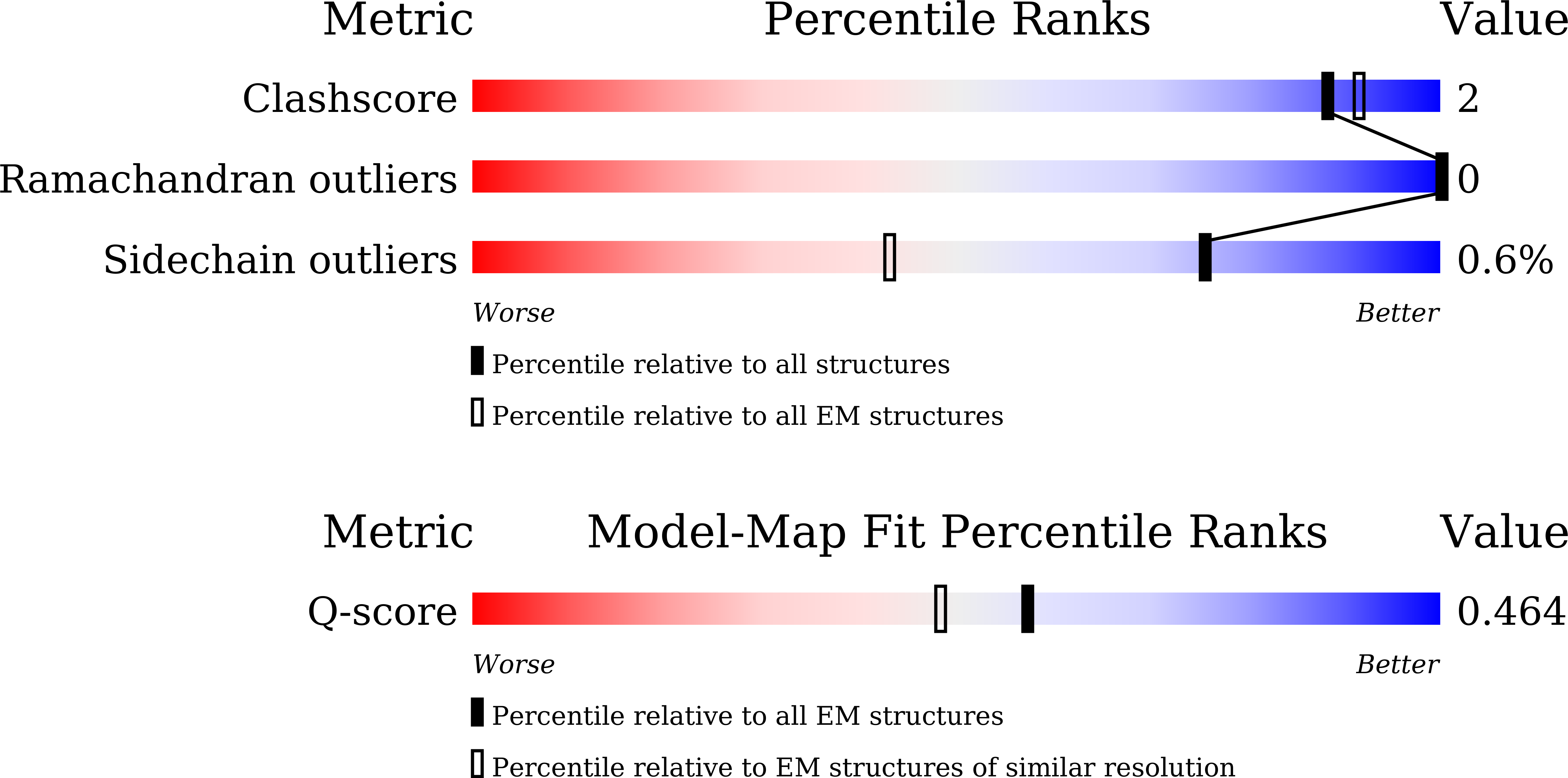
Macromolecular Entities
Structures with similar UniProt ID
Protein Blast
Polymer Type:polypeptide(L)
Molecule:Histone H3.1
Gene (Uniprot):H3C1, H3C2, H3C3, H3C4, H3C6, H3C7, H3C8, H3C10, H3C11, H3C12
Mutagens:C96S/C110S/K115C
Chain IDs:A
Chain Length:135
Number of Molecules:1
Biological Source:Homo sapiens
Structures with similar UniProt ID
Protein Blast
Polymer Type:polypeptide(L)
Molecule:Histone H3.1
Gene (Uniprot):H3C1, H3C2, H3C3, H3C4, H3C6, H3C7, H3C8, H3C10, H3C11, H3C12
Mutagens:C96S/C110S/K115C
Chain IDs:B
Chain Length:135
Number of Molecules:1
Biological Source:Homo sapiens
Structures with similar UniProt ID
Protein Blast
Polymer Type:polypeptide(L)
Molecule:Histone H4
Gene (Uniprot):H4C1, H4C2, H4C3, H4C4, H4C5, H4C6, H4C8, H4C9, H4C11, H4C12, H4C13, H4C14, H4C15, H4C16
Chain IDs:C, D
Chain Length:102
Number of Molecules:2
Biological Source:Homo sapiens
Structures with similar UniProt ID
Protein Blast
Polymer Type:polypeptide(L)
Molecule:Histone H2A type 1-B/E
Gene (Uniprot):H2AC4, H2AC8
Chain IDs:E, F
Chain Length:129
Number of Molecules:2
Biological Source:Homo sapiens
Structures with similar UniProt ID
Protein Blast
Polymer Type:polypeptide(L)
Molecule:Histone H2B type 1-J
Gene (Uniprot):H2BC11
Chain IDs:G, H
Chain Length:125
Number of Molecules:2
Biological Source:Homo sapiens
Polymer Type:polydeoxyribonucleotide
Molecule:DNA (145-MER)
Chain IDs:I
Chain Length:145
Number of Molecules:1
Biological Source:synthetic construct
Polymer Type:polydeoxyribonucleotide
Molecule:DNA (145-MER)
Chain IDs:J
Chain Length:145
Number of Molecules:1
Biological Source:synthetic construct
Ligand Molecules
Primary Citation
DNA - histone cross-link locks the nucleosome structure and disrupts its recognition and processing.
Protein Cell ? ? ? (2025)
PMID: 41206067 DOI: 10.1093/procel/pwaf094

Abstact

DNA-histone cross-links (DHCs) frequently arise within nucleosomes during DNA damage and repair processes. However, the functional consequences of DHC within nucleosomes remain largely unexplored. In this study, we prepared structurally homogeneous nucleosomes containing a single, site-specific DHC using click chemistry and systematically evaluated the impact of DHC on nucleosome structure and function. Our results show that DHC markedly enhances nucleosome thermal stability and completely blocks both thermally induced passive sliding and chromatin remodeler-mediated active sliding. Moreover, DHC obstructs SP6 RNA polymerase-driven transcription elongation through nucleosomes, leading to premature termination approximately 15 bp upstream of the cross-linking site. DHC also increases histone resistance to proteolytic digestion within nucleosomes. These findings suggest that even a single DHC can substantially lock and rigidify the nucleosome structure and broadly interfere with the recognition and processing of nucleosomes by various cellular machineries, thereby rendering DHC a highly toxic and persistent form of DNA damage. This in vitro study highlights the unique impact of DHC on nucleosome architecture and is expected to motivate further exploration of its biological roles in vivo.

Legend

Protein

Chemical

Disease

Primary Citation of related structures
Feedback Form
Name
Email
Institute
Feedback