

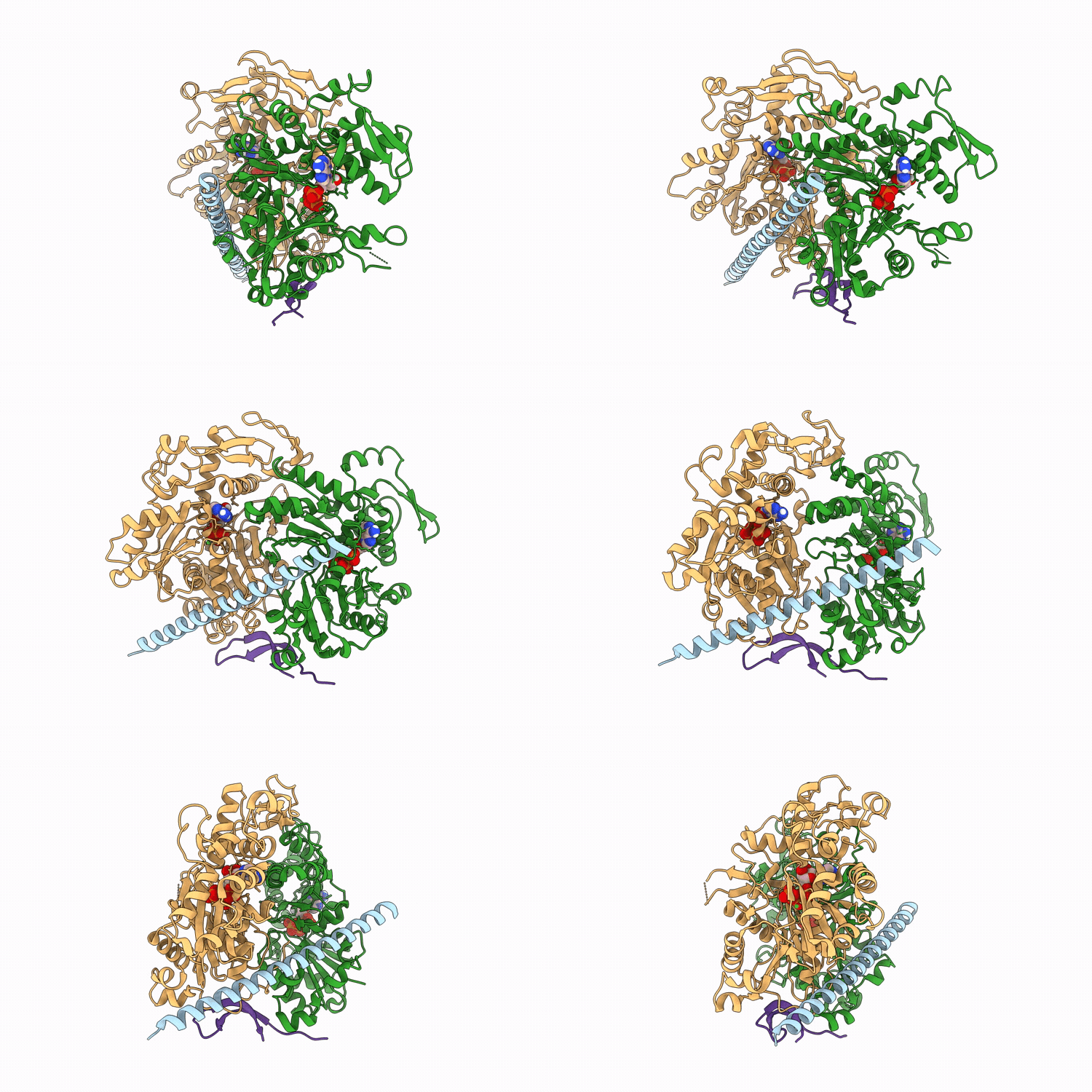
9UXB image
Deposition Date 2025-05-13
Release Date 2026-05-06
Last Version Date 2026-05-06
Entry Detail
PDB ID:
9UXB
Keywords:
Title:
The apo structure of BCL7B-containing ARP module of the human SWI/SNF complex
Biological Source:
Source Organism(s):
Homo sapiens (Taxon ID: 9606)
Expression System(s):
Method Details:
Experimental Method:
Resolution:
2.92 Å
Aggregation State:
PARTICLE
Reconstruction Method:
SINGLE PARTICLE
Macromolecular Entities
Structures with similar UniProt ID
Protein Blast
Polymer Type:polypeptide(L)
Molecule:Transcription activator BRG1
Gene (Uniprot):SMARCA4
Chain IDs:A
Chain Length:101
Number of Molecules:1
Biological Source:Homo sapiens
Structures with similar UniProt ID
Protein Blast
Polymer Type:polypeptide(L)
Molecule:Actin, cytoplasmic 1, N-termi
Gene (Uniprot):ACTB
Chain IDs:B
Chain Length:376
Number of Molecules:1
Biological Source:Homo sapiens
Structures with similar UniProt ID
Protein Blast
Polymer Type:polypeptide(L)
Molecule:Actin-like protein 6A
Gene (Uniprot):ACTL6A
Chain IDs:C
Chain Length:430
Number of Molecules:1
Biological Source:Homo sapiens
Structures with similar UniProt ID
Protein Blast
Polymer Type:polypeptide(L)
Molecule:B-cell CLL/lymphoma 7 protein
Chain IDs:D
Chain Length:203
Number of Molecules:1
Biological Source:Homo sapiens
Primary Citation
Structural basis for BCL7B-mediated ncBAF-nucleosome engagement.
Nucleic Acids Res. 54 ? ? (2026)
PMID: 41657245 DOI: 10.1093/nar/gkag092

Abstact

The mammalian SWI/SNF family of chromatin remodelers comprises BRG1/BRM-associated factor (cBAF), polybromo-associated BAF (PBAF), and non-canonical BAF (ncBAF) complexes, which slide and disassemble nucleosomes to regulate gene expression and chromatin structure dependent on ATP hydrolysis energy. While the chromatin engagement mechanisms of cBAF and PBAF have been structurally resolved, the molecular architecture governing ncBAF interaction with chromatin remains elusive. In this study, by integrating cryo-electron microscopy, biochemical assays, and cross-linking mass spectrometry, we resolved the conformational transition of ncBAF-nucleosome complexes from nucleotide-free to nucleotide-bound states. Our analyses establish BCL7 proteins as dynamic molecular tethers connecting the ARP module to the nucleosomal acidic patch and demonstrate that BCL7B promotes ncBAF-mediated nucleosome remodeling, with BRG1-catalyzed ATP hydrolysis triggering conformational changes that modulate BCL7-mediated histone association. Structurally and biochemically, we further demonstrate that beta-actin within the BCL7-containing ARP module retains ATP hydrolysis activity, rendering its exposed pointed end structurally compatible with incorporation into the barbed end of nuclear actin filaments, which provides a potential molecular basis for coordinating nuclear actin networks with chromatin remodeling. Collectively, our findings unravel a dynamic role of BCL7 in regulating ncBAF-mediated chromatin remodeling and establish a distinct chromatin engagement mode of ncBAF from that of cBAF/PBAF.

Legend

Protein

Chemical

Disease

Primary Citation of related structures
Feedback Form
Name
Email
Institute
Feedback