

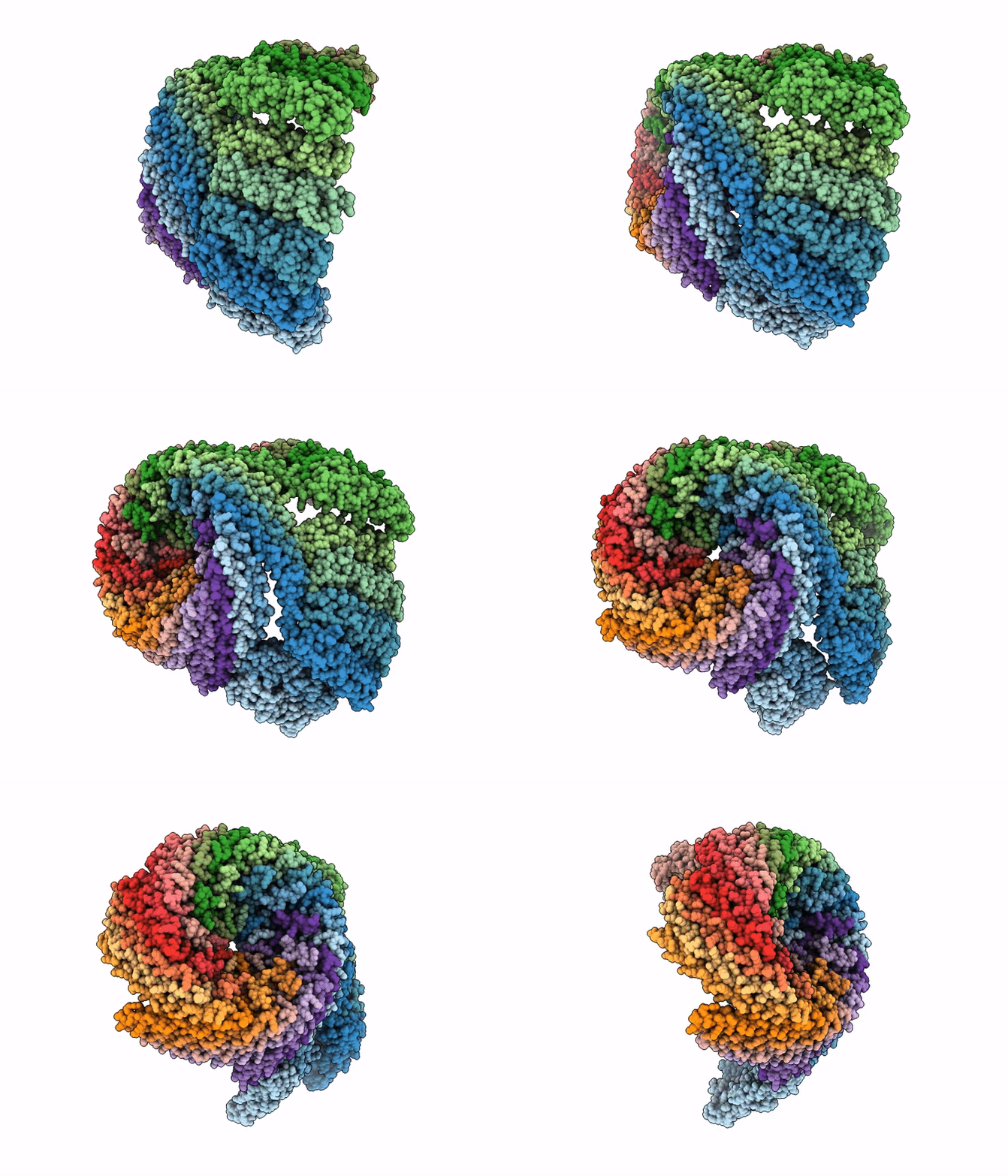
9UNL image
Deposition Date 2025-04-23
Release Date 2025-09-10
Last Version Date 2026-03-25
Entry Detail
PDB ID:
9UNL
Title:
Cryo-EM structure of the human prohibitin complex
Biological Source:
Source Organism(s):
Homo sapiens (Taxon ID: 9606)
Method Details:
Experimental Method:
Resolution:
2.80 Å
Aggregation State:
PARTICLE
Reconstruction Method:
SINGLE PARTICLE
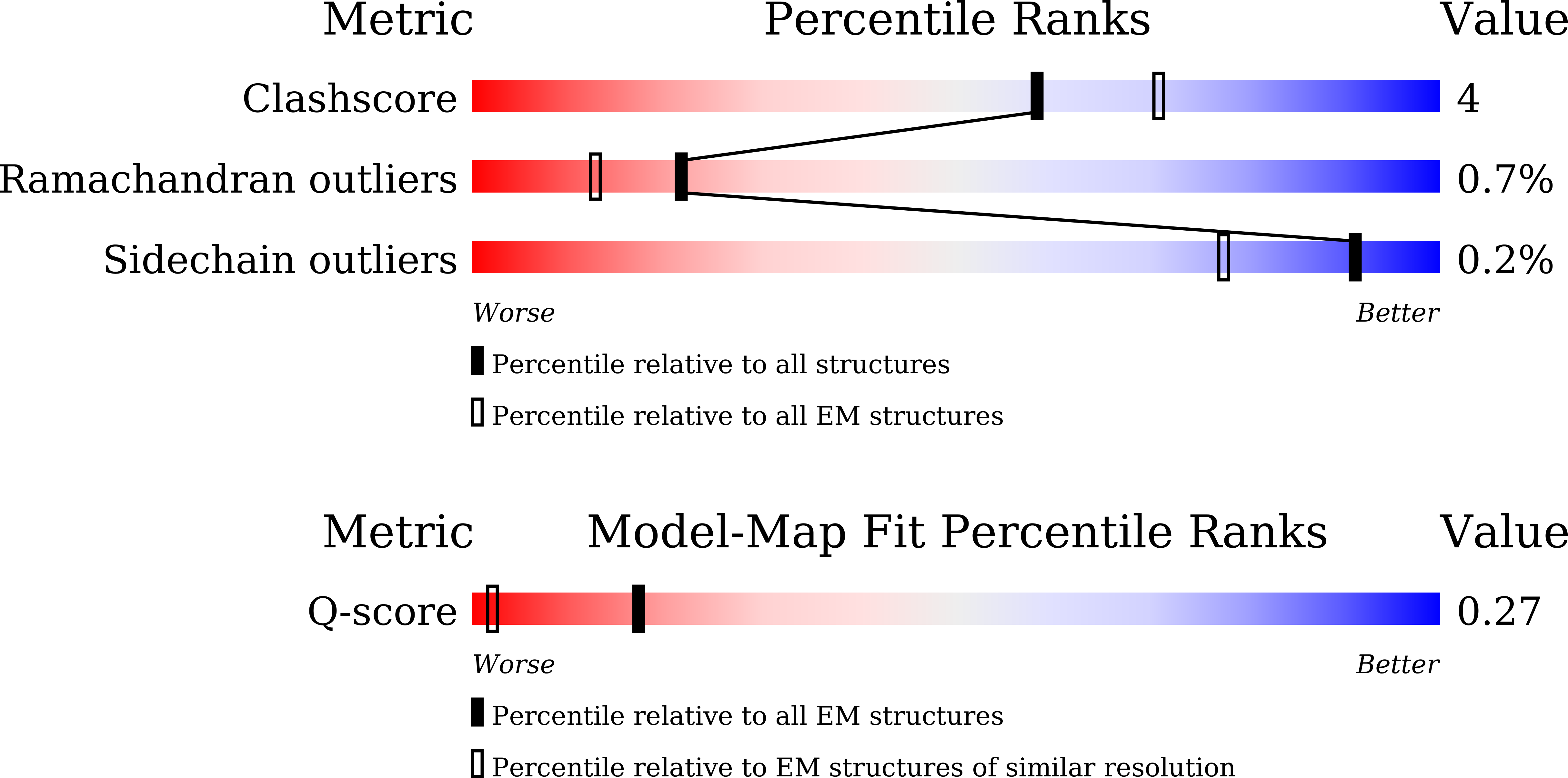
Macromolecular Entities
Structures with similar UniProt ID
Protein Blast
Polymer Type:polypeptide(L)
Molecule:Prohibitin 1
Gene (Uniprot):PHB1
Chain IDs:A (auth: E), B (auth: C), C (auth: A), D (auth: U), E (auth: S), F (auth: Q), G (auth: O), H (auth: M), I (auth: K), J (auth: I), K (auth: G)
Chain Length:296
Number of Molecules:11
Biological Source:Homo sapiens
Structures with similar UniProt ID
Protein Blast
Polymer Type:polypeptide(L)
Molecule:Prohibitin-2
Gene (Uniprot):PHB2
Chain IDs:L (auth: F), M (auth: D), N (auth: B), O (auth: V), P (auth: T), Q (auth: R), R (auth: P), S (auth: N), T (auth: L), U (auth: J), V (auth: H)
Chain Length:299
Number of Molecules:11
Biological Source:Homo sapiens
Ligand Molecules
Primary Citation
Cryo-EM structure of the prohibitin complex in open conformation.
Proc. Natl. Acad. Sci. U.S.A. 122 e2512430122 e2512430122 (2025)
PMID: 40966277 DOI: 10.1073/pnas.2512430122

Abstact

Prohibitin 1 (PHB1) and Prohibitin 2 (PHB2), two conserved prohibitin members, are primarily localized to the mitochondrial inner membrane (MIM) to form a nanoscale macromolecular prohibitin complex. This prohibitin complex can facilitate the spatial organization of proteins and lipids, thus maintaining cellular metabolism and homeostasis, but its architecture remains largely unknown. Here, we report the cryo-EM structure of a prohibitin complex at 2.8 A resolution, which contains 11 PHB1-PHB2 heterodimers. This complex displays a bell-like cage, consisting of a lid and a wall, which creates an intermembrane space-facing compartment for the MIM. The lid of the cage is stably assembled, and it is responsible for the prohibitin complex formation. In contrast, the wall of the cage is flexible and exhibits lateral openings, providing a channel for intramembrane exchange of proteins and lipids. These findings provide a structural basis for understanding the scaffold role of the prohibitin complex in organizing intramembrane proteins and lipids.

Legend

Protein

Chemical

Disease

Primary Citation of related structures
Feedback Form
Name
Email
Institute
Feedback