

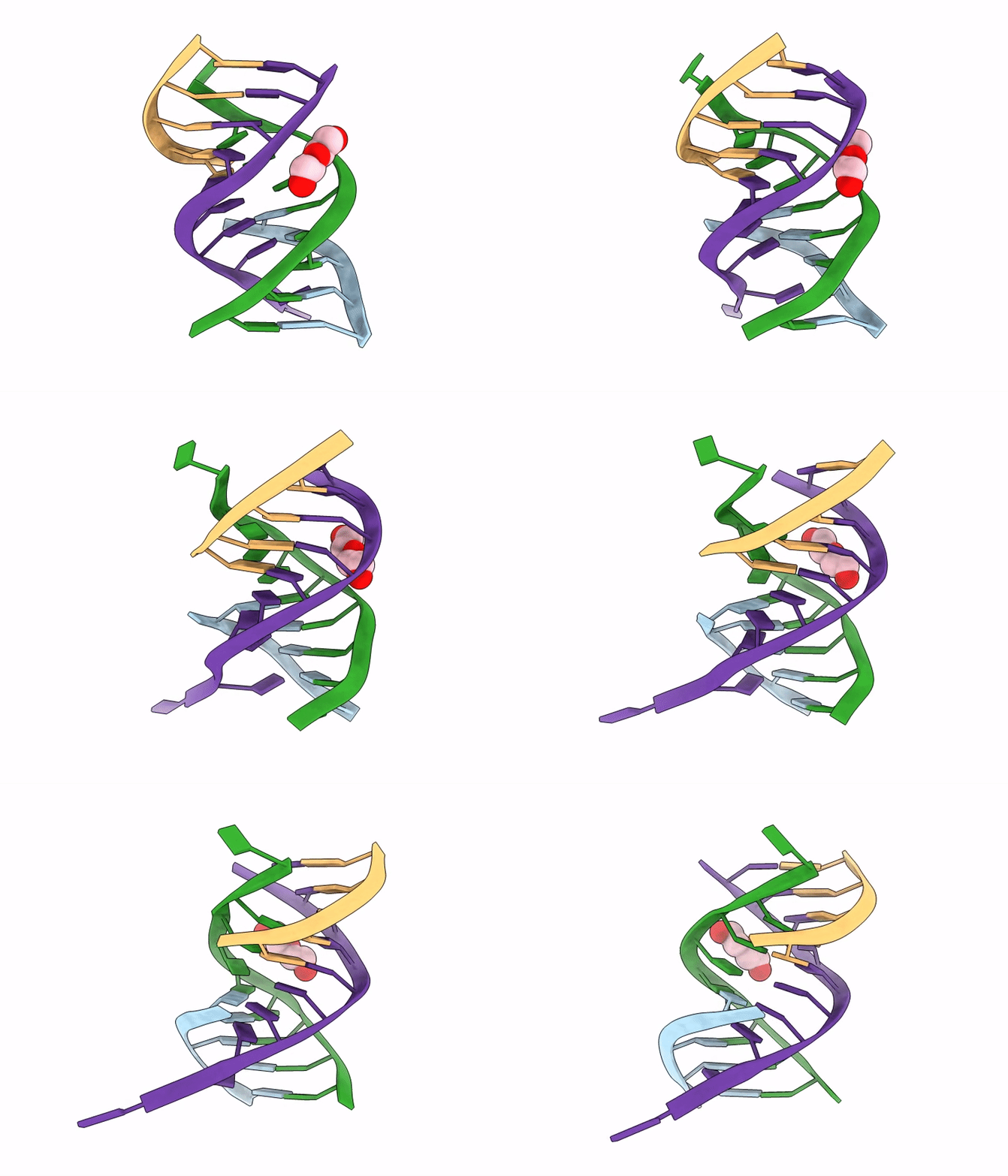
9TCA image
Deposition Date 2025-11-20
Release Date 2026-02-11
Last Version Date 2026-02-11
Entry Detail
PDB ID:
9TCA
Keywords:
Title:
Crystal Structure of a tRNA acceptor stem mimic at 1.94 A resolution
Biological Source:
Source Organism(s):
Method Details:
Experimental Method:
Resolution:
1.94 Å
R-Value Free:
0.27
R-Value Work:
0.24
Space Group:
P 21 21 21
Macromolecular Entities
Polymer Type:polyribonucleotide
Molecule:RNA (5'-R(P*AP*GP*CP*GP*A)-3'
Chain IDs:A, C
Chain Length:5
Number of Molecules:2
Biological Source:synthetic construct
Polymer Type:polyribonucleotide
Molecule:RNA (5'-R(*UP*CP*GP*CP*UP*UP*
Chain IDs:B, D
Chain Length:10
Number of Molecules:2
Biological Source:synthetic construct
Ligand Molecules
Primary Citation
Crystal structure of a tRNA acceptor-stem mimic at 1.94 angstrom resolution.
Acta Crystallogr. Sect. F Struct. Biol. Cryst. Commun. 82 57 65 (2026)
PMID: 41608807 DOI: 10.1107/S2053230X26000658

Abstact

Despite the theoretical advantages of phosphorus single-wavelength anomalous diffraction (P-SAD) for nucleic acid phasing, its application remains limited due to high atomic displacement parameters and an unfavourable ratio of unique reflections to anomalous scatterers. In this study, we report the crystal structure of an RNA complex composed of four strands, which was solved by experimental phasing after AlphaFold3 failed to produce reliable models. Bromine single-wavelength anomalous diffraction (Br-SAD) data were collected at 0.916 Å on beamline I04 at Diamond Light Source, while phosphorus anomalous data were obtained at 3.024 Å on beamline I23. The structure was successfully phased using bromine anomalous scattering, and phosphorus anomalous peaks corroborated the backbone positions and validated the model. Attempts to phase the structure directly from phosphorus data failed, consistent with theoretical predictions that successful SAD phasing requires a significantly higher reflection-to-scatterer ratio. The final models reveal an RNA complex stabilized by Watson-Crick and Hoogsteen base pairing, forming a pseudo-helical complex instead of the anticipated hairpin stem-loop, likely reflecting crystallization artefacts. This work demonstrates the complementary use of bromine and phosphorus anomalous signals in RNA crystallography.

Legend

Protein

Chemical

Disease

Primary Citation of related structures
Feedback Form
Name
Email
Institute
Feedback