

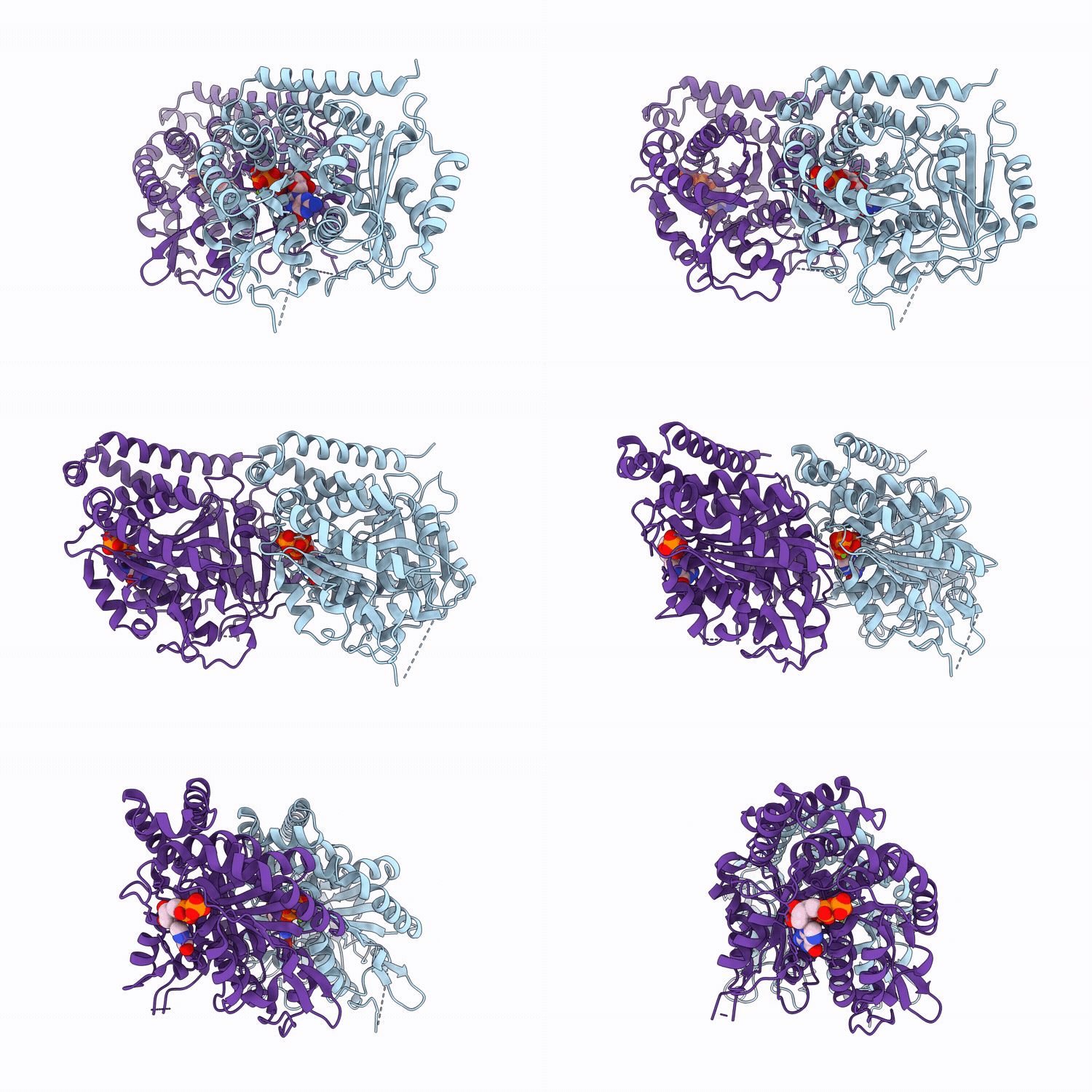
9T1D image
Deposition Date 2025-10-21
Release Date 2026-05-06
Last Version Date 2026-05-06
Entry Detail
PDB ID:
9T1D
Title:
Cryo-EM reconstruction of undecorated GDP microtubule
Biological Source:
Source Organism(s):
Sus scrofa (Taxon ID: 9823)
Method Details:
Experimental Method:
Resolution:
2.90 Å
Aggregation State:
FILAMENT
Reconstruction Method:
SINGLE PARTICLE

Macromolecular Entities
Structures with similar UniProt ID
Protein Blast
Polymer Type:polypeptide(L)
Molecule:Detyrosinated tubulin alpha-1
Gene (Uniprot):TUBA1A
Chain IDs:A
Chain Length:439
Number of Molecules:1
Biological Source:Sus scrofa
Structures with similar UniProt ID
Protein Blast
Polymer Type:polypeptide(L)
Molecule:Tubulin beta chain
Chain IDs:B
Chain Length:429
Number of Molecules:1
Biological Source:Sus scrofa
Primary Citation
A cryo-EM processing pipeline for microtubules using CryoSPARC.
Acta Crystallogr D Struct Biol ? ? ? (2026)
PMID: 42044018 DOI: 10.1107/S2059798326003062

Abstact

Microtubules are cytoskeletal filaments that are typically characterized by a discontinuous helical lattice of alpha/beta-tubulin heterodimers. Microtubules can also adopt variable lattice architectures both in vitro and in cellular contexts. Pseudo-helical averaging processing strategies have been developed to generate cryo-EM reconstructions of microtubules with and without decorating protein-binding partners, but these pipelines can be difficult to implement for the average user, especially for undecorated filaments. Here, we describe MiCSPARC, a cryo-EM processing pipeline developed around CryoSPARC [Punjani et al. (2017), Nat. Methods, 14, 290-296], which leverages automated particle picking and fast 3D refinement times in CryoSPARC to determine the structures of both decorated and undecorated microtubules. We generate reconstructions of undecorated GDP microtubules, as well as kinesin-1 motor domain-decorated GMPCPP filaments, at resolutions of up to 2.8 A, demonstrating the robustness of the pipeline. Based on its convenient implementation and its ability to routinely generate high-resolution, seam-corrected microtubule reconstructions, MiCSPARC should provide a valuable tool for understanding microtubule dynamics, microtubule-associated proteins and microtubule-targeting agents.

Legend

Protein

Chemical

Disease

Primary Citation of related structures
Feedback Form
Name
Email
Institute
Feedback