

9RST image
Deposition Date 2025-07-01
Release Date 2026-05-06
Last Version Date 2026-05-06
Entry Detail
PDB ID:
9RST
Title:
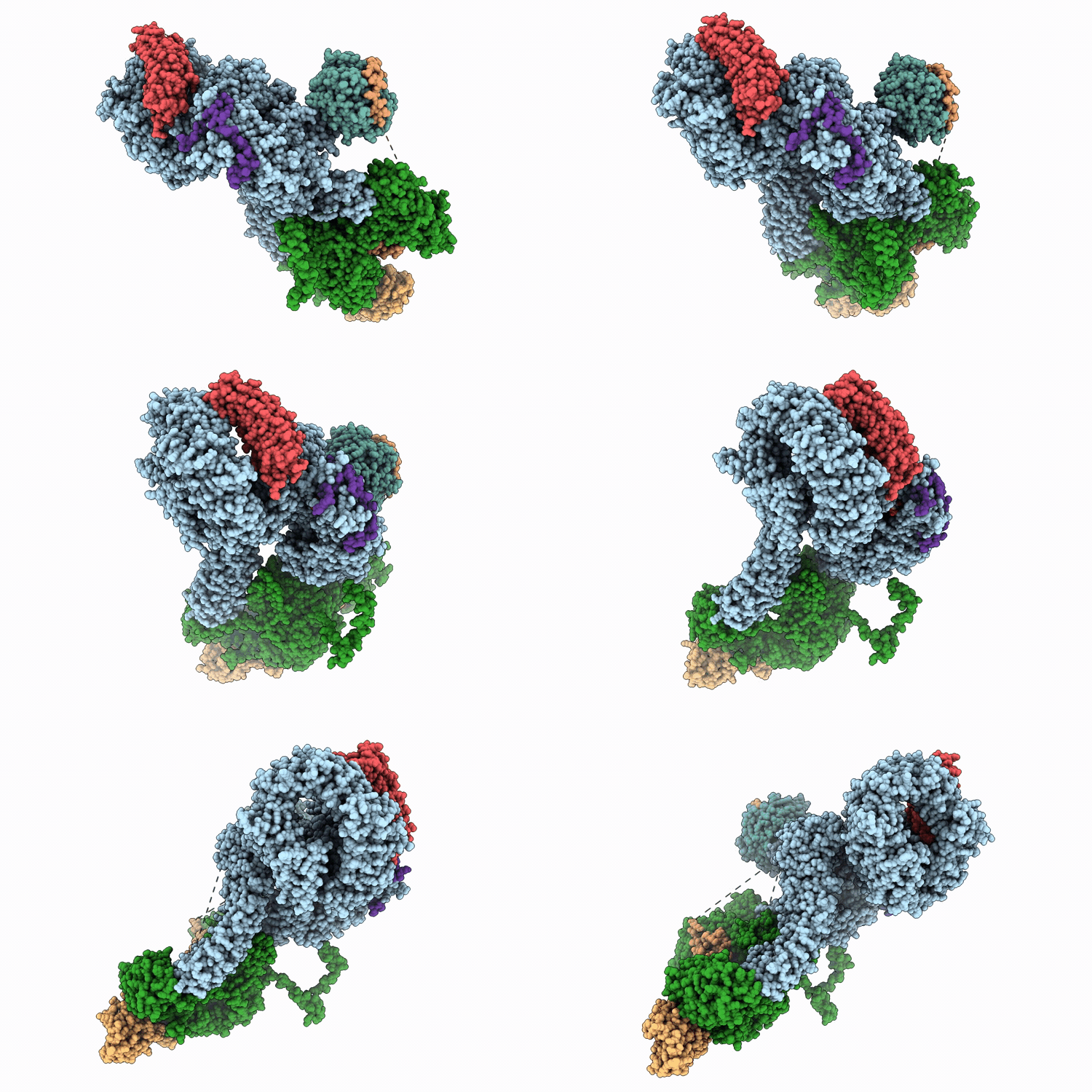
Cryo-EM structure of the Target of Rapamycin Complex 2 (TORC2) in autoinhibted conformation (monomer)
Biological Source:
Source Organism(s):
Method Details:
Experimental Method:
Resolution:
2.93 Å
Aggregation State:
PARTICLE
Reconstruction Method:
SINGLE PARTICLE
Macromolecular Entities
Structures with similar UniProt ID
Protein Blast
Polymer Type:polypeptide(L)
Molecule:Serine/threonine-protein kina
Gene (Uniprot):TOR2
Chain IDs:A
Chain Length:2474
Number of Molecules:1
Biological Source:Saccharomyces cerevisiae
Structures with similar UniProt ID
Protein Blast
Polymer Type:polypeptide(L)
Molecule:Target of rapamycin complex s
Gene (Uniprot):LST8
Chain IDs:B
Chain Length:303
Number of Molecules:1
Biological Source:Saccharomyces cerevisiae
Structures with similar UniProt ID
Protein Blast
Polymer Type:polypeptide(L)
Molecule:Target of rapamycin complex 2
Chain IDs:C, G (auth: H)
Chain Length:1430
Number of Molecules:2
Biological Source:Saccharomyces cerevisiae
Structures with similar UniProt ID
Protein Blast
Polymer Type:polypeptide(L)
Molecule:Target of rapamycin complex 2
Gene (Uniprot):AVO2
Chain IDs:D
Chain Length:426
Number of Molecules:1
Biological Source:Saccharomyces cerevisiae
Structures with similar UniProt ID
Protein Blast
Polymer Type:polypeptide(L)
Molecule:Target of rapamycin complex 2
Chain IDs:E
Chain Length:543
Number of Molecules:1
Biological Source:Saccharomyces cerevisiae
Structures with similar UniProt ID
Protein Blast
Polymer Type:polypeptide(L)
Molecule:Target of rapamycin complex 2
Gene (Uniprot):AVO1
Chain IDs:F (auth: G)
Chain Length:1176
Number of Molecules:1
Biological Source:Saccharomyces cerevisiae
Ligand Molecules
Primary Citation
Structural basis for TORC2 activation.
Mol.Cell 86 1560 1573.e5 (2026)
PMID: 41997113 DOI: 10.1016/j.molcel.2026.03.022

Abstact

The target of rapamycin complex 2 (TORC2) is a central node in signaling feedback loops, serving to maintain the biophysical homeostasis of the plasma membrane (PM). How TORC2 is regulated by mechanical perturbation of the PM is not well understood. To address this, we determined the cryo-electron microscopy structure of endogenous yeast TORC2 at up to 2.2 A resolution. Our model refines the position and interactions of TORC2-specific subunits, providing a structural basis for the differential assembly of Tor2 into TORC2. Furthermore, we observe the insertion of the pleckstrin-homology domain of the Avo1 subunit into the Tor2 active site, providing a regulatory mechanism mediated by phosphoinositides. Structure-guided functional experiments reveal a potential TORC2 membrane-binding surface and a positively charged pocket in the Avo3 subunit that is necessary for TORC2 activation. Collectively, our data suggest that signaling phosphoinositides activate TORC2 by membrane-induced structural rearrangements via the concerted action of conserved regulatory subunits.

Legend

Protein

Chemical

Disease

Primary Citation of related structures
Feedback Form
Name
Email
Institute
Feedback