

9QXL image
Deposition Date 2025-04-15
Release Date 2026-01-14
Last Version Date 2026-02-18
Entry Detail
PDB ID:
9QXL
Title:
The structure of ADGRL4 in the active-state
Biological Source:
Source Organism(s):
Homo sapiens (Taxon ID: 9606)
Expression System(s):
Method Details:
Experimental Method:
Resolution:
3.14 Å
Aggregation State:
PARTICLE
Reconstruction Method:
SINGLE PARTICLE
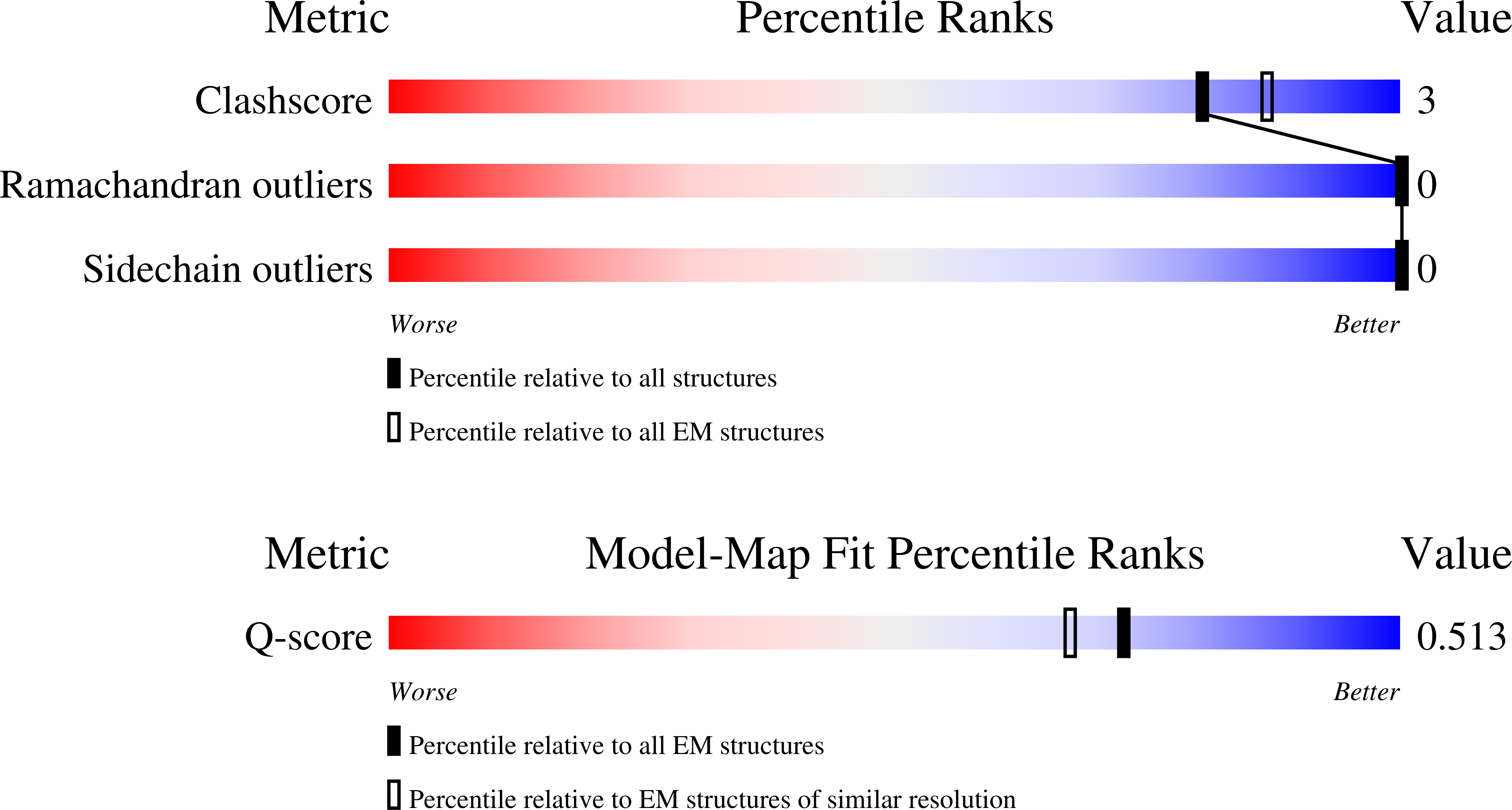
Macromolecular Entities
Protein Blast
Polymer Type:polypeptide(L)
Molecule:Green fluorescent protein,Adh
Gene (Uniprot):GFP, ADGRL4
Chain IDs:A
Chain Length:628
Number of Molecules:1
Biological Source:Homo sapiens
Protein Blast
Polymer Type:polypeptide(L)
Molecule:GNAS complex locus,Guanine nu
Gene (Uniprot):GNAS, GNAS
Chain IDs:B
Chain Length:268
Number of Molecules:1
Biological Source:Homo sapiens
Structures with similar UniProt ID
Protein Blast
Polymer Type:polypeptide(L)
Molecule:Guanine nucleotide-binding pr
Gene (Uniprot):GNB1
Chain IDs:C
Chain Length:348
Number of Molecules:1
Biological Source:Homo sapiens
Structures with similar UniProt ID
Protein Blast
Polymer Type:polypeptide(L)
Molecule:Guanine nucleotide-binding pr
Gene (Uniprot):GNG2
Chain IDs:D (auth: E)
Chain Length:71
Number of Molecules:1
Biological Source:Homo sapiens
Ligand Molecules
Primary Citation
Structure of the G q -coupled adhesion receptor ADGRL4.
Nat Commun 17 907 907 (2025)
PMID: 41469374 DOI: 10.1038/s41467-025-67629-0

Abstact

Adhesion G protein-coupled receptors (aGPCRs) are a 32-member family of Class B GPCRs that have diverse cellular roles including mechanosensation, cell-fate determination, neurodevelopment, immune function and tumour biology. ADGRL4 is upregulated in the tumour microenvironment and is implicated in tumour pathogenesis across a broad range of malignancies. Inhibiting ADGRL4 is a potential therapeutic treatment for currently intractable cancers such as glioblastoma. Previous work suggested that ADGRL4 does not signal through G protein coupled pathways. However, using a sensitive bioluminescent assay, we demonstrate here that ADGRL4 couples weakly to the heterotrimeric G protein Gq, whilst there is no robust coupling to other G proteins (Gs, G12, Go) or β-arrestin 1 or 2. We determine the cryo-EM structure of ADGRL4 coupled to a heterotrimeric Gq complex to a resolution of 3.1 Å. The overall fold of ADGRL4 is similar to that of other aGPCRs, but the coupling to Gq is distinct with fewer interactions between the receptor and G protein. The structure is consistent with ADGRL4 being activated by its tethered agonist and represents an important step towards the development of potential inhibitors for the treatment of multiple tumour types.

Legend

Protein

Chemical

Disease

Primary Citation of related structures
Feedback Form
Name
Email
Institute
Feedback