

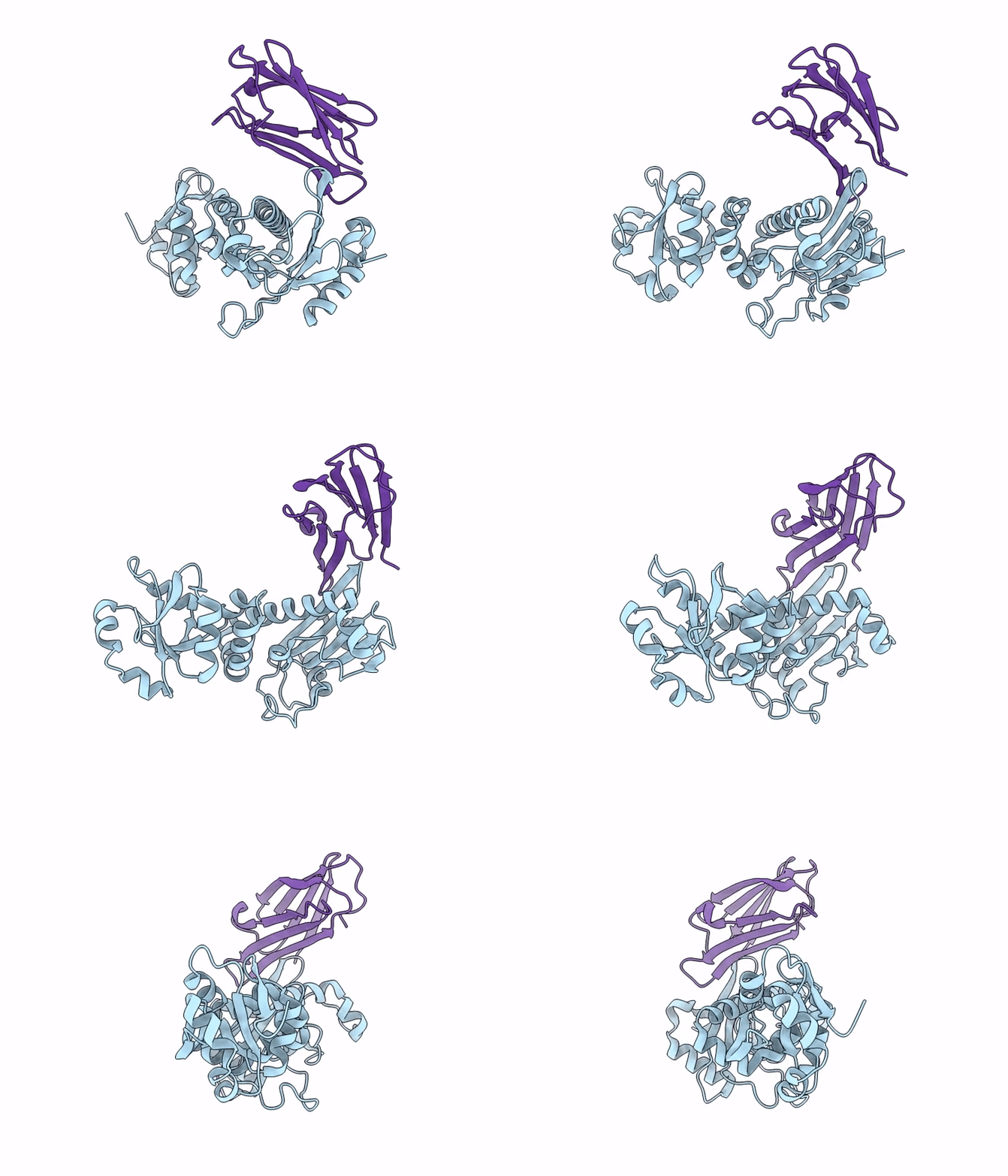
9Q8O image
Deposition Date 2025-02-25
Release Date 2026-01-21
Last Version Date 2026-01-21
Entry Detail
PDB ID:
9Q8O
Keywords:
Title:
Crystal structure of Hsp82-MD in complex with the CS domain of Sgt1
Biological Source:
Source Organism(s):
Expression System(s):
Method Details:
Experimental Method:
Resolution:
2.10 Å
R-Value Free:
0.24
R-Value Work:
0.19
Space Group:
I 2 2 2
Macromolecular Entities
Structures with similar UniProt ID
Protein Blast
Polymer Type:polypeptide(L)
Molecule:ATP-dependent molecular chape
Gene (Uniprot):HSP82
Chain IDs:A
Chain Length:257
Number of Molecules:1
Biological Source:Saccharomyces cerevisiae
Structures with similar UniProt ID
Protein Blast
Polymer Type:polypeptide(L)
Molecule:Protein SGT1
Gene (Uniprot):SGT1
Chain IDs:B
Chain Length:94
Number of Molecules:1
Biological Source:Saccharomyces cerevisiae
Primary Citation
The essential co-chaperone Sgt1 regulates client dwell time in the Hsp90 chaperone cycle.
Mol. Cell 86 166 179.e6 (2026)
PMID: 41435837 DOI: 10.1016/j.molcel.2025.12.002

Abstact

The Hsp90 molecular chaperone system is regulated by numerous co-chaperones that modulate its function. In Saccharomyces cerevisiae, most of these cofactors can be deleted without affecting viability. Of the three essential ones, only the function of Sgt1 has remained enigmatic. Our in vivo and in vitro experiments define key structural elements and determine the essential function of Sgt1 in the chaperoning of client proteins. We demonstrate that yeast Sgt1 adopts a unique binding mode, engaging primarily with the middle domain of Hsp90. Through simultaneous interaction with both Hsp90 and client proteins, Sgt1 enhances client maturation efficiency. Specifically, Sgt1 stabilizes Hsp90-client complexes and prevents their dissociation by the co-chaperone Aha1. Our findings reveal a previously unrecognized layer of Hsp90 regulation, highlighting Sgt1 as a critical modulator of chaperone cycle progression.

Legend

Protein

Chemical

Disease

Primary Citation of related structures
Feedback Form
Name
Email
Institute
Feedback