

9PRC image
Deposition Date 2025-07-23
Release Date 2026-01-28
Last Version Date 2026-04-01
Entry Detail
PDB ID:
9PRC
Keywords:
Title:
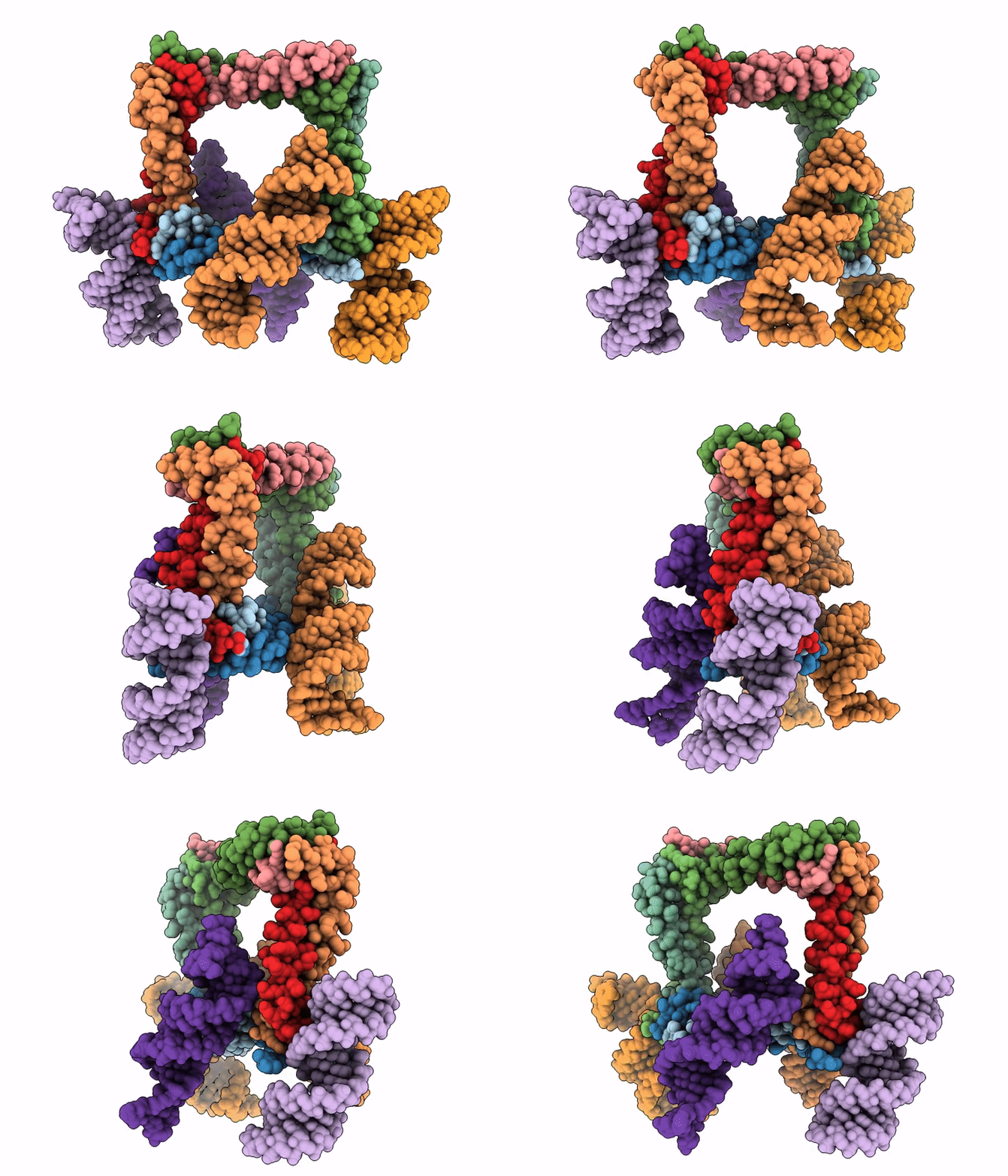
HDAg complex with 86-pRNA, Body1
Biological Source:
Source Organism(s):
Expression System(s):
Method Details:
Experimental Method:
Resolution:
3.50 Å
Aggregation State:
PARTICLE
Reconstruction Method:
SINGLE PARTICLE
Macromolecular Entities
Structures with similar UniProt ID
Protein Blast
Polymer Type:polypeptide(L)
Molecule:Small delta antigen
Chain IDs:A, B, C, D, E, F, G, H
Chain Length:194
Number of Molecules:8
Biological Source:Hepatitis delta virus
Polymer Type:polyribonucleotide
Molecule:Palindromic RNA
Chain IDs:I (auth: J), J (auth: K), K (auth: M), L (auth: P)
Chain Length:55
Number of Molecules:4
Biological Source:synthetic construct
Ligand Molecules
Primary Citation
Structural characterization of the HDV virion and its ribonucleoprotein.
Proc. Natl. Acad. Sci. U.S.A. 123 e2519809123 e2519809123 (2026)
PMID: 41564123 DOI: 10.1073/pnas.2519809123

Abstact

Hepatitis D virus (HDV) is a small RNA satellite virus of hepatitis B virus (HBV) which encodes a single protein, HDV delta antigen (HDAg), that is required for replication. Viral replication occurs independently from HBV and relies primarily on host RNA polymerase(s). Bulevirtide, a viral entry inhibitor, is the only approved treatment for chronic HDV but has a low cure rate as a monotherapy, and most patients rebound following cessation of therapy. It is likely that an inhibitor targeting HDV replication is necessary to achieve HDV cure, but the paucity of HDV-derived elements and limited understanding of HDV replication presents a significant therapeutic challenge. Understanding the precise mechanism of interactions between HDAg and viral RNA, and how it is packaged within the virion can inspire structure-guided drug design targeting replication. Using cryoelectron tomography and single particle cryoelectron microscopy, we present reconstructions of the virion and viral RNPs. We observed multiple binding configurations in vitro that suggest a propensity to arrange four RNA segments around repeating units of HDAg in a ladder-like formation. The oligomerization domains of a homo-octameric HDAg complex are directly involved in RNA binding by utilizing the vertices and sides of its square-shaped architecture to bind RNA in a sequence-promiscuous fashion. Structure-function analysis reveals that these RNA contact sites are important for viral replication and their disruption may be a potential avenue for next-generation antivirals to treat HDV.

Legend

Protein

Chemical

Disease

Primary Citation of related structures
Feedback Form
Name
Email
Institute
Feedback