

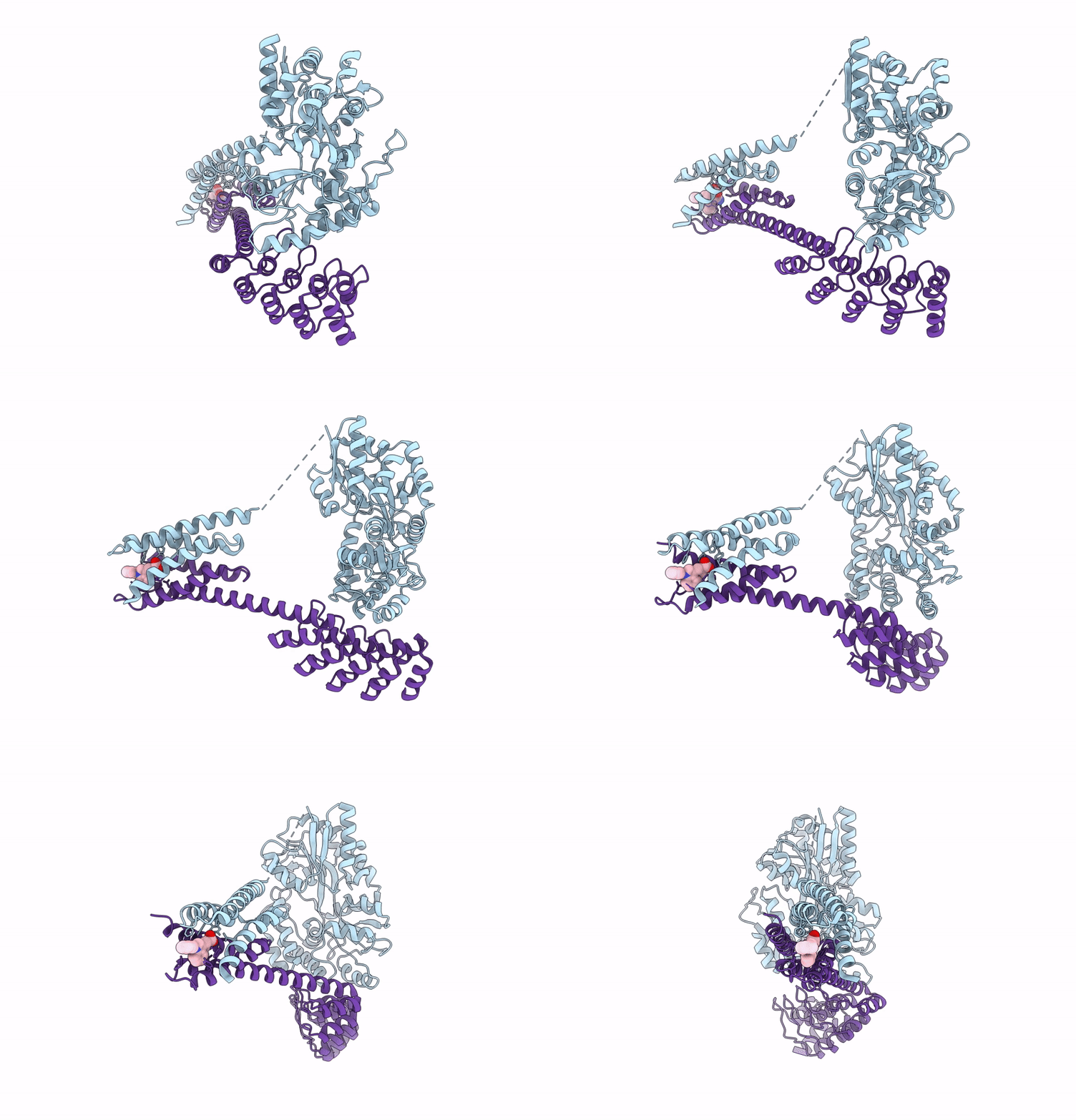
9O9S image
Deposition Date 2025-04-18
Release Date 2025-07-30
Last Version Date 2026-02-11
Entry Detail
PDB ID:
9O9S
Title:
Structure of human MPC matrix-open
Biological Source:
Source Organism(s):
Expression System(s):
Method Details:
Experimental Method:
Resolution:
3.57 Å
Aggregation State:
PARTICLE
Reconstruction Method:
SINGLE PARTICLE
Macromolecular Entities
Protein Blast
Polymer Type:polypeptide(L)
Molecule:Mitochondrial pyruvate carrie
Gene (Uniprot):malE, MPC1
Chain IDs:A
Chain Length:487
Number of Molecules:1
Biological Source:Homo sapiens, Escherichia coli K-12
Structures with similar UniProt ID
Protein Blast
Polymer Type:polypeptide(L)
Molecule:Mitochondrial pyruvate carrie
Gene (Uniprot):MPC2
Chain IDs:B
Chain Length:281
Number of Molecules:1
Biological Source:Homo sapiens
Ligand Molecules
Primary Citation
Structure of human mitochondrial pyruvate carrier MPC1 and MPC2 complex.
Nat Commun 16 6700 6700 (2025)
PMID: 40691140 DOI: 10.1038/s41467-025-61939-z

Abstact

The Mitochondrial Pyruvate Carrier (MPC) bridges cytosolic and mitochondrial metabolism by transporting pyruvate into mitochondria for ATP production and biosynthesis of various essential molecules. MPC functions as a heterodimer composed of MPC1 and MPC2 in most mammalian cells. Here, we present the cryogenic electron microscopy (cryo-EM) structures of the human MPC1-2 complex in the mitochondrial intermembrane space (IMS)-open state and the inhibitor-bound in the mitochondrial matrix-open state. Structural analysis shows that the transport channel of MPC is formed by the interaction of transmembrane helix (TM) 1 and TM2 of MPC1 with TM2 and TM1 of MPC2, respectively. UK5099, a potent MPC inhibitor, shares the same binding site with pyruvate at the matrix side of the transport channel, stabilizing MPC in its matrix-open conformation. Notably, a functional W82F mutation in MPC2 leads to the complex in an IMS-open conformation. Structural comparisons across different conformations, combined with yeast rescue assays, reveal the mechanisms of substrate binding and asymmetric conformational changes in MPC during pyruvate transport across the inner mitochondrial membrane (IMM) as well as the inhibitory mechanisms of MPC inhibitors.

Legend

Protein

Chemical

Disease

Primary Citation of related structures
Feedback Form
Name
Email
Institute
Feedback