

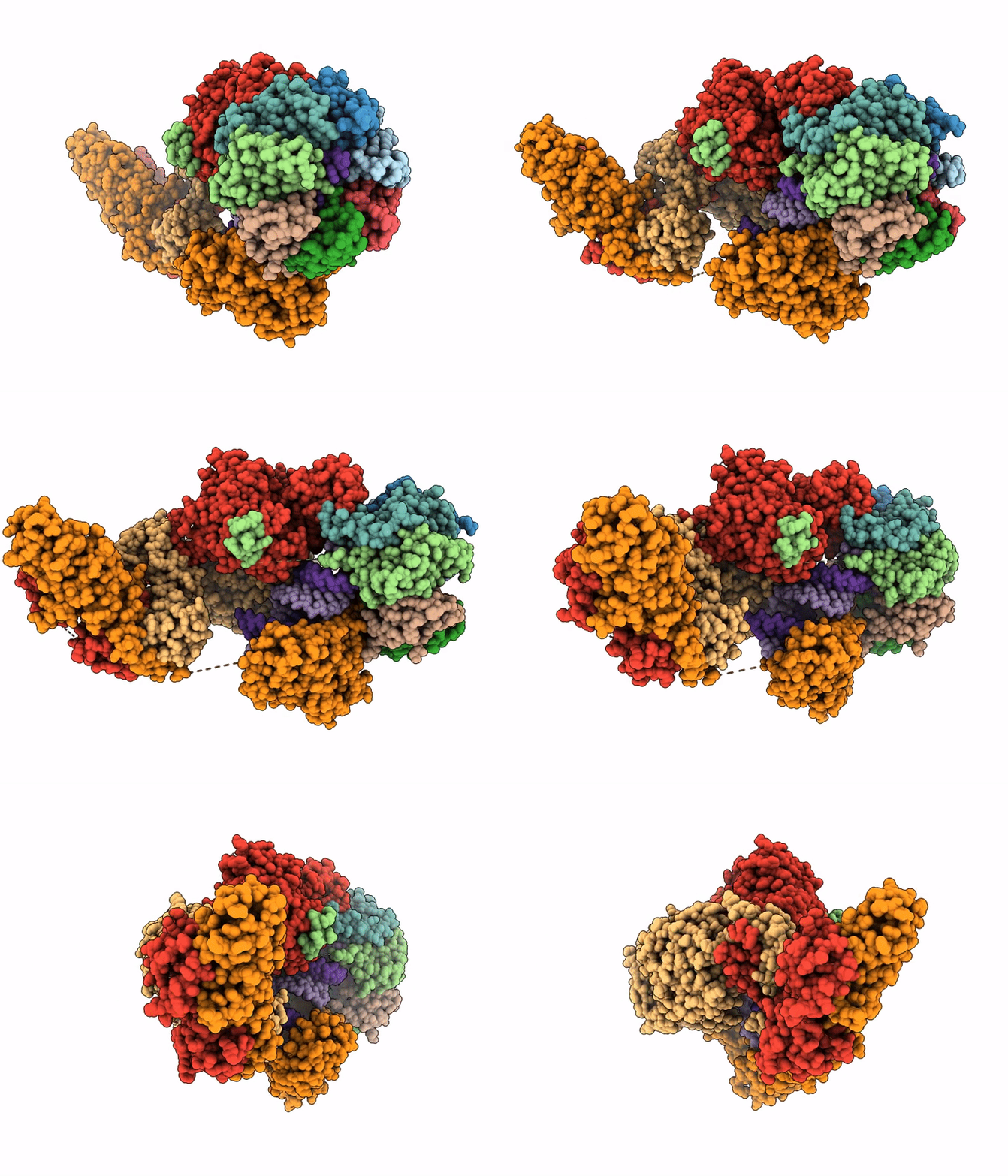
9NH6 image
Deposition Date 2025-02-24
Release Date 2026-01-21
Last Version Date 2026-01-21
Entry Detail
PDB ID:
9NH6
Title:
CRYO-EM STRUCTURE OF HUMAN U7 SNRNP WITH METHYLATED noncleavable H2A* SUBSTRATE PRE-MRNA (COMPOSITE MAP)
Biological Source:
Source Organism(s):
Homo sapiens (Taxon ID: 9606)
Trichoplusia ni (Taxon ID: 7111)
Method Details:
Experimental Method:
Resolution:
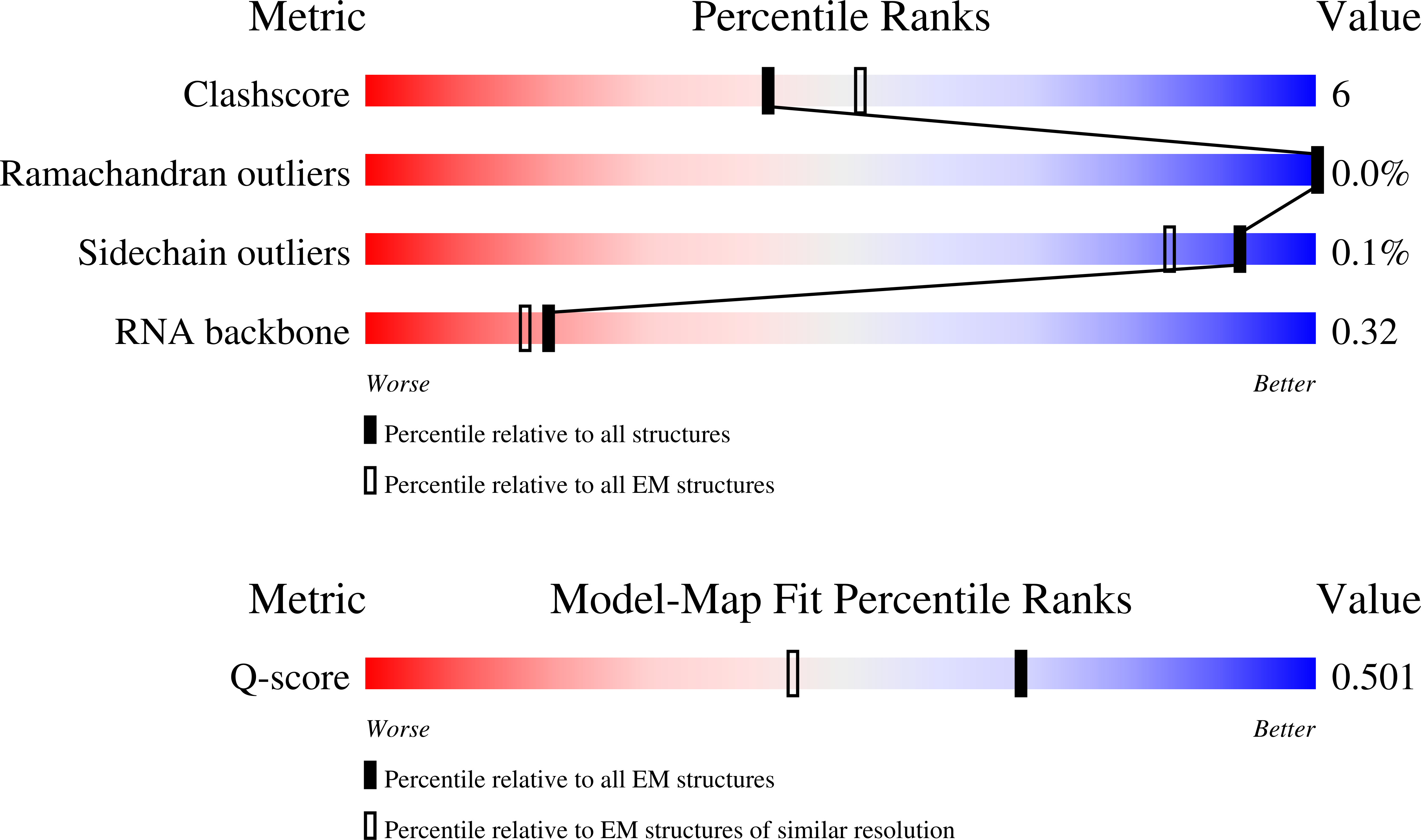
2.82 Å
Aggregation State:
PARTICLE
Reconstruction Method:
SINGLE PARTICLE
Macromolecular Entities
Structures with similar UniProt ID
Protein Blast
Polymer Type:polypeptide(L)
Molecule:Small nuclear ribonucleoprote
Gene (Uniprot):SNRPD3
Chain IDs:A
Chain Length:146
Number of Molecules:1
Biological Source:Homo sapiens
Structures with similar UniProt ID
Protein Blast
Polymer Type:polypeptide(L)
Molecule:Small nuclear ribonucleoprote
Gene (Uniprot):SNRPB
Chain IDs:B
Chain Length:95
Number of Molecules:1
Biological Source:Homo sapiens
Structures with similar UniProt ID
Protein Blast
Polymer Type:polypeptide(L)
Molecule:U7 snRNA-associated Sm-like p
Gene (Uniprot):LSM10
Chain IDs:F (auth: C)
Chain Length:123
Number of Molecules:1
Biological Source:Homo sapiens
Structures with similar UniProt ID
Protein Blast
Polymer Type:polypeptide(L)
Molecule:U7 snRNA-associated Sm-like p
Gene (Uniprot):LSM11
Chain IDs:G (auth: D)
Chain Length:371
Number of Molecules:1
Biological Source:Homo sapiens
Structures with similar UniProt ID
Protein Blast
Polymer Type:polypeptide(L)
Molecule:Small nuclear ribonucleoprote
Gene (Uniprot):SNRPE
Chain IDs:D (auth: E)
Chain Length:92
Number of Molecules:1
Biological Source:Homo sapiens
Structures with similar UniProt ID
Protein Blast
Polymer Type:polypeptide(L)
Molecule:Small nuclear ribonucleoprote
Gene (Uniprot):SNRPF
Chain IDs:C (auth: F)
Chain Length:86
Number of Molecules:1
Biological Source:Homo sapiens
Structures with similar UniProt ID
Protein Blast
Polymer Type:polypeptide(L)
Molecule:Small nuclear ribonucleoprote
Gene (Uniprot):SNRPG
Chain IDs:E (auth: G)
Chain Length:84
Number of Molecules:1
Biological Source:Homo sapiens
Structures with similar UniProt ID
Protein Blast
Polymer Type:polypeptide(L)
Molecule:Cleavage and polyadenylation
Gene (Uniprot):CPSF3
Chain IDs:H
Chain Length:684
Number of Molecules:1
Biological Source:Homo sapiens
Structures with similar UniProt ID
Protein Blast
Polymer Type:polypeptide(L)
Molecule:Cleavage and polyadenylation
Gene (Uniprot):CPSF2
Chain IDs:I
Chain Length:782
Number of Molecules:1
Biological Source:Homo sapiens
Structures with similar UniProt ID
Protein Blast
Polymer Type:polypeptide(L)
Molecule:Symplekin
Gene (Uniprot):SYMPK
Chain IDs:J
Chain Length:1072
Number of Molecules:1
Biological Source:Homo sapiens
Polymer Type:polypeptide(L)
Molecule:Cleavage stimulation factor s
Chain IDs:K
Chain Length:8
Number of Molecules:1
Biological Source:Trichoplusia ni
Polymer Type:polyribonucleotide
Molecule:Methylated H2A* pre-mRNA
Chain IDs:M (auth: Y)
Chain Length:56
Number of Molecules:1
Biological Source:Homo sapiens
Polymer Type:polyribonucleotide
Molecule:U7 snRNA
Chain IDs:L (auth: Z)
Chain Length:64
Number of Molecules:1
Biological Source:Homo sapiens
Ligand Molecules
Primary Citation
An N-terminal helix of Lsm11 stabilizes CPSF73 in U7 snRNP for histone pre-mRNA 3'-end processing.
Nucleic Acids Res. 54 ? ? (2026)
PMID: 41495886 DOI: 10.1093/nar/gkaf1442

Abstact

The U7 snRNP (small nuclear ribonucleoprotein) is responsible for the 3'-end processing of replication-dependent histone messenger RNA precursors (pre-mRNAs). A helix in the Lsm11 N-terminal extension contacts the metallo-β-lactamase domain of the U7 snRNP endonuclease CPSF73. We mutated or deleted this helix and found that the mutant machineries had substantially reduced cleavage activity toward the pre-mRNA. Our cryo-electron microscopy (cryo-EM) studies indicated that the helix was important for helping to hold CPSF73 in its correct position for the cleavage reaction. We also reconstituted a wild-type U7 snRNP in complex with a methylated, noncleavable pre-mRNA. We observed that CPSF73 could achieve an open conformation independent of RNA binding to its active site. Finally, we found that a previously uninterpreted EM density for a small helix at the CPSF73-CPSF100 interface belonged to the C-terminal end of CstF77, copurified from insect cells and highly conserved among CstF77 homologs. This CstF77 binding site had a small effect on the cleavage activity of U7 snRNP. Overall, our studies have revealed the importance of the conserved helix in the Lsm11 N-terminal extension for U7 snRNP, provided structural evidence that CPSF73 can achieve an open, active conformation without RNA binding in its active site, and identified a previously unknown binding site for CstF77 in CPSF100.

Legend

Protein

Chemical

Disease

Primary Citation of related structures
Feedback Form
Name
Email
Institute
Feedback