

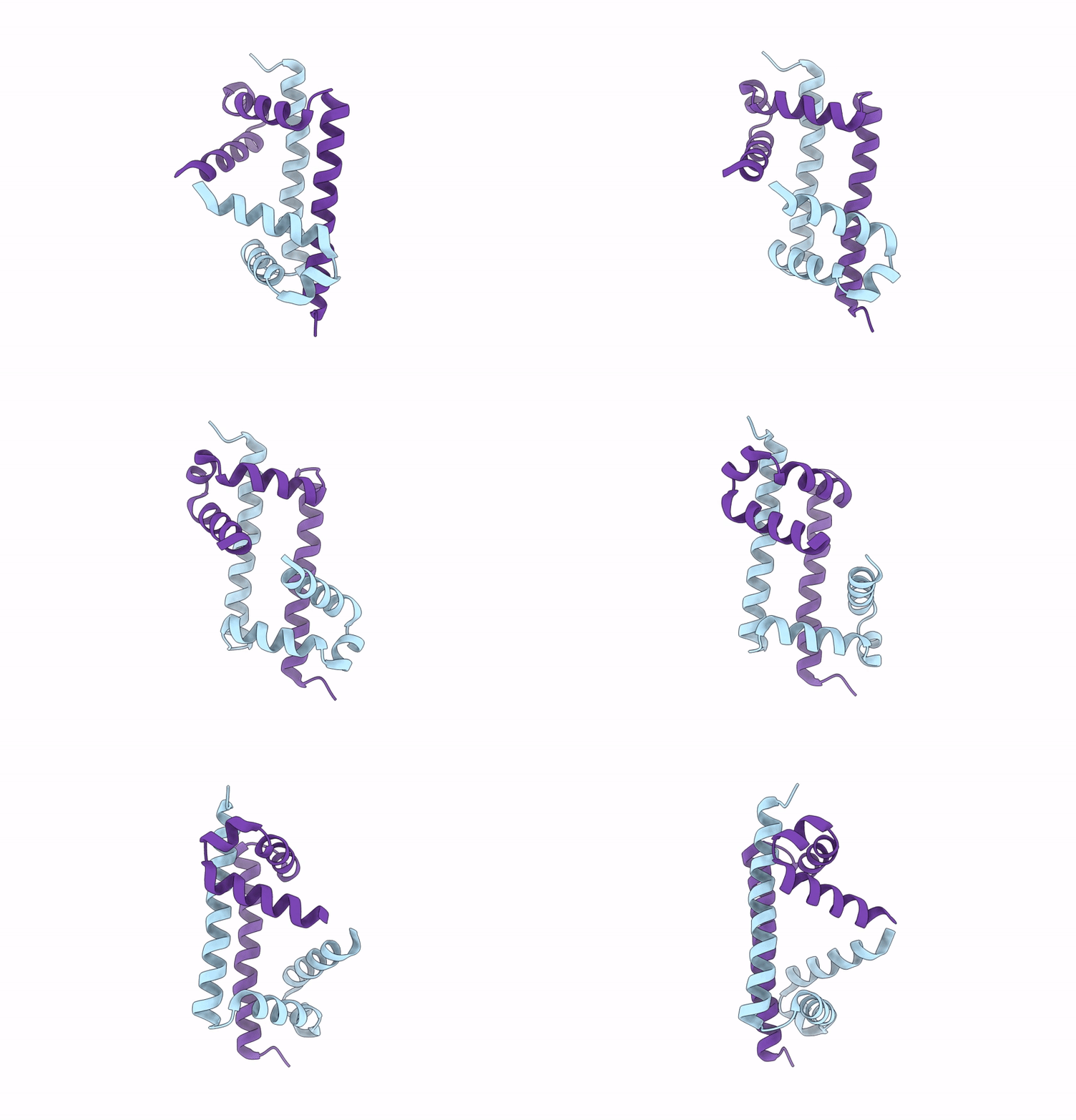
9N2G image
Deposition Date 2025-01-28
Release Date 2025-10-22
Last Version Date 2026-05-06
Entry Detail
PDB ID:
9N2G
Title:
Structure of apo Mtb NapA(16-90)
Biological Source:
Source Organism(s):
Expression System(s):
Method Details:
Experimental Method:
Resolution:
2.39 Å
R-Value Free:
0.24
R-Value Work:
0.22
R-Value Observed:
0.22
Space Group:
I 1 2 1

Macromolecular Entities
Protein Blast
Polymer Type:polypeptide(L)
Molecule:Fis family transcriptional re
Gene (Uniprot):A4S10_00456, DKC2_0461, DSJ38_01090, ERS007657_03567, ERS007679_01808, ERS007681_02029, ERS007688_00846, ERS007741_01318, ERS027646_00220, ERS027659_01205, ERS027661_02888, ERS094118_00516, J8J21_05935
Chain IDs:A (auth: U), B (auth: A)
Chain Length:78
Number of Molecules:2
Biological Source:Mycobacterium tuberculosis
Primary Citation
Structural Studies on the M. tuberculosis Nucleoid-associated-Protein, NapA, Indicates DNA Bridging Mechanism.
J.Mol.Biol. 437 169486 169486 (2025)
PMID: 41106805 DOI: 10.1016/j.jmb.2025.169486

Abstact

Nucleoid-associated proteins (NAPs) play central roles in bacterial chromosome organization and DNA processes. Interestingly, Mycobacterium tuberculosis (Mtb) lacks most common NAPs and only recently have NAPs been uncovered in this bacterium. One such protein, NapA, was revealed to be an essential Mtb NAP that can bridge DNA. NapA shows no sequence homology to any protein and hence its DNA-binding functions remain unclear. Here we describe structures of apo NapA and a DNA-bound complex of NapA. The NapA structures reveal a dimeric fold for the protein, which is supported by mass photometry analyses, with each subunit comprised of an extended alpha1 helix and C-terminal three-helix module. The alpha1 helices combine to form a helical-bundle dimer scaffold that forms dimer-of-dimers at elevated protein concentrations. Each NapA dimer projects two DNA interacting elements, that bind and link between DNA sites. Combined these studies provide mechanistic insight into the DNA binding and bridging capabilities of a unique NAP that appears broadly conserved among most Actinobacteria.

Legend

Protein

Chemical

Disease

Primary Citation of related structures
Feedback Form
Name
Email
Institute
Feedback