

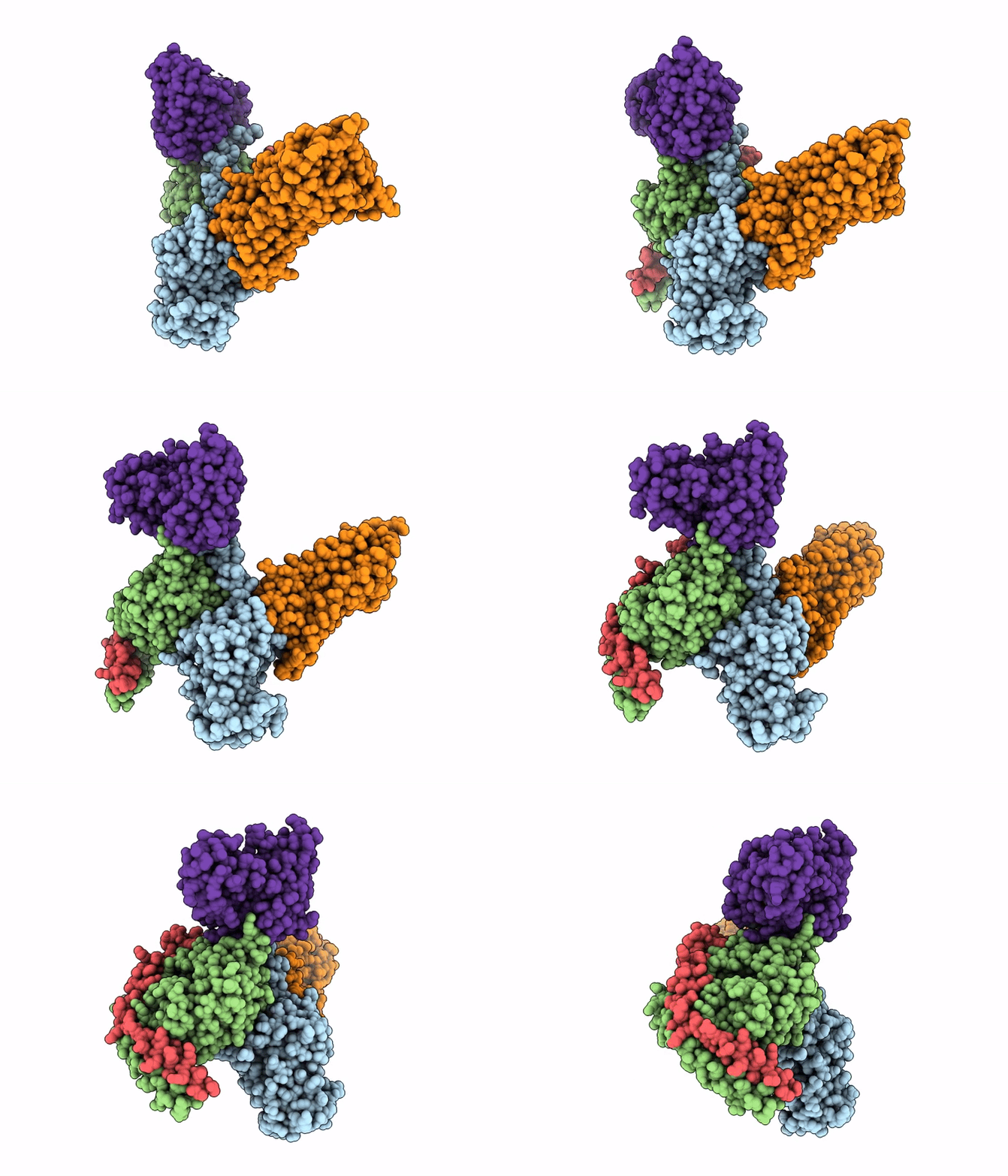
9LE0 image
Deposition Date 2025-01-06
Release Date 2026-01-28
Last Version Date 2026-03-25
Entry Detail
PDB ID:
9LE0
Title:
Consensus olfactory receptor bmOR6A2 in complex with mini-Golf trimeric protein
Biological Source:
Source Organism(s):
Expression System(s):
Method Details:
Experimental Method:
Resolution:
2.54 Å
Aggregation State:
PARTICLE
Reconstruction Method:
SINGLE PARTICLE

Macromolecular Entities
Structures with similar UniProt ID
Protein Blast
Polymer Type:polypeptide(L)
Molecule:Guanine nucleotide-binding pr
Gene (Uniprot):GNAL
Chain IDs:A
Chain Length:246
Number of Molecules:1
Biological Source:Homo sapiens
Structures with similar UniProt ID
Protein Blast
Polymer Type:polypeptide(L)
Molecule:Guanine nucleotide-binding pr
Gene (Uniprot):GNB1
Chain IDs:B
Chain Length:339
Number of Molecules:1
Biological Source:Homo sapiens
Structures with similar UniProt ID
Protein Blast
Polymer Type:polypeptide(L)
Molecule:Guanine nucleotide-binding pr
Gene (Uniprot):GNG2
Chain IDs:C
Chain Length:71
Number of Molecules:1
Biological Source:Homo sapiens
Polymer Type:polypeptide(L)
Molecule:bmOR6A2
Chain IDs:E (auth: R)
Chain Length:312
Number of Molecules:1
Biological Source:synthetic construct
Polymer Type:polypeptide(L)
Molecule:scFv16
Chain IDs:D (auth: S)
Chain Length:259
Number of Molecules:1
Biological Source:Mus musculoides
Ligand Molecules
Primary Citation
Structural decoding of reversible covalent linkage of odorants in human olfactory receptor OR6A2.
Cell 189 1451 ? (2026)
PMID: 41570822 DOI: 10.1016/j.cell.2025.12.017

Abstact

Olfactory receptors (ORs) are a diverse superfamily of G protein-coupled receptors responsible for odor detection that are also implicated in non-olfactory physiological functions. OR6A2, a class II OR, selectively senses medium-chain aldehydes and belongs to a cluster of ORs genetically associated with the "soapy" perception of cilantro. It also modulates macrophage-mediated inflammatory responses. Structural studies of ORs have long been challenging. Using a back-mutation strategy, we engineered a functional OR6A2 variant (bmOR6A2) from a consensus OR6 (consOR6). Structures of bmOR6A2 in complex with aldehydes reveal a novel ligand-recognition mechanism involving a reversible Schiff base linkage with residue K4.60, validated by mass spectrometry. By integrating structures of consOR6, molecular dynamics simulations, and functional assays, we identified a conserved D45.51Y6.55Y7.41 triad critical for activation in class II ORs. These findings establish a practical strategy for decoding odorant recognition, offering new insights into olfaction signaling and applications in fragrance and therapeutic development.

Legend

Protein

Chemical

Disease

Primary Citation of related structures
Feedback Form
Name
Email
Institute
Feedback