

9K1S image
Deposition Date 2024-10-16
Release Date 2026-02-18
Last Version Date 2026-02-25
Entry Detail
PDB ID:
9K1S
Keywords:
Title:
Crystal structure of human granzyme A in complex with GSDMB-C domain
Biological Source:
Source Organism(s):
Homo sapiens (Taxon ID: 9606)
Method Details:
Experimental Method:
Resolution:
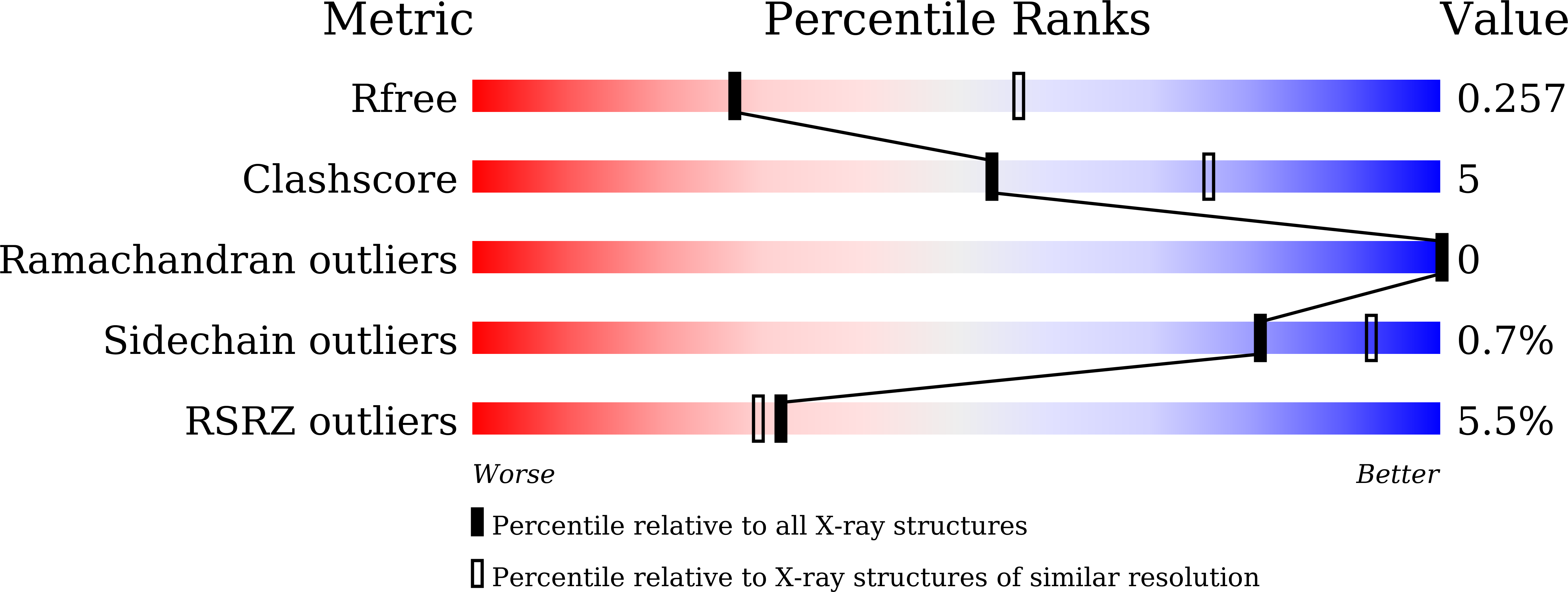
2.69 Å
R-Value Free:
0.25
R-Value Work:
0.23
R-Value Observed:
0.23
Space Group:
P 21 21 21
Macromolecular Entities
Structures with similar UniProt ID
Protein Blast
Polymer Type:polypeptide(L)
Molecule:Granzyme A
Gene (Uniprot):GZMA
Chain IDs:A, B
Chain Length:242
Number of Molecules:2
Biological Source:Homo sapiens
Structures with similar UniProt ID
Protein Blast
Polymer Type:polypeptide(L)
Molecule:Isoform 4 of Gasdermin-B
Gene (Uniprot):GSDMB
Chain IDs:C, D
Chain Length:176
Number of Molecules:2
Biological Source:Homo sapiens
Ligand Molecules
Primary Citation
Exosite-mediated targeting of GSDMB by dimeric granzyme A in lymphocyte pyroptotic killing.
Immunity 59 257 ? (2026)
PMID: 41592574 DOI: 10.1016/j.immuni.2025.12.009

Abstact

In cellular immunity, cytotoxic lymphocytes employ granzyme A (GZMA) to cleave and activate the pore-forming protein gasdermin B (GSDMB) for the pyroptotic killing of target cells. How GZMA recognizes and cleaves GSDMB is unknown. Here, we show that human GZMA targets GSDMB via specific, high-affinity binding to its autoinhibitory GSDMB-C domain. This binding requires the dimerization of GZMA, a unique property among human granzymes. A crystal structure of the GZMA-GSDMB-C complex shows a 2:2 stoichiometry, featuring an exosite at each of the two symmetric dimer interfaces in GZMA. The exosite engages a two-loop-organized site in the GSDMB-C domain, rendering a functional cleavage at Lys244 in GSDMB. Mouse GZMA (mGZMA) adopts a similar dimer structure, but its exosite is less efficient in engaging GSDMB. Mutation of the exosite enabled mGZMA to efficiently cleave and activate GSDMB. Our study reveals a substrate-targeting mechanism used by lymphocyte-derived granzymes to kill target cells.

Legend

Protein

Chemical

Disease

Primary Citation of related structures
Feedback Form
Name
Email
Institute
Feedback